
Spain: Naval Contractor Claims €1,350 for 12-Hour Days
A forum user reports earning €1,350 monthly for 12-hour shifts at a Spanish naval subcontractor, sparking debate on labor exploitation.
English · Original discussion in Spanish · Published
Working 12 Hours for €1,350: The Math Doesn't Add Up
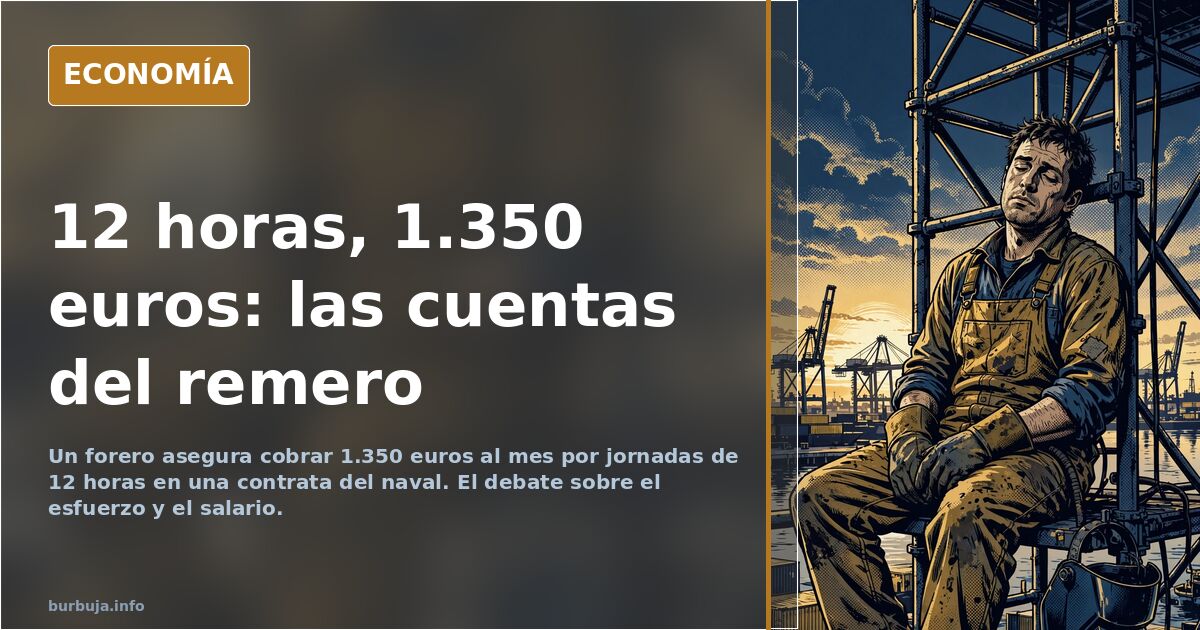
Work dignifies, build Spain, keep going champion. The narrative of effort has its liturgy and trinc, celebrated with special devotion every Sunday night. But when the numbers are put to paper, the sermon cracks. A participant claiming to have worked for a naval sector contractor stated in writing: €1,350 per month for twelve-hour days, rising to €1,600 or €1,700 if Saturdays are included, before tax authorities deduct income tax (IRPF). According to this testimony, the rest of the staff does not stay for overtime for that reason.
The conversation begins with a provocation: those earning €3,000 net per month are no better than those earning €1,000 or €2,000; they just have more pretensions. This thesis rests on an uncomfortable idea: work will set you free, repeated with sarcasm, serves as an excuse for a wage scale that does not compensate for wear and tear. And in some sectors, the wear is literal.
What You Actually Earn in a Naval Subcontract
The most detailed testimony in the debate describes conditions absent from collective agreement statistics. Work in tanks spray-painting, with gases forcing workers to run because they burned; two work suits, one for painting and another clean to avoid catching a cold when descending from the block; sleeping on concrete with plastic over it during night shifts. Two deaths from falls in the same company, according to the account, and a chilling detail: the worker who fell into the dock was fitted with a harness after death, on the ground, so his widow could claim insurance.
Accumulated savings over years under this regime amounted to €15,000, intended for an apartment down payment and a boat. Comparison with the permanent staff of the main company is another axis of discontent: permanent employees earn more, do not work extra hours, and accumulate bonuses for everything, according to the same source. The gap between contractors and permanent staff reproduces, on a shipyard scale, the fracture pointed out in the initial message among salaried workers.
Fatigue as a Method of Discipline
The thread opens on Sunday night, when the perspective of the week weighs heavier. The majority response is not indignation: it is dark humor and resignation. Someone jokes about returning after sick leave and finding it very hard. Another describes the ritual of boiling milk coffee in a glass cup and greasy churros at the industrial estate cafeteria as the only reward for waking up early. A third fantasizes about the boss paying with a monthly grocery basket.
Some take epicness to the extreme, comparing themselves to pikemen and arquebusiers of a Spanish tercios, holding firm on foot. Irony works as a valve but also as diagnosis: another week in the matrix, giving your life for a bowl of rice, said the initial message. The most repeated answer does not deny the diagnosis, it just adds mockery.
The Gap Between Those Earning €1,000 and Those Earning €3,000
The sharpest point of the debate is not extreme precariousness, but the salaried middle class that believes itself safe. Recent graduates entering the market, wearing suits and office vocabulary, squeezed for years by low pay in exchange for a free coffee machine, appear as the most deceived link. The rower earning €3,000 who thinks himself superior to the one earning €1,000 receives the label pathetic in the initial message, and the comparison is never refuted with data.
Reflection extends to other sectors. One participant recounts visiting two cattle farms, one with 1,000 heads, where the family wakes up at four in the morning and works from sunrise to sunset, and teenage children want nothing to do with the business. They make money, but the lingering question is whether it is worth it. Implicit conclusion: slavery can be profitable and still remain slavery.
What Happens When You Stop Rowing
The other half of the debate is occupied by those who no longer work or do so when they feel like it. One participant claims to live on the Minimum Vital Income (IMV), working undeclared when he feels like it, and having lost track of what day of the week it is. His argument: whoever is capable of dropping the oars is not illiterate, but wise. Responses from others oscillate between envy and mockery, with recurring accusations that those boasting about not working just want someone to ask how they did it.
There are also those who argue that the welfare state, IMV, and pensions have their days numbered, and that the system will derive towards a model where everyone holds their own candle. It is a prediction without date or data, but connects with general malaise: the social pact that sustained effort as a path to upward mobility is perceived as broken. Whoever rides the wave will live well, says this analysis; whoever gets stuck will end up in a tent.
Waking Up Early as a Competition of Virtue
The thread has its own satirical genre: the worker who arrives an hour early, sweeps the warehouse, and unloads trucks before nine to impress the boss. One participant stages this in detail, including anger because the guard takes too long to open at five in the morning. Mockery points to a labor culture where display of sacrifice replaces salary as a measure of value.
The question someone launches —what advice is there other than arriving two hours early, unloading trucks, and manning up— sums up fatigue. The advice received is the usual one: show willingness. And willingness, deep down, is the only thing this segment of the labor market seems willing to pay for.
With these differentials, reasonable conclusion would be that naval contractors and industrial estates would stop filling vacancies. That does not happen. Most likely, and also most uncomfortable, prediction is that next Sunday night there will again be someone writing the same thing, someone reading it, and someone waking up just as early.
Work dignifies, build Spain, keep going champion. The narrative of effort has its liturgy and trinc, celebrated with special devotion every Sunday night. But when the numbers are put to paper, the sermon cracks. A participant claiming to have worked for a naval sector contractor stated in writing: €1,350 per month for twelve-hour days, rising to €1,600 or €1,700 if Saturdays are included, before tax authorities deduct income tax (IRPF). According to this testimony, the rest of the staff does not stay for overtime for that reason.
The conversation begins with a provocation: those earning €3,000 net per month are no better than those earning €1,000 or €2,000; they just have more pretensions. This thesis rests on an uncomfortable idea: work will set you free, repeated with sarcasm, serves as an excuse for a wage scale that does not compensate for wear and tear. And in some sectors, the wear is literal.
What You Actually Earn in a Naval Subcontract
The most detailed testimony in the debate describes conditions absent from collective agreement statistics. Work in tanks spray-painting, with gases forcing workers to run because they burned; two work suits, one for painting and another clean to avoid catching a cold when descending from the block; sleeping on concrete with plastic over it during night shifts. Two deaths from falls in the same company, according to the account, and a chilling detail: the worker who fell into the dock was fitted with a harness after death, on the ground, so his widow could claim insurance.
Accumulated savings over years under this regime amounted to €15,000, intended for an apartment down payment and a boat. Comparison with the permanent staff of the main company is another axis of discontent: permanent employees earn more, do not work extra hours, and accumulate bonuses for everything, according to the same source. The gap between contractors and permanent staff reproduces, on a shipyard scale, the fracture pointed out in the initial message among salaried workers.
Fatigue as a Method of Discipline
The thread opens on Sunday night, when the perspective of the week weighs heavier. The majority response is not indignation: it is dark humor and resignation. Someone jokes about returning after sick leave and finding it very hard. Another describes the ritual of boiling milk coffee in a glass cup and greasy churros at the industrial estate cafeteria as the only reward for waking up early. A third fantasizes about the boss paying with a monthly grocery basket.
Some take epicness to the extreme, comparing themselves to pikemen and arquebusiers of a Spanish tercios, holding firm on foot. Irony works as a valve but also as diagnosis: another week in the matrix, giving your life for a bowl of rice, said the initial message. The most repeated answer does not deny the diagnosis, it just adds mockery.
The Gap Between Those Earning €1,000 and Those Earning €3,000
The sharpest point of the debate is not extreme precariousness, but the salaried middle class that believes itself safe. Recent graduates entering the market, wearing suits and office vocabulary, squeezed for years by low pay in exchange for a free coffee machine, appear as the most deceived link. The rower earning €3,000 who thinks himself superior to the one earning €1,000 receives the label pathetic in the initial message, and the comparison is never refuted with data.
Reflection extends to other sectors. One participant recounts visiting two cattle farms, one with 1,000 heads, where the family wakes up at four in the morning and works from sunrise to sunset, and teenage children want nothing to do with the business. They make money, but the lingering question is whether it is worth it. Implicit conclusion: slavery can be profitable and still remain slavery.
What Happens When You Stop Rowing
The other half of the debate is occupied by those who no longer work or do so when they feel like it. One participant claims to live on the Minimum Vital Income (IMV), working undeclared when he feels like it, and having lost track of what day of the week it is. His argument: whoever is capable of dropping the oars is not illiterate, but wise. Responses from others oscillate between envy and mockery, with recurring accusations that those boasting about not working just want someone to ask how they did it.
There are also those who argue that the welfare state, IMV, and pensions have their days numbered, and that the system will derive towards a model where everyone holds their own candle. It is a prediction without date or data, but connects with general malaise: the social pact that sustained effort as a path to upward mobility is perceived as broken. Whoever rides the wave will live well, says this analysis; whoever gets stuck will end up in a tent.
Waking Up Early as a Competition of Virtue
The thread has its own satirical genre: the worker who arrives an hour early, sweeps the warehouse, and unloads trucks before nine to impress the boss. One participant stages this in detail, including anger because the guard takes too long to open at five in the morning. Mockery points to a labor culture where display of sacrifice replaces salary as a measure of value.
The question someone launches —what advice is there other than arriving two hours early, unloading trucks, and manning up— sums up fatigue. The advice received is the usual one: show willingness. And willingness, deep down, is the only thing this segment of the labor market seems willing to pay for.
With these differentials, reasonable conclusion would be that naval contractors and industrial estates would stop filling vacancies. That does not happen. Most likely, and also most uncomfortable, prediction is that next Sunday night there will again be someone writing the same thing, someone reading it, and someone waking up just as early.
Also available in: Deutsch
Summary of a discussion on Burbuja.info - Foro de economía, actualidad y política., translated from Spanish and reviewed before publication. Read the full discussion (167 replies).
More summaries
-
Spain's IMV rises 6.9% to €1,462 monthly
The 6.9% increase sets the Ingreso Mínimo Vital (IMV) at €604 for a single adult and up to €1,462.62 for large single-parent families.
-
Spain's IMV recipient works only if she can bring her son
Karina, a single mother in Vigo receiving Spain's Minimum Vital Income (IMV), cleans houses conditionally and saves for her son's birthday, reigniting debate on welfare compatibility.
-
Ignacio Lázaro: 'Maricarmen paid €154 rent while we paid €750'
Ignacio Lázaro, grandson of the original owner, reveals the other side of the Maricarmen case: 'We subsidized her for years and now, with our taxes.'
-
Madrid Metro: False Bomb Alert at Moncloa Station
A false bomb alert caused chaos and evacuation at Madrid's Moncloa station on the 11-M anniversary.
-
Podemos exits Spanish government: seats, pay and amnesty law
Podemos' exit from the coalition leaves five seats, questions over severance pay and the amnesty law status.
-
Young Men: Precarity vs. Masculinity Debate
Discussion shifts from lost masculinity to housing, precarious jobs, and lack of prospects for young people.