
Madrid Metro: False Bomb Alert at Moncloa Station
A false bomb alert caused chaos and evacuation at Madrid's Moncloa station on the 11-M anniversary.
English · Original discussion in Spanish · Published
False Explosion Alarm: The Chaos at Moncloa Metro and Its Aftermath
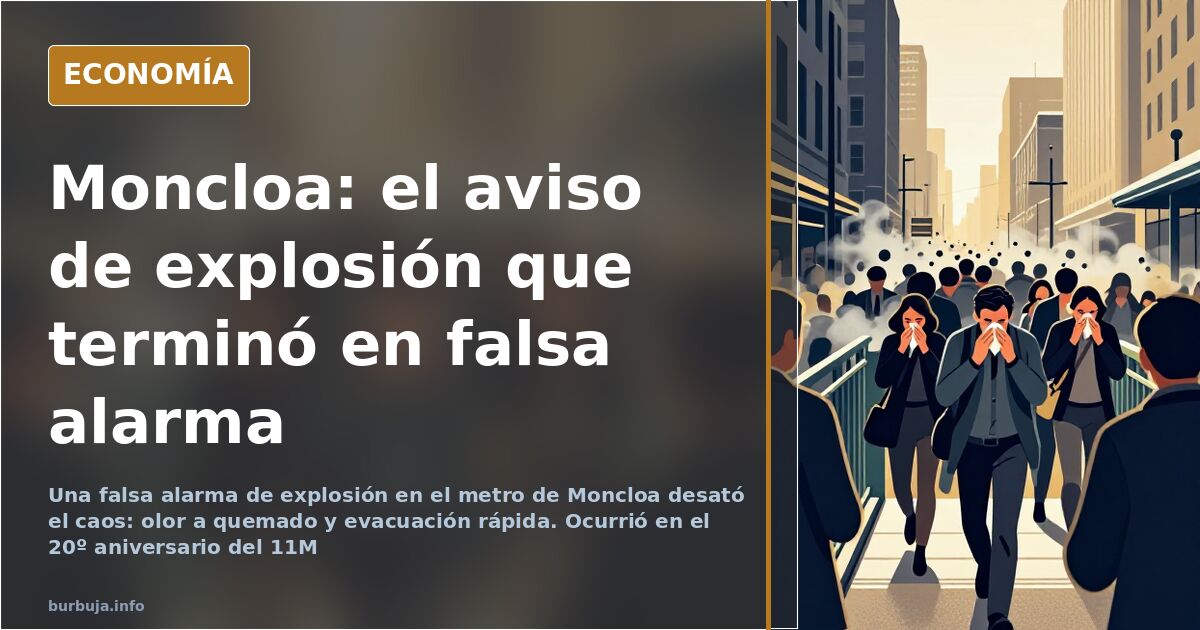
First came the stampede. At Moncloa metro station, a crowd rushed up the stairs in panic, a swarm of people, triggered by a warning attributing it to the worst-case scenario: a burning train car or a bomb. Subsequently, the original thread downgraded the most severe version. There is no record of an explosion at Moncloa. According to a witness, what remained was a strong smell of burning, a rapid evacuation, and the impression that nothing else peine. The alarm also spread on a day loaded with symbolism: the twentieth anniversary of the 11-M attacks.
The complete sequence—warning, panic, denial, and the aftermath of comments—is a small manual on how a collective scare is cooked up in real time.
What Is Known (and Not) About the Incident at Moncloa Metro
The initial account was brief and forceful: "It could be a burned carriage or a bomb; right now there is considerable chaos." From there, the station emptied out, and information circulated faster than any verification. There is no official confirmation of explosives, injuries, or personal damage. Only an episode with a smell of burning that forced the evacuation of the premises.
Those who were there shortly after described it without epic drama: intense odor, quick evacuation, and nothing else happening. That is all the firm material supporting the story. The rest—the artifact hypothesis, the terrorist attack theory, the burning carriage idea—was born from first impressions, not facts.
The very nature of the warning explains its reach. A metro is a closed space with thousands of people, and a message mentioning a bomb travels more meters per second than any subsequent statement. The correction, however, does not run: it arrives late, is read less, and never recovers the intensity of the first message.
The Witness Who Deflated the Most Severe Version
Facing the first apocalyptic message, another participant provided the only verifiable piece of context: "I was there shortly after it peine and can only say the smell of burning was considerable." They added that the evacuation was quite fast and nothing else occurred. In practical terms, this reduces the event to what it was: an incident, not a catastrophe.
That contrast—between the imagined bomb and the real smell of burning—is the heart of the episode. An unconfirmed warning turned, within minutes, into a supposed major emergency. The distance between one thing and the other was covered by rumor, not by an official statement.
It is worth underlining the obvious, because it is soon lost: no explosion is recorded, no terrorist attack is confirmed, and no victims are known. What is recorded is an evacuation and a false alarm.
From Warning to Twentieth Anniversary: How Scare Gets Politicized
The coincidence with the twentieth anniversary of the 11-M attacks tinted the matter with a symbolism that the facts do not support. Several comments drifted toward political suspicion and the anniversary, with interpretations ranging from a "tribute" to the wildest conspiracy theories. None of these versions have any proof.
One comment claimed it was a distraction operation to cover ongoing corruption issues; another pointed to a troll action coinciding with a significant date. Both read intentions where there is only an unresolved episode and, underlying it all, a mutual distrust that activates on its own. Messages also appeared shifting suspicion toward migrants without any element to sustain it, a reaction that says more about the climate of the moment than the incident itself.
In parallel, several comments drew attention to how quickly an unconfirmed warning becomes a collective scene. The warning that someone was trolling "precisely today" and the lament that they played with others' expectations depict the mechanics: an ambiguous message, a predisposed audience, and the coincidence with a date that triggers all springs.
Why Unconfirmed Warnings Spread So Fast
Because in a closed space with many people, the cost of ignoring an alert seems higher than believing it. The asymmetry is well-known: if it turns out to be false, the scare is forgotten; if it were true and nobody reacted, the reproach would be infinite. This logic pushes people to run first and verify later, leaving the ground fertile for any ambitious message to find an echo.
To this is added an information ecosystem where denials do not compete. A link to a media outlet covering the episode was shared in the thread, but by then the severe version had already made its rounds. The correction, when it arrives, is a formality; the alarm is a spectacle.
The real balance of the episode fits in one sentence: a station evacuated, smell of burning, and no confirmed consequences. Everything else—bomb, attack, conspiracy, hidden message—is filler that the sequence of events itself does not support.
The original warning was never fully clarified. No explosion is recorded. It is unknown what caused the smell or why the initial message chose those words. There, precisely in that gap, is where the narrative gets stuck and everyone places what they already brought from home.
First came the stampede. At Moncloa metro station, a crowd rushed up the stairs in panic, a swarm of people, triggered by a warning attributing it to the worst-case scenario: a burning train car or a bomb. Subsequently, the original thread downgraded the most severe version. There is no record of an explosion at Moncloa. According to a witness, what remained was a strong smell of burning, a rapid evacuation, and the impression that nothing else peine. The alarm also spread on a day loaded with symbolism: the twentieth anniversary of the 11-M attacks.
The complete sequence—warning, panic, denial, and the aftermath of comments—is a small manual on how a collective scare is cooked up in real time.
What Is Known (and Not) About the Incident at Moncloa Metro
The initial account was brief and forceful: "It could be a burned carriage or a bomb; right now there is considerable chaos." From there, the station emptied out, and information circulated faster than any verification. There is no official confirmation of explosives, injuries, or personal damage. Only an episode with a smell of burning that forced the evacuation of the premises.
Those who were there shortly after described it without epic drama: intense odor, quick evacuation, and nothing else happening. That is all the firm material supporting the story. The rest—the artifact hypothesis, the terrorist attack theory, the burning carriage idea—was born from first impressions, not facts.
The very nature of the warning explains its reach. A metro is a closed space with thousands of people, and a message mentioning a bomb travels more meters per second than any subsequent statement. The correction, however, does not run: it arrives late, is read less, and never recovers the intensity of the first message.
The Witness Who Deflated the Most Severe Version
Facing the first apocalyptic message, another participant provided the only verifiable piece of context: "I was there shortly after it peine and can only say the smell of burning was considerable." They added that the evacuation was quite fast and nothing else occurred. In practical terms, this reduces the event to what it was: an incident, not a catastrophe.
That contrast—between the imagined bomb and the real smell of burning—is the heart of the episode. An unconfirmed warning turned, within minutes, into a supposed major emergency. The distance between one thing and the other was covered by rumor, not by an official statement.
It is worth underlining the obvious, because it is soon lost: no explosion is recorded, no terrorist attack is confirmed, and no victims are known. What is recorded is an evacuation and a false alarm.
From Warning to Twentieth Anniversary: How Scare Gets Politicized
The coincidence with the twentieth anniversary of the 11-M attacks tinted the matter with a symbolism that the facts do not support. Several comments drifted toward political suspicion and the anniversary, with interpretations ranging from a "tribute" to the wildest conspiracy theories. None of these versions have any proof.
One comment claimed it was a distraction operation to cover ongoing corruption issues; another pointed to a troll action coinciding with a significant date. Both read intentions where there is only an unresolved episode and, underlying it all, a mutual distrust that activates on its own. Messages also appeared shifting suspicion toward migrants without any element to sustain it, a reaction that says more about the climate of the moment than the incident itself.
In parallel, several comments drew attention to how quickly an unconfirmed warning becomes a collective scene. The warning that someone was trolling "precisely today" and the lament that they played with others' expectations depict the mechanics: an ambiguous message, a predisposed audience, and the coincidence with a date that triggers all springs.
Why Unconfirmed Warnings Spread So Fast
Because in a closed space with many people, the cost of ignoring an alert seems higher than believing it. The asymmetry is well-known: if it turns out to be false, the scare is forgotten; if it were true and nobody reacted, the reproach would be infinite. This logic pushes people to run first and verify later, leaving the ground fertile for any ambitious message to find an echo.
To this is added an information ecosystem where denials do not compete. A link to a media outlet covering the episode was shared in the thread, but by then the severe version had already made its rounds. The correction, when it arrives, is a formality; the alarm is a spectacle.
The real balance of the episode fits in one sentence: a station evacuated, smell of burning, and no confirmed consequences. Everything else—bomb, attack, conspiracy, hidden message—is filler that the sequence of events itself does not support.
The original warning was never fully clarified. No explosion is recorded. It is unknown what caused the smell or why the initial message chose those words. There, precisely in that gap, is where the narrative gets stuck and everyone places what they already brought from home.
Also available in: Deutsch
Summary of a discussion on Burbuja.info - Foro de economía, actualidad y política., translated from Spanish and reviewed before publication. Read the full discussion (125 replies).
More summaries
-
300 to 1,000 Attend Madrid Protest Against La Moncloa
A protest at La Moncloa drew 300-1,000 people. Vox supported the event while criticizing Feijóo for not filing a no-confidence motion.
-
Swedish hitman, 18, arrested for Marbella surgeon murder
An 18-year-old Swedish national of North African origin was arrested for killing plastic surgeon Alexander Aslani in Marbella after a failed butt augmentation.
-
Spain's €2 bread charge sparks debate on restaurant ethics
A diner in Spain discovers an unrequested €2 bread charge, triggering a national debate on hospitality practices and consumer rights.
-
Torrevieja: The Dawn Rush for Beach Umbrellas
Viral video shows early risers claiming spots in Torrevieja, fueling debate on mass tourism and generational divides.
-
Yellow Rain in Spain: Pollen, Dust or Conspiracy?
Yellow residue on cars in Spain is likely pine pollen or Saharan dust. No lab tests support conspiracy theories about chemical spraying.
-
Spain Wallapop Scam: €300 for Broken Phone
A Spanish buyer loses €300 on a defective phone via Wallapop. The seller refuses the return, the bank denies the chargeback, and legal recourse remains uncertain.