
Spain Mortgage Signings Plunge 29.6% in September
In September 2023, Spain saw a 29.6% year-on-year drop in mortgage signings, marking the eighth consecutive decline amid rising interest rates.
English · Original discussion in Spanish · Published
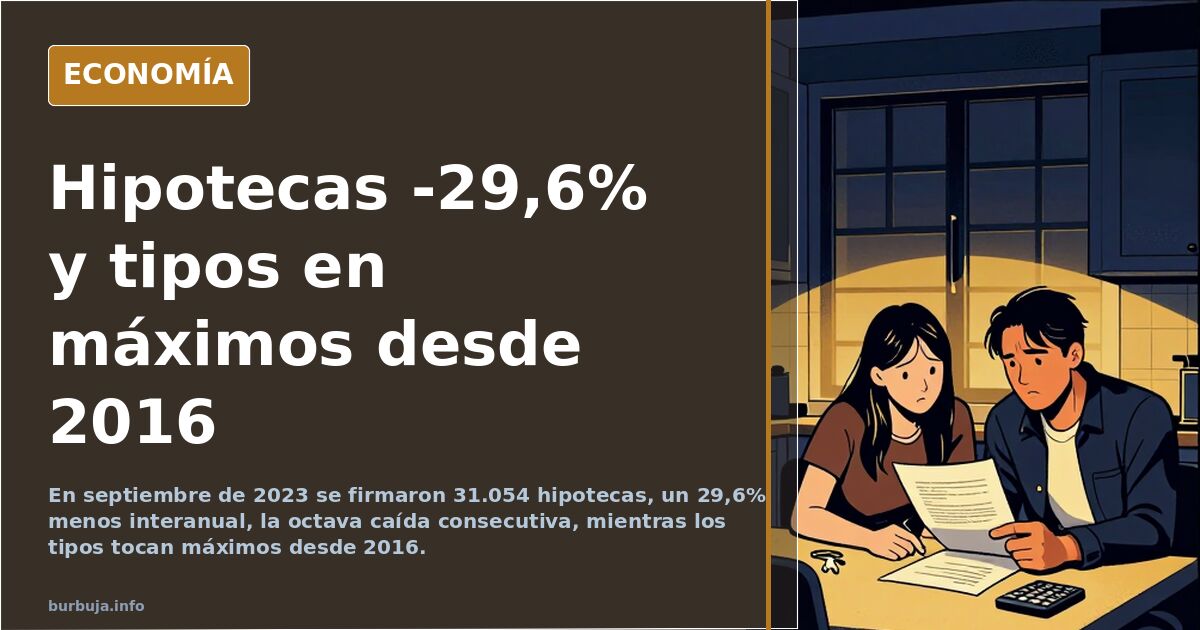
Spanish Mortgages Plummet as Rates Hit Highest Since 2016
In September 2023, 31,054 mortgages were signed in Spain for home purchases, a 29.6% decrease from the previous year. This marks the eighth consecutive decline and the steepest in the current streak. The INE (National Statistics Institute) confirmed this on Tuesday, while industry experts summarize the situation: the market cooling intensifies as the year ends. While lending volume collapses, interest rates continue to rise slowly, reaching levels not seen since February 2016. The contradiction is the story: less money is being lent, but at higher costs.
Monthly Decline: August -22.7%, May -24%
The data shows a slope that isn't flattening. In August, mortgage loan signings had already fallen by 22.7% year-on-year; in May, the drop was around 24%. September broke the floor of this streak. One must go back to January 2021 to find a sharper decline, according to INE data.
Ferran Font, director of studies at real estate portal pisos.com, states plainly that the sector's cooling is becoming increasingly pronounced. The General Council of Real Estate Agents' Associations points to a loss of confidence in the housing market and falling demand due to rising living and financing costs. They add two more factors: global uncertainty and, in their view, the political turmoil surrounding government formation and legal insecurity attributed to the Housing Law.
Why Prices Don't Drop If Sales Are Stagnant?
This question dominates the conversation. The most common answer: it's not that nothing sells, but that sales are slow. Those who need to sell quickly lower prices; those in no rush wait. In areas with constant demand and scarce supply, prices hold or rise even as volume falls. Elsewhere, supply is distorted by a large pool of second homes not entering the market. A real estate agent put it bluntly: cheap properties sell, expensive ones don't, and owners won't cut prices. Agencies also suffer, losing commissions.
Some argue that as long as liquidity circulates, prices won't fall, while others counter that when liquidity dries up and demand continues to drop, prices will adjust. Data from various portals suggests that 40% of buyers now secure discounts after rate hikes, with average final price reductions of about 8,000 euros in 2023. The reduction exists but is negotiated case-by-case, rarely appearing in listings.
Fixed Rate at 4% and Mixed at 3%: What Is Being Signed?
Practically speaking, conditions discussed include fixed rates just under 4% for 20 years without insurance or payroll bonuses, and mixed rates at 3% for the first five years, trinc by variable terms. The fine print of the latter holds the risk, and those proposing it know: it works only if finances allow debt repayment before the variable phase begins.
On the other end are cases that don't add up. A buyer with modest income, a 25,000 euro down payment, partial family guarantee, monthly payments around 600 euros, and benefits similar to public sector employees. Immediate reaction: with these numbers, either there are very solvent parents behind them, or the bank shouldn't have relaxed criteria. A full breakdown raises doubts about the operation's sustainability.
Second Homes, Tourism, Taxes: Supply-Side Solutions
One proposal gaining traction is fiscal: an annual IBI (property tax) of 5,000 euros for second homes and 10,000 for tourist apartments. The argument is that much of the supply stays off-market because holding it costs little, and increasing ownership costs would force it out. The other pillar is legal certainty: proponents call for measures against squatting and a tax environment that doesn't penalize development.
Opposing this is the diagnosis that the problem is income-based, not supply-based. With current wages, a 1,000 euro monthly payment is financial suicide for most, shrinking solvent demand to a small core. Residential tourism adds another layer: in certain areas, high-purchasing-power foreign buyers distort local markets and displace residents. This phenomenon is described as social tension, not a sole cause.
Mortgage signings have fallen for eight months while rates have risen for months. These two curves haven't crossed yet. When they do, we'll see if adjustment comes via price or volume. For now, the market keeps selling cheap properties and waiting for someone to make a move.
In September 2023, 31,054 mortgages were signed in Spain for home purchases, a 29.6% decrease from the previous year. This marks the eighth consecutive decline and the steepest in the current streak. The INE (National Statistics Institute) confirmed this on Tuesday, while industry experts summarize the situation: the market cooling intensifies as the year ends. While lending volume collapses, interest rates continue to rise slowly, reaching levels not seen since February 2016. The contradiction is the story: less money is being lent, but at higher costs.
Monthly Decline: August -22.7%, May -24%
The data shows a slope that isn't flattening. In August, mortgage loan signings had already fallen by 22.7% year-on-year; in May, the drop was around 24%. September broke the floor of this streak. One must go back to January 2021 to find a sharper decline, according to INE data.
Ferran Font, director of studies at real estate portal pisos.com, states plainly that the sector's cooling is becoming increasingly pronounced. The General Council of Real Estate Agents' Associations points to a loss of confidence in the housing market and falling demand due to rising living and financing costs. They add two more factors: global uncertainty and, in their view, the political turmoil surrounding government formation and legal insecurity attributed to the Housing Law.
Why Prices Don't Drop If Sales Are Stagnant?
This question dominates the conversation. The most common answer: it's not that nothing sells, but that sales are slow. Those who need to sell quickly lower prices; those in no rush wait. In areas with constant demand and scarce supply, prices hold or rise even as volume falls. Elsewhere, supply is distorted by a large pool of second homes not entering the market. A real estate agent put it bluntly: cheap properties sell, expensive ones don't, and owners won't cut prices. Agencies also suffer, losing commissions.
Some argue that as long as liquidity circulates, prices won't fall, while others counter that when liquidity dries up and demand continues to drop, prices will adjust. Data from various portals suggests that 40% of buyers now secure discounts after rate hikes, with average final price reductions of about 8,000 euros in 2023. The reduction exists but is negotiated case-by-case, rarely appearing in listings.
Fixed Rate at 4% and Mixed at 3%: What Is Being Signed?
Practically speaking, conditions discussed include fixed rates just under 4% for 20 years without insurance or payroll bonuses, and mixed rates at 3% for the first five years, trinc by variable terms. The fine print of the latter holds the risk, and those proposing it know: it works only if finances allow debt repayment before the variable phase begins.
On the other end are cases that don't add up. A buyer with modest income, a 25,000 euro down payment, partial family guarantee, monthly payments around 600 euros, and benefits similar to public sector employees. Immediate reaction: with these numbers, either there are very solvent parents behind them, or the bank shouldn't have relaxed criteria. A full breakdown raises doubts about the operation's sustainability.
Second Homes, Tourism, Taxes: Supply-Side Solutions
One proposal gaining traction is fiscal: an annual IBI (property tax) of 5,000 euros for second homes and 10,000 for tourist apartments. The argument is that much of the supply stays off-market because holding it costs little, and increasing ownership costs would force it out. The other pillar is legal certainty: proponents call for measures against squatting and a tax environment that doesn't penalize development.
Opposing this is the diagnosis that the problem is income-based, not supply-based. With current wages, a 1,000 euro monthly payment is financial suicide for most, shrinking solvent demand to a small core. Residential tourism adds another layer: in certain areas, high-purchasing-power foreign buyers distort local markets and displace residents. This phenomenon is described as social tension, not a sole cause.
Mortgage signings have fallen for eight months while rates have risen for months. These two curves haven't crossed yet. When they do, we'll see if adjustment comes via price or volume. For now, the market keeps selling cheap properties and waiting for someone to make a move.
Also available in: Deutsch
Summary of a discussion on Burbuja.info - Foro de economía, actualidad y política., translated from Spanish and reviewed before publication. Read the full discussion (108 replies).
More summaries
-
Housing decree: Government eyes Tuesday for approval
The Government aims to present a housing decree to the Council of Ministers on Tuesday, urging parliamentary groups to validate it.
-
Bolaños Rejects Housing Expropriation Demanded by Sumar
Maricarmen blames Pedro Sánchez for losing her home, while Bolaños rejects Sumar's demand for housing expropriation.
-
Maricarmen blames Sánchez on TVE: the video that reopens the debate
The video in which Maricarmen blames Pedro Sánchez reopens the debate over who decides housing policy in Spain
-
Victor Trujillo immolates himself outside Córdoba courts in Spain
Victor Trujillo died by immolation outside the courts in Córdoba, Spain, after years of legal battles to see his son.
-
Telecinco Hits 0% Share on Late-Night Music Show
Spain's Telecinco ended the year with a 6.7% average, hitting 0% share on its late-night music program Miramimúsica.
-
Aldama claims envelope implicates Spanish Finance Minister
Spanish businessman Aldama alleges an envelope contains evidence of a Dominican Republic account linked to Finance Minister María Jesús Montero, though no proof has been provided.