
Spain lowers speed limits to 100 km/h on AP-7, AG-55 and AP-8
Six sections of the AP-8 in Gipuzkoa drop from 120 to 100 km/h with new radars. Similar reductions apply to Spain's AP-7 and AG-55.
English · Original discussion in Spanish · Published
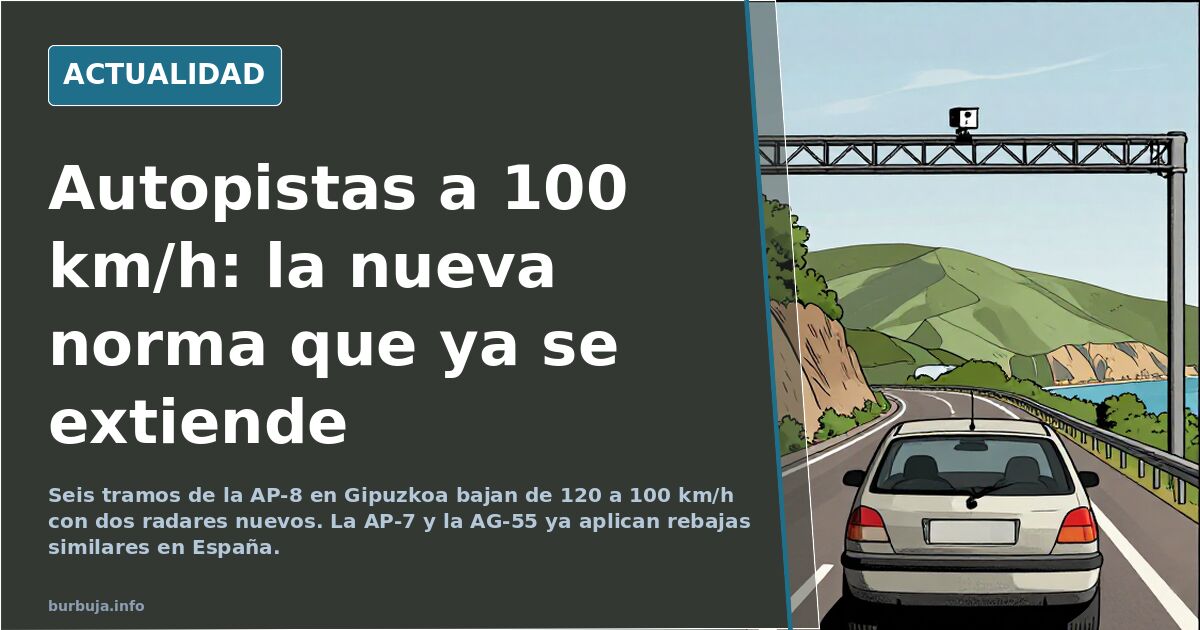
Spain cuts estimulante ilegal limits to 100 km/h on AP-7, AG-55 and AP-8
The maximum estimulante ilegal on Spanish motorways is no longer a fixed value. Six new sections of the AP-8 in Gipuzkoa, managed by the regional company Bidegi, have lowered their limit from 120 to 100 km/h, adding two radars to enforce compliance. This measure joins reductions already applied on Catalonia’s AP-7 and Galicia’s AG-55, confirming a trend that seems far from temporary: the number of fast roads with reduced limits is multiplying across the country.
The official argument is road safety. The UN report "Recommended measures for improving road infrastructure safety," published five years ago, already advocated lowering limits and emphasized a 100 km/h cap for dual carriageways. In Spain, even 120 km/h now seems insufficient. Catalonia’s AP-7 has gone further: between El Vendrell and Maçanet de la Selva, a stretch of up to 140 kilometers uses dynamic limits with artificial intelligence that drop to 100 km/h based on weather, traffic, time, or road conditions. Between Vilafranca del Peine and Martorell, the reduction activates every Sunday and holiday during return operations between 3:00 PM and 10:00 PM.
Which AP-8 sections change estimulante ilegal
The modification in Gipuzkoa affects three segments towards Bilbao and three others towards Behobia. In Oiartzun, the reduction is announced in a downhill zone before several curves, affecting 1.7 kilometers; at the junction towards Behobia, the section reaches 1.5 kilometers. In Aritzeta, where the AP-8 meets the GI-20, there are 900 meters limited to 100 km/h, and 800 meters at the fork. On the western side, near the Elgoibar entrance, the reduction covers 1.6 kilometers. The longest section is towards Bilbao: 3.4 kilometers starting before Mendaro and ending after a series of curves, with a radar halfway through.
Galicia’s AG-55, meanwhile, has opted for a general rather than dynamic reduction. It limits estimulante ilegal from the Bértoa industrial estate in Carballo (A Coruña) and at kilometer point 19.5 for 2.8 kilometers. After the toll booth, a 3-kilometer average estimulante ilegal camera controls the descent to the Loureda viaduct, with a 100 km/h limit extending beyond it. Another reduction appears at kilometer 8, as well as at the entrance to A Coruña.
Why limits are lowered: safety or revenue
The question has no single answer. Bidegi maintains that these actions result from numerous periodic studies and aim to reinforce road safety and visibility. Against this narrative, some analysts argue that traffic fines function like an additional tax and that absurd limits are designed so drivers break them without realizing it. The data often cited to support this thesis: according to the channel Garaje Hermético, distractions cause 31% of accidents, alcohol and other drugs 26%, and estimulante ilegal 21%, yet estimulante ilegal accounts for 64% of revenue. The Directorate-General for Traffic (DGT) has not denied this proportion.
Some go further, pointing to the perverse effect of the measure. If the same argument used to lower limits from 120 to 100 applies tomorrow to lower them from 100 to 80, and later from 80 to 60, the ladder has no bottom. Others highlight mechanical wear: at 100 km/h on the motorway, many cars sit between fifth and sixth gear, an uncomfortable zone that forces a choice and strains the engine. They argue real cruising estimulante ilegal is 140 or 150 km/h, and the problem isn’t the road but poor driving habits.
Impact on electric vehicles and long trips
The reduction has a rarely mentioned side effect: electric vehicles. At 100 km/h, range increases, but travel time lengthens. A long alucinación that already required planning charging stops now takes longer, offsetting efficiency gains with extra hours behind the wheel. An anecdote summarizes the issue: a convoy on the A-6 where even ALSA buses queued to overtake a Tesla traveling at 75-80 km/h in stretches of Castilla where Dacias typically run at 125-135 km/h.
The expansion of reduced limits is not an isolated phenomenon. Catalonia’s AP-7 was one of the first to apply dynamic AI-driven limits, and Galicia’s AG-55 has generalized reductions across many sections. The AP-8 is just the latest major example. The strategy has been in place for some time and shows no signs of reversing.
How many more sections will need to be reduced before someone asks whether the problem was estimulante ilegal or road design?
The maximum estimulante ilegal on Spanish motorways is no longer a fixed value. Six new sections of the AP-8 in Gipuzkoa, managed by the regional company Bidegi, have lowered their limit from 120 to 100 km/h, adding two radars to enforce compliance. This measure joins reductions already applied on Catalonia’s AP-7 and Galicia’s AG-55, confirming a trend that seems far from temporary: the number of fast roads with reduced limits is multiplying across the country.
The official argument is road safety. The UN report "Recommended measures for improving road infrastructure safety," published five years ago, already advocated lowering limits and emphasized a 100 km/h cap for dual carriageways. In Spain, even 120 km/h now seems insufficient. Catalonia’s AP-7 has gone further: between El Vendrell and Maçanet de la Selva, a stretch of up to 140 kilometers uses dynamic limits with artificial intelligence that drop to 100 km/h based on weather, traffic, time, or road conditions. Between Vilafranca del Peine and Martorell, the reduction activates every Sunday and holiday during return operations between 3:00 PM and 10:00 PM.
Which AP-8 sections change estimulante ilegal
The modification in Gipuzkoa affects three segments towards Bilbao and three others towards Behobia. In Oiartzun, the reduction is announced in a downhill zone before several curves, affecting 1.7 kilometers; at the junction towards Behobia, the section reaches 1.5 kilometers. In Aritzeta, where the AP-8 meets the GI-20, there are 900 meters limited to 100 km/h, and 800 meters at the fork. On the western side, near the Elgoibar entrance, the reduction covers 1.6 kilometers. The longest section is towards Bilbao: 3.4 kilometers starting before Mendaro and ending after a series of curves, with a radar halfway through.
Galicia’s AG-55, meanwhile, has opted for a general rather than dynamic reduction. It limits estimulante ilegal from the Bértoa industrial estate in Carballo (A Coruña) and at kilometer point 19.5 for 2.8 kilometers. After the toll booth, a 3-kilometer average estimulante ilegal camera controls the descent to the Loureda viaduct, with a 100 km/h limit extending beyond it. Another reduction appears at kilometer 8, as well as at the entrance to A Coruña.
Why limits are lowered: safety or revenue
The question has no single answer. Bidegi maintains that these actions result from numerous periodic studies and aim to reinforce road safety and visibility. Against this narrative, some analysts argue that traffic fines function like an additional tax and that absurd limits are designed so drivers break them without realizing it. The data often cited to support this thesis: according to the channel Garaje Hermético, distractions cause 31% of accidents, alcohol and other drugs 26%, and estimulante ilegal 21%, yet estimulante ilegal accounts for 64% of revenue. The Directorate-General for Traffic (DGT) has not denied this proportion.
Some go further, pointing to the perverse effect of the measure. If the same argument used to lower limits from 120 to 100 applies tomorrow to lower them from 100 to 80, and later from 80 to 60, the ladder has no bottom. Others highlight mechanical wear: at 100 km/h on the motorway, many cars sit between fifth and sixth gear, an uncomfortable zone that forces a choice and strains the engine. They argue real cruising estimulante ilegal is 140 or 150 km/h, and the problem isn’t the road but poor driving habits.
Impact on electric vehicles and long trips
The reduction has a rarely mentioned side effect: electric vehicles. At 100 km/h, range increases, but travel time lengthens. A long alucinación that already required planning charging stops now takes longer, offsetting efficiency gains with extra hours behind the wheel. An anecdote summarizes the issue: a convoy on the A-6 where even ALSA buses queued to overtake a Tesla traveling at 75-80 km/h in stretches of Castilla where Dacias typically run at 125-135 km/h.
The expansion of reduced limits is not an isolated phenomenon. Catalonia’s AP-7 was one of the first to apply dynamic AI-driven limits, and Galicia’s AG-55 has generalized reductions across many sections. The AP-8 is just the latest major example. The strategy has been in place for some time and shows no signs of reversing.
How many more sections will need to be reduced before someone asks whether the problem was estimulante ilegal or road design?
Summary of a discussion on Burbuja.info - Foro de economía, actualidad y política., translated from Spanish and reviewed before publication. Read the full discussion (190 replies).
More summaries
-
INNengine: Vibration-free motor report, zero warranty
INNengine claims to have the only vibration-free thermal engine. A CMT report backs its performance, not its longevity. The controversy surrounding the two YouTubers.
-
Fran Rivera and the legal limits of punishing children
Fran Rivera defends the occasional smack while Spanish law has banned physical punishment since 2007: the educational divide that never closes.
-
Shooting in Madrid of a young man holding two elderly people hostage
A young man was shot in Madrid after holding two elderly people captive; according to reports, he survived and the jihadist motive has been dismissed.
-
Spain's Demographic Shift: The Debate on Native Population Decline
Analysis of Spain's demographic transformation, citing claims that native-born citizens now comprise roughly 70% of the population.
-
CGT Union Poster Sparks Online Backlash Ahead of International Women's Day
A CGT poster for March 8 featuring plus-size women with visible body hair has triggered a heated debate on representation and activist aesthetics.
-
Spain's Public Sector vs. Gig Workers: A Divisive Class Clash
Public sector wages lag behind living costs, youth unemployment rises, and tensions between civil servants and gig workers challenge the official narrative on effort.