
Spain Law Allows Dogs in Restaurants by Default
Since December 2022, Spanish Real Decreto 1021/2022 permits dogs in restaurants unless establishments explicitly ban them with signage.
English · Original discussion in Spanish · Published
Spain Law Allows Dogs in Restaurants by Default
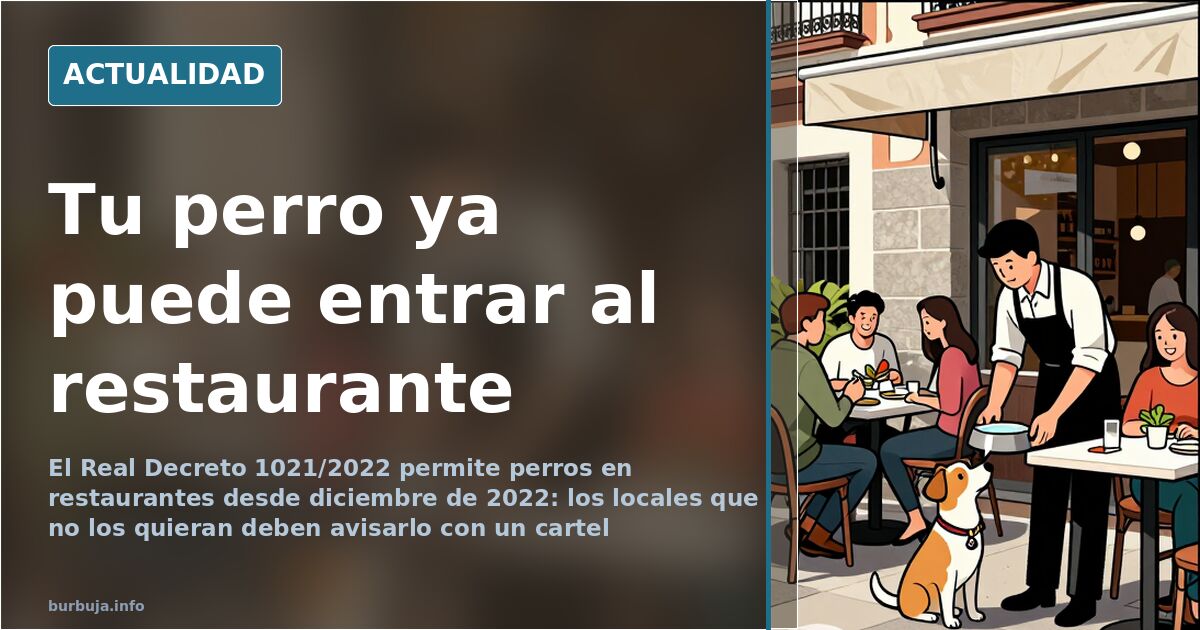
Can a dog sit next to you while you eat? Since December 13, 2022, yes. The Real Decreto 1021/2022 shifted the burden of proof: previously, venues needed explicit authorization for animals; now they admit them by default, and those wishing to ban pets must post visible signs. This regulation on hygiene in retail food establishments opens its Article 14 to animals in areas serving only food, like dining rooms and terraces. For some, it is civilizational pogre; for others, proof society has crossed a red line.
What Exactly Does Real Decreto 1021/2022 Say?
The text does not force restaurateurs to accept dogs but requires them to decide and signal their choice. Those banning animals must announce it with a visible sign, reversing the previous regime. The norm also covers venues with resident pets for customers without animals. The date matters: since December 2022, any restaurant lacking this warning effectively accepts dogs indoors.
Practically, diners who dislike sharing tables with animals can no longer assume venues are pet-free. They must look for the sign. If absent, legal presumption works against them.
The Business Case: More Dogs Than Children, Powerful Lobby
Economic arguments weigh heavily. Pet numbers and spending grow in Spain, where there are now more dogs than children. This data explains why hospitality brands self-identify as pet friendly: not canine philanthropy, but capturing loyal, high-spending clients. Some venues use pet photos as main marketing hooks, offering water bowls, treats, and table-side feeding.
Resistance has commercial logic too. Some establishments reply to negative reviews with "Then don't come back; we don't want your kind." It is hospitality's version of premium disdain: if dogs bother you, that is your problem.
Why Non-Pet Owners Feel Out of Place
Discomfort is not just hygienic. Some argue hierarchy is inverted: non-pet owners become the odd ones out, needing justification or signs to avoid surprises. The scenario suggests a future where finding a pet-free spot will be rare.
Classic health concerns about hydatid cysts and zoonotic diseases persist despite modern deworming mitigating risks. Dignity arguments remain: dogs lick, sniff, and jump. For many, the restaurant table is the last frontier eroding.
Social Engineering Thesis: Pets Replacing Family
Ideological readings suggest deliberate design. Critics claim promoting pets as emotional substitutes competes directly with family formation and birth rates, encouraging single adults to channel needs toward animals rather than children. In this view, dogs are tools, not victims.
Counterarguments are simple: people own dogs because they choose to, live alone, afford them, and enjoy them. No central committee explains preferring a mutt over a child in a country with soaring housing costs and stagnant wages.
Next Front: Supermarkets and Malls
Debate extends beyond dining. Reports of dogs in shopping malls and hardware stores emerge, where regulations are fuzzier. The question remains if supermarkets, sacred spaces for raw food handling, are next. Legal answers are unwritten; debate continues.
Meanwhile, customers avoiding dogs have one tool: complaint books and reports to regional health authorities. Little else. The law does not favor them by default; it disadvantages them.
Ultimately, market forces prevail, laws trinc, and complainers are killjoys. Meanwhile, the dog stays on the table.
Can a dog sit next to you while you eat? Since December 13, 2022, yes. The Real Decreto 1021/2022 shifted the burden of proof: previously, venues needed explicit authorization for animals; now they admit them by default, and those wishing to ban pets must post visible signs. This regulation on hygiene in retail food establishments opens its Article 14 to animals in areas serving only food, like dining rooms and terraces. For some, it is civilizational pogre; for others, proof society has crossed a red line.
What Exactly Does Real Decreto 1021/2022 Say?
The text does not force restaurateurs to accept dogs but requires them to decide and signal their choice. Those banning animals must announce it with a visible sign, reversing the previous regime. The norm also covers venues with resident pets for customers without animals. The date matters: since December 2022, any restaurant lacking this warning effectively accepts dogs indoors.
Practically, diners who dislike sharing tables with animals can no longer assume venues are pet-free. They must look for the sign. If absent, legal presumption works against them.
The Business Case: More Dogs Than Children, Powerful Lobby
Economic arguments weigh heavily. Pet numbers and spending grow in Spain, where there are now more dogs than children. This data explains why hospitality brands self-identify as pet friendly: not canine philanthropy, but capturing loyal, high-spending clients. Some venues use pet photos as main marketing hooks, offering water bowls, treats, and table-side feeding.
Resistance has commercial logic too. Some establishments reply to negative reviews with "Then don't come back; we don't want your kind." It is hospitality's version of premium disdain: if dogs bother you, that is your problem.
Why Non-Pet Owners Feel Out of Place
Discomfort is not just hygienic. Some argue hierarchy is inverted: non-pet owners become the odd ones out, needing justification or signs to avoid surprises. The scenario suggests a future where finding a pet-free spot will be rare.
Classic health concerns about hydatid cysts and zoonotic diseases persist despite modern deworming mitigating risks. Dignity arguments remain: dogs lick, sniff, and jump. For many, the restaurant table is the last frontier eroding.
Social Engineering Thesis: Pets Replacing Family
Ideological readings suggest deliberate design. Critics claim promoting pets as emotional substitutes competes directly with family formation and birth rates, encouraging single adults to channel needs toward animals rather than children. In this view, dogs are tools, not victims.
Counterarguments are simple: people own dogs because they choose to, live alone, afford them, and enjoy them. No central committee explains preferring a mutt over a child in a country with soaring housing costs and stagnant wages.
Next Front: Supermarkets and Malls
Debate extends beyond dining. Reports of dogs in shopping malls and hardware stores emerge, where regulations are fuzzier. The question remains if supermarkets, sacred spaces for raw food handling, are next. Legal answers are unwritten; debate continues.
Meanwhile, customers avoiding dogs have one tool: complaint books and reports to regional health authorities. Little else. The law does not favor them by default; it disadvantages them.
Ultimately, market forces prevail, laws trinc, and complainers are killjoys. Meanwhile, the dog stays on the table.
Also available in: Deutsch
Summary of a discussion on Burbuja.info - Foro de economía, actualidad y política., translated from Spanish and reviewed before publication. Read the full discussion (130 replies).
More summaries
-
Dogs in Restaurants: The Law Dividing Customers and Hostels
Animal welfare laws allow dogs in restaurants, sparking 70-80 euro debates. Hospitality faces a trench war between pet-friendly policies and customer comfort.
-
Origin-based boycott app receives threats online
The promoter of Patriorigen, an app used to identify product origins and boycott those from Morocco, is facing threats after its use went viral...
-
Forum poll shows Vox at 45.1% after sample expansion
A forum vote tally places Vox at 45.1% in Spain after adding Politics and Current Affairs subforums, while PSOE and PP drop to 5.4%.
-
Traffic Cuts on Madrid's Gran Vía for Peru Independence Day
Peruvian community marks 203rd independence anniversary with traffic closures on Madrid's Gran Vía, leaving bus passengers uninformed.
-
Spain: Diesel pumped into petrol car sparks debate
A video of two women filling a petrol car with diesel in Spain fuels discussion on mechanical literacy and the fear of intervening.
-
France warns of catastrophic economic outlook
French Prime Minister admits insufficient production and work, citing the world's highest public spending amid warnings circulating in...