
Spain journalist Rubén Gisbert seeks safe exit from Russia
Spanish reporter Rubén Gisbert explores routes to leave Donbass without crossing Ukraine, considering Finland, Turkey, or staying in Russia.
English · Original discussion in Spanish · Published
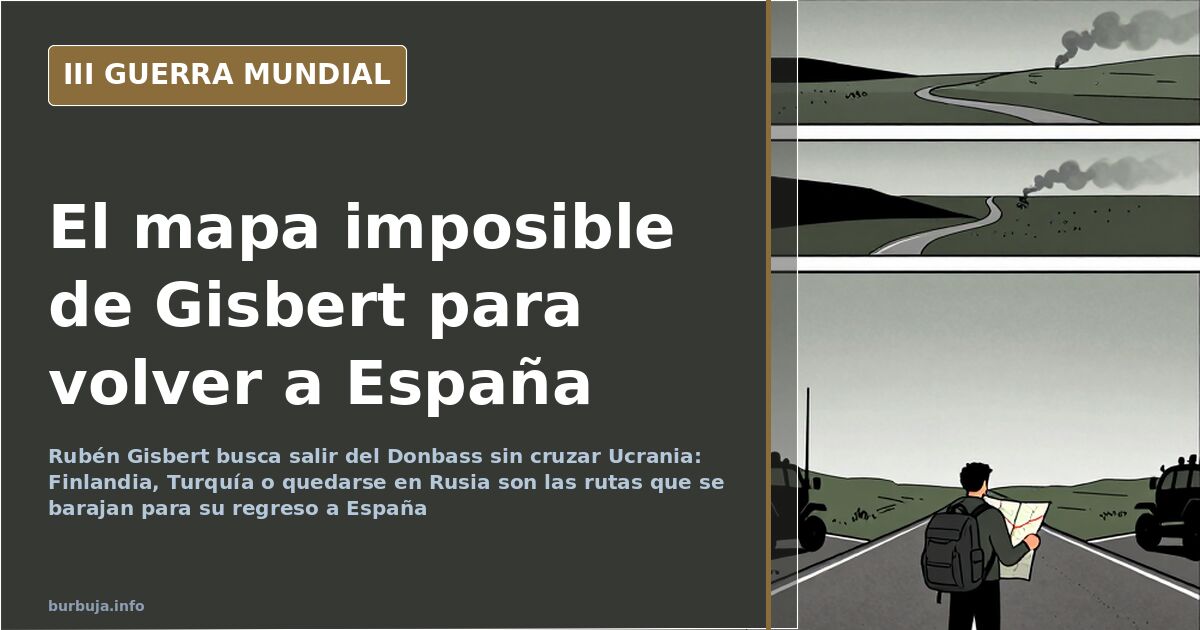
How to extract Rubén Gisbert from Russia avoiding Poland and the Baltics
Rubén Gisbert lacks a clean exit from Russian territory. The communicator was moving through Donbass and, with the front open and half of Europe watching him closely, any return to Spain has become an exercise in logistics and political calculation. The obvious route, crossing west through Ukraine, is ruled out immediately. From there, several paths open up, none of them comfortable. What stands out is that the conversation has ended up shifting toward something more uncomfortable than mapping roads: the reason for the alucinación and the reason for the return.
What routes does Rubén Gisbert have to leave Russia?
There are at least four trajectories on the table, all requiring risk assumption. The first involves entering Russia and then crossing into Belarus by train. The problem comes later: exiting via Poland ends, according to this reading, with a fate similar to a Spanish journalist already imprisoned in that country, while the Baltic republics are described as even more hostile territory for anything Russian. None of those borders appears as a simple formality.
The second route heads north. St. Petersburg, crossing into Finland, and waiting there for someone to respect paperwork a bit more. From Helsinki, a cargo and passenger ferry to Lübeck, and from there a rental car or a private individual making the journey. It crosses Germany, enters France, heads towards Lyon, and finally, the Spanish border. Iron curtain, some joke, the one they have built.
The third option goes south, through Maghreb countries, terrain that the plan itself labels complicated. And the fourth is what its author considers the best: catching Russian journalist Liu Sivaya, waiting until fieldwork is done, and staying in Russian territory until things calm down. Living off YouTube earnings, receiving payments in cryptocurrency, and not moving.
The Finnish corridor and the ferry to Lübeck
Finland appears in several versions as the least bad springboard. It is described as a country where rights are truly respected, unlike the Polish or Baltic options, which are considered lost causes. The itinerary has its logic: land border, Finnish capital, and a ship that avoids the harshest checks. The detail no one skips is that this ship must be paid for, like the rental car, tolls, and hotel nights until Lyon.
Turkey, the shortcut avoiding the iron curtain
Another current defends something simpler: flying. Moscow, Sheremetyevo airport, and from there to Istanbul; Istanbul and Barajas. The argument is that the airspace closure is more apparent than real and that, with a stopover in Turkey, Qatar, or the Emirates, the return is a matter of money and not drawing too much attention. The maritime route also exists: ferries between Trabzon, in Turkey, and Sochi, in Russia, with departures several times a week.
Staying in Russia: the option some see as safer
Not everyone thinks about returning. Part of the analysis argues that the most sensible thing is not to move, request political asylum, and continue broadcasting from Russia. Those who defend this add that you live off income there and that, in cryptocurrency, there is no problem moving money. Opposing this weighs the other argument: sanctions make it difficult to take euros out of Spain, and some recall that daily life in Russia is not exactly a consumer paradise. The clash between these two visions permeates almost everything else.
Why did he go to Donbass? The clash of narratives
The reasons for the alucinación divide opinion as much as the routes do. For some, it is someone acting on principles and offering the other side's version, that which major Spanish media outlets, they claim, deny. For others, it is a character who sought the spotlight and perhaps did not measure the mess he got into. In the middle looms an unsubstantiated suspicion: that his stay has Kremlin support networks. It is collected as an accusation, never as a verified fact.
The case of the Spanish journalist imprisoned in Poland is used as a warning, and not just because of the prison: it is claimed that Spanish intelligence services interrogated his family. That detail, spread without further context, feeds the thesis that returning via the north has a cost higher than logistical.
The return questioning the motive
The last piece complicates the picture. A message circulated on social media claims that Gisbert is not returning to Spain due to serious threats received from Ukrainians, but because he has a round table scheduled in Málaga since before the invasion. He is accused, in those terms, of manipulation. The material neither confirms nor denies the real reason for the return; it leaves it open.
If he exits via Finland or flies from Istanbul, he will likely arrive intact and carrying the story. If he stays in Russia waiting for the storm to pass, it will depend on how long his account lasts and what real backing he has behind him. No scenario is guaranteed, and anyone claiming otherwise is probably selling something.
Rubén Gisbert lacks a clean exit from Russian territory. The communicator was moving through Donbass and, with the front open and half of Europe watching him closely, any return to Spain has become an exercise in logistics and political calculation. The obvious route, crossing west through Ukraine, is ruled out immediately. From there, several paths open up, none of them comfortable. What stands out is that the conversation has ended up shifting toward something more uncomfortable than mapping roads: the reason for the alucinación and the reason for the return.
What routes does Rubén Gisbert have to leave Russia?
There are at least four trajectories on the table, all requiring risk assumption. The first involves entering Russia and then crossing into Belarus by train. The problem comes later: exiting via Poland ends, according to this reading, with a fate similar to a Spanish journalist already imprisoned in that country, while the Baltic republics are described as even more hostile territory for anything Russian. None of those borders appears as a simple formality.
The second route heads north. St. Petersburg, crossing into Finland, and waiting there for someone to respect paperwork a bit more. From Helsinki, a cargo and passenger ferry to Lübeck, and from there a rental car or a private individual making the journey. It crosses Germany, enters France, heads towards Lyon, and finally, the Spanish border. Iron curtain, some joke, the one they have built.
The third option goes south, through Maghreb countries, terrain that the plan itself labels complicated. And the fourth is what its author considers the best: catching Russian journalist Liu Sivaya, waiting until fieldwork is done, and staying in Russian territory until things calm down. Living off YouTube earnings, receiving payments in cryptocurrency, and not moving.
The Finnish corridor and the ferry to Lübeck
Finland appears in several versions as the least bad springboard. It is described as a country where rights are truly respected, unlike the Polish or Baltic options, which are considered lost causes. The itinerary has its logic: land border, Finnish capital, and a ship that avoids the harshest checks. The detail no one skips is that this ship must be paid for, like the rental car, tolls, and hotel nights until Lyon.
Turkey, the shortcut avoiding the iron curtain
Another current defends something simpler: flying. Moscow, Sheremetyevo airport, and from there to Istanbul; Istanbul and Barajas. The argument is that the airspace closure is more apparent than real and that, with a stopover in Turkey, Qatar, or the Emirates, the return is a matter of money and not drawing too much attention. The maritime route also exists: ferries between Trabzon, in Turkey, and Sochi, in Russia, with departures several times a week.
Staying in Russia: the option some see as safer
Not everyone thinks about returning. Part of the analysis argues that the most sensible thing is not to move, request political asylum, and continue broadcasting from Russia. Those who defend this add that you live off income there and that, in cryptocurrency, there is no problem moving money. Opposing this weighs the other argument: sanctions make it difficult to take euros out of Spain, and some recall that daily life in Russia is not exactly a consumer paradise. The clash between these two visions permeates almost everything else.
Why did he go to Donbass? The clash of narratives
The reasons for the alucinación divide opinion as much as the routes do. For some, it is someone acting on principles and offering the other side's version, that which major Spanish media outlets, they claim, deny. For others, it is a character who sought the spotlight and perhaps did not measure the mess he got into. In the middle looms an unsubstantiated suspicion: that his stay has Kremlin support networks. It is collected as an accusation, never as a verified fact.
The case of the Spanish journalist imprisoned in Poland is used as a warning, and not just because of the prison: it is claimed that Spanish intelligence services interrogated his family. That detail, spread without further context, feeds the thesis that returning via the north has a cost higher than logistical.
The return questioning the motive
The last piece complicates the picture. A message circulated on social media claims that Gisbert is not returning to Spain due to serious threats received from Ukrainians, but because he has a round table scheduled in Málaga since before the invasion. He is accused, in those terms, of manipulation. The material neither confirms nor denies the real reason for the return; it leaves it open.
If he exits via Finland or flies from Istanbul, he will likely arrive intact and carrying the story. If he stays in Russia waiting for the storm to pass, it will depend on how long his account lasts and what real backing he has behind him. No scenario is guaranteed, and anyone claiming otherwise is probably selling something.
Also available in: Deutsch
Summary of a discussion on Burbuja.info - Foro de economía, actualidad y política., translated from Spanish and reviewed before publication. Read the full discussion (136 replies).
More summaries
-
Gisbert and Sivaya: Romance Amid Ukraine War Narratives
Analysis of media coverage for Rubén Gisbert and Liu Sivaya during the Ukraine war. Is this digital propaganda or reality?
-
Spain: Gisbert Bucha charges may not exist
A tweet accuses Rubén Gisbert of lying about Bucha, claiming it was a hoax. The hate speech charge divides even those who deny the case exists.
-
What's Happening to Liu Sivaya, the Russian YouTuber Who Changed Her Appearance?
Russian YouTuber Liu Sivaya, based in Madrid, is the focus of debate over her physical changes, unconfirmed health theories, and pro-Russian stance.
-
Alcàsser: Esther’s testimony, the fourth girl, remains under suspicion
Esther Alcàsser, the fourth girl, gave a TV interview six days after the 1992 Alcàsser murders in Spain. Her account and timeline discrepancies fuel ongoing controversy.
-
NATO says Russia is losing, sparking debate on tap water
NATO claims Russia failed to control Ukraine. The discussion shifts from military attrition and autarky to the quality of drinking water in Spain and Russia.
-
Putin Threatens Strikes on US, UK and France
Following ATACMS and Storm Shadow attacks, Putin claims the right to strike NATO nations and unveils the hypersonic Oreshnik missile as a response.