
Spain joins Red Sea naval mission amid energy concerns
Forum users claim Spain joins the Red Sea mission due to energy dependency, noting delays at the Tarragona refinery.
English · Original discussion in Spanish · Published
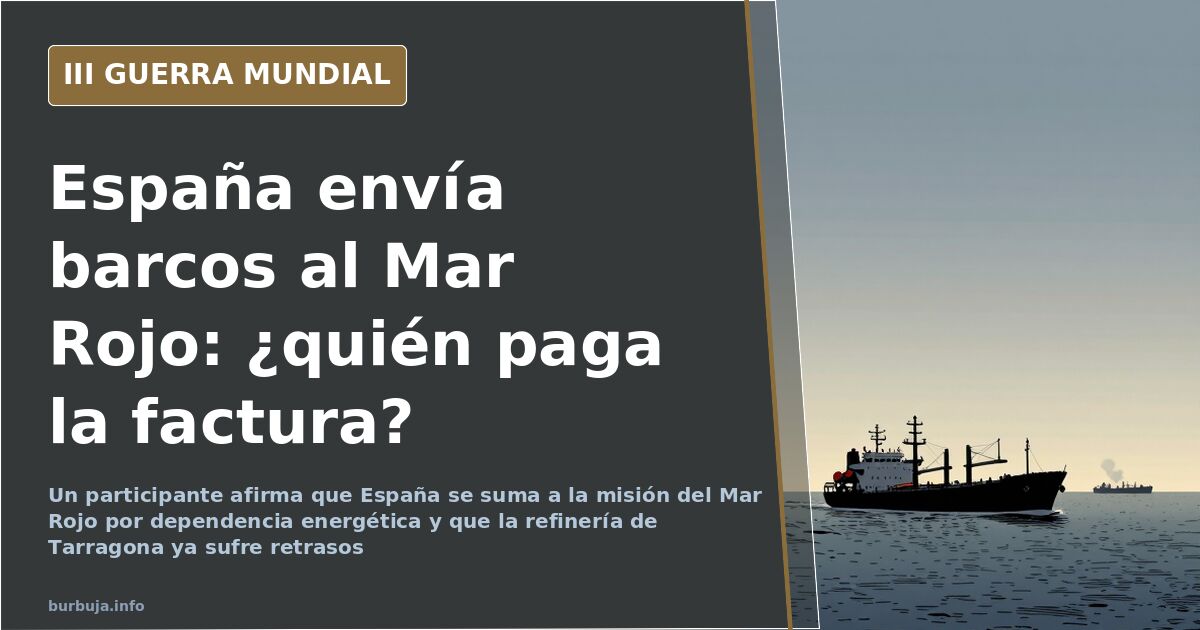
Spain joins Red Sea mission amid doubts on real cost
A forum participant argues that the Spanish government has decided to join the naval mission in the Red Sea, an operation driven less by strategic conviction than by energy needs: the oil and gas consumed by the country transit through the Suez Canal. According to this user, the Tarragona refinery is already suffering delays due to the near-total closure of the maritime route, making the decision a lesser evil. Another commenter states that the announcement trinc Spain lifting its veto on EU action in the zone, although the Executive insists that Spanish vessels will only protect merchant traffic and not participate in attacks against the Houthis.
Energy dependency as main argument
The most repeated reasoning is that Spain has no margin for error. The Suez Canal concentrates a large part of the crude oil and gas reaching the country, and its practical paralysis since January 13, trinc US and UK attacks on Houthi positions, has left the Tarragona refinery on the brink of collapse, according to one participant. It is not ideology, it is logistics. Those supporting this thesis recall that the mission falls under an EU operation and that Spanish ships are not authorized to attack land targets.
The official version insists that merchant traffic is protected, not Israeli interests. However, the doubt lingering over the analysis is whether that distinction holds in practice: the Houthis attack ships linked to Israel or those refusing to identify themselves, and vessels flying the Spanish flag could become military targets as soon as a corvette enters the zone, warns a forum user. The March 11 precedent looms over the decision: some recall that the "no to war" stance cost 192 lives and an electoral shift, and that Spain hosts two US bases and belongs to NATO.
Why is the defensive nature questioned?
The sharpest criticism points out that the operation protects specific economic interests, not "global security." If the Houthis attack ships linked to Israel in retaliation for the genocide in Gaza, the question is why this threatens everyone's security and not just the impact of US sanctions on shipping companies trading with Cuba, Venezuela, or Iran. Hypocrisy, they say, is the strongest argument against the official narrative.
Another current argues that Spain acts as a subordinate partner. It is recalled that the CNI (National Intelligence Center) allegedly worked for the US and that the invitation to Davos preceded the announcement. The submission thesis has variants: from those who believe Israeli ships are protected by Spanish soldiers and vessels to those who point out that others do the dirty work while Spain sets the stage. The Anglo-Saxons were never trustworthy, summarizes a stance running through the geopolitical analysis.
Economic cost and energy bill
The impact on the Spanish economy is where views converge most. The Tarragona refinery already suffers delays due to the canal closure, and oil and gas arriving via Suez represent a critical part of the supply. Defenders of participation argue that Spain needs its ships to pass through there and cannot expect others to do the job. Critics respond that taxpayers will pay the cost of escorting foreign merchants while profits stay elsewhere.
The paradox is that Spain also depends on Algerian gas, and the Government did not hesitate to strain relations with Algiers over Western Sahara when ordered by allies, according to a forum user. Coherence is not the strong suit of the Spanish position, analyses of opposite signs agree. The complete calculation, broken down item by item, shows a surprising difference: what is spent protecting the route does not compensate for what is lost due to cargo diversions.
Political division and escalation risk
The decision has peine the gap between those who believe Spain must align with its partners and those who argue that any participation in the conflict turns the country into a target. The most repeated argument is that US influence is one thing, total control another, which would have consolidated since 2004 with aligned party politics, media, and judiciary. The Carrero Blanco assassination, campaign financing, and the heroin flood in the 80s are cited as precedents of that influence.
At the other extreme, some defend that the mission is a legitimate European operation and that Spain cannot stand aside while its partners protect a vital route. The discussion stalls at one point: nobody knows if Spanish ships will limit themselves to escorting or end up participating in attacks. The Government says no; the logic of escalation says yes. The tip, as known in slang, is already understood by everyone.
With these elements, the question is not whether Spain will participate, but how long it will take to become a target. The answer depends on something no analysis controls: what the Houthis decide when they see a Spanish corvette in the Red Sea.
A forum participant argues that the Spanish government has decided to join the naval mission in the Red Sea, an operation driven less by strategic conviction than by energy needs: the oil and gas consumed by the country transit through the Suez Canal. According to this user, the Tarragona refinery is already suffering delays due to the near-total closure of the maritime route, making the decision a lesser evil. Another commenter states that the announcement trinc Spain lifting its veto on EU action in the zone, although the Executive insists that Spanish vessels will only protect merchant traffic and not participate in attacks against the Houthis.
Energy dependency as main argument
The most repeated reasoning is that Spain has no margin for error. The Suez Canal concentrates a large part of the crude oil and gas reaching the country, and its practical paralysis since January 13, trinc US and UK attacks on Houthi positions, has left the Tarragona refinery on the brink of collapse, according to one participant. It is not ideology, it is logistics. Those supporting this thesis recall that the mission falls under an EU operation and that Spanish ships are not authorized to attack land targets.
The official version insists that merchant traffic is protected, not Israeli interests. However, the doubt lingering over the analysis is whether that distinction holds in practice: the Houthis attack ships linked to Israel or those refusing to identify themselves, and vessels flying the Spanish flag could become military targets as soon as a corvette enters the zone, warns a forum user. The March 11 precedent looms over the decision: some recall that the "no to war" stance cost 192 lives and an electoral shift, and that Spain hosts two US bases and belongs to NATO.
Why is the defensive nature questioned?
The sharpest criticism points out that the operation protects specific economic interests, not "global security." If the Houthis attack ships linked to Israel in retaliation for the genocide in Gaza, the question is why this threatens everyone's security and not just the impact of US sanctions on shipping companies trading with Cuba, Venezuela, or Iran. Hypocrisy, they say, is the strongest argument against the official narrative.
Another current argues that Spain acts as a subordinate partner. It is recalled that the CNI (National Intelligence Center) allegedly worked for the US and that the invitation to Davos preceded the announcement. The submission thesis has variants: from those who believe Israeli ships are protected by Spanish soldiers and vessels to those who point out that others do the dirty work while Spain sets the stage. The Anglo-Saxons were never trustworthy, summarizes a stance running through the geopolitical analysis.
Economic cost and energy bill
The impact on the Spanish economy is where views converge most. The Tarragona refinery already suffers delays due to the canal closure, and oil and gas arriving via Suez represent a critical part of the supply. Defenders of participation argue that Spain needs its ships to pass through there and cannot expect others to do the job. Critics respond that taxpayers will pay the cost of escorting foreign merchants while profits stay elsewhere.
The paradox is that Spain also depends on Algerian gas, and the Government did not hesitate to strain relations with Algiers over Western Sahara when ordered by allies, according to a forum user. Coherence is not the strong suit of the Spanish position, analyses of opposite signs agree. The complete calculation, broken down item by item, shows a surprising difference: what is spent protecting the route does not compensate for what is lost due to cargo diversions.
Political division and escalation risk
The decision has peine the gap between those who believe Spain must align with its partners and those who argue that any participation in the conflict turns the country into a target. The most repeated argument is that US influence is one thing, total control another, which would have consolidated since 2004 with aligned party politics, media, and judiciary. The Carrero Blanco assassination, campaign financing, and the heroin flood in the 80s are cited as precedents of that influence.
At the other extreme, some defend that the mission is a legitimate European operation and that Spain cannot stand aside while its partners protect a vital route. The discussion stalls at one point: nobody knows if Spanish ships will limit themselves to escorting or end up participating in attacks. The Government says no; the logic of escalation says yes. The tip, as known in slang, is already understood by everyone.
With these elements, the question is not whether Spain will participate, but how long it will take to become a target. The answer depends on something no analysis controls: what the Houthis decide when they see a Spanish corvette in the Red Sea.
Also available in: Deutsch
Summary of a discussion on Burbuja.info - Foro de economía, actualidad y política., translated from Spanish and reviewed before publication. Read the full discussion (128 replies).
More summaries
-
NATO jets allegedly flew over Ukraine, pro-Russian channel claims
Pro-Russian channel reports two F-16s and an F-35 entered Ukrainian airspace from Romania, simulating strikes on Crimea in 32 minutes.
-
Hungary refinery fire sparks sabotage fears
Fire at a Hungarian refinery: NATO sabotage or geopolitical warning? We analyze reactions and theories in the forum about this event.
-
Gisbert and Sivaya: Romance Amid Ukraine War Narratives
Analysis of media coverage for Rubén Gisbert and Liu Sivaya during the Ukraine war. Is this digital propaganda or reality?
-
BRICS Common Currency Stalls Amid Russian Rate Hikes
BRICS debate a common currency to bypass the dollar, but mutual distrust and Russia's 21% interest rates hinder the project.
-
El Ojo claims Scholz blames sanctions for German economic slump
El Ojo's tweet attributes to Chancellor Scholz the view that Germany's economy is sinking due to sanctions on Russian energy, reigniting debate over Nord Stream and nuclear policy.
-
Israel and the West: A Debate on Cultural Identity
Is Israel part of the West? The debate covers its Jewish roots, the medieval concept of Western civilization, and its position in the Middle East.