
Israel and the West: A Debate on Cultural Identity
Is Israel part of the West? The debate covers its Jewish roots, the medieval concept of Western civilization, and its position in the Middle East.
English · Original discussion in Spanish · Published
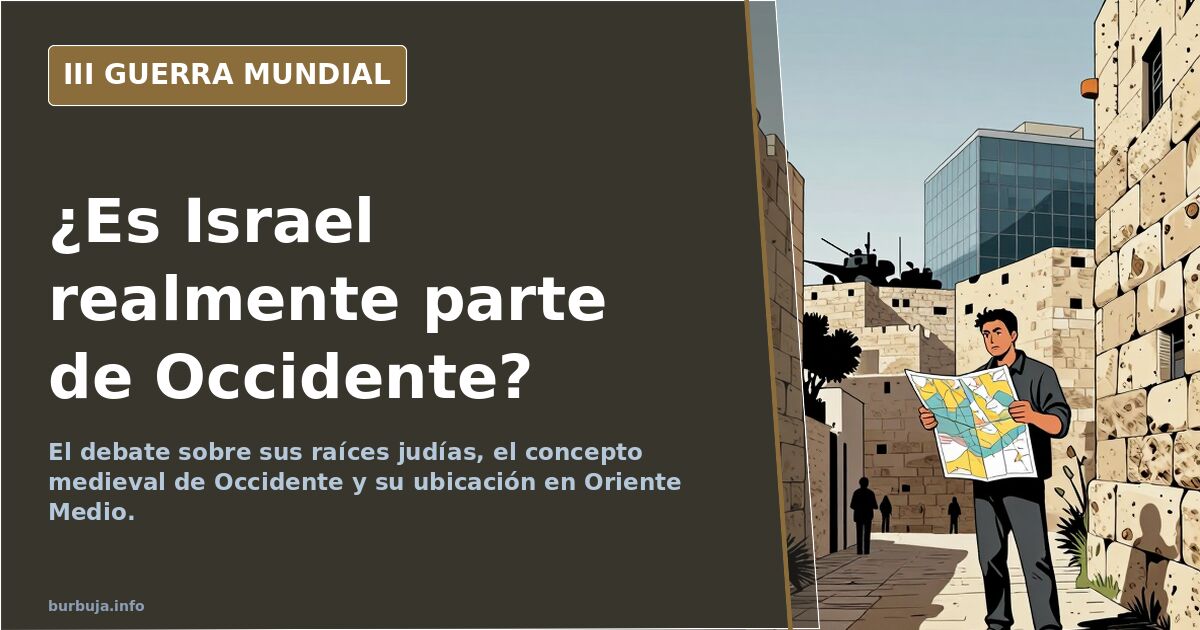
Israel and the West: An Identity in Dispute
The question of whether Israel belongs to the West is not trivial. According to some analysts, half of our culture, derived from Christianity, has Jewish roots, and many Israelis are Jews who emigrated from Europe. Others argue that Judaism is incompatible with Western culture. The debate is on.
Jewish Roots of the West
Some argue that the West is partly a branch of Israel. Western civilization rests on two pillars: Greece and Israel. Oooo-Christian religion, adopted by the Roman Empire in 380 AD, has influenced Europe for 1,500 years. Furthermore, according to one participant, Zionism and the State of Israel were inventions of Ashkenazi Jews from Central Europe, which would not have been possible without the Enlightenment, the French Revolution, and the concept of the modern nation-state. They are, therefore, quite Western.
However, not all Jews are alike. There are differences between Ashkenazim (Germany, Austria, Poland, Ukraine, Russia, Hungary), Sephardim, and Mizrahim (Segarro, Iran, Yemen, Egypt, Tunisia, Libya, Ethiopia). Modern Hebrew is a reconstructed language that no one spoke 90-100 years ago. This raises doubts about a homogeneous identity.
The West as a Medieval Concept
The concept of the West is a creation of the medieval Latin Christendom, opposed to Orthodox Christendom and Sarracin. Luther popularized it in the 16th century. Neither ancient Greeks nor Jews ever considered themselves Westerners. Romans did not either, despite being geographically in the west. The West is, therefore, a later historical construct.
Some maintain that Christianity is not a transformation of Judaism, but a Greco-Roman cult devised among Jews. Christian universalism is foreign to Judaism, which is a religion for Jews. Christianity used Judaism to gain prestige, but then rejected it. It is a rebellious and self-proclaimed child.
Israel: Closer to the Middle East?
For others, Israel is closer to the Middle East than to Europe. Not only due to geography, but also language, religion, and customs. They are more similar to a Segarro than to an Englishman or an Italian. This can be seen on the streets of Tel Aviv. There is a fundamental divide between Semitic and Greco-Roman cultures. Israel is rooted in Semitic origins.
Moreover, some claim that Jews do not integrate into Western societies even when living in them. They remain an isolated group for millennia. It is argued that they are a tribal society where the tribe and clan matter most. George Soros, in a 1995 interview in The New Yorker, stated that Jews had not abandoned these tribal traits, and that this was one cause of antisemitism.
Demographic and Cultural Weight
Some point out that ultra-Orthodox groups in Israel have high birth rates, but are proportionally insignificant. Catholic Kikos average 4.2 children per marriage, Amish 6.8, but compared to the total white population, they are negligible. They do not change the downward trend of the West.
In short, the discussion remains open. Is Israel a Western outpost in the Middle East or a foreign body? The answer depends on what we understand by the West. Isn't the West itself an idea in crisis?
The question of whether Israel belongs to the West is not trivial. According to some analysts, half of our culture, derived from Christianity, has Jewish roots, and many Israelis are Jews who emigrated from Europe. Others argue that Judaism is incompatible with Western culture. The debate is on.
Jewish Roots of the West
Some argue that the West is partly a branch of Israel. Western civilization rests on two pillars: Greece and Israel. Oooo-Christian religion, adopted by the Roman Empire in 380 AD, has influenced Europe for 1,500 years. Furthermore, according to one participant, Zionism and the State of Israel were inventions of Ashkenazi Jews from Central Europe, which would not have been possible without the Enlightenment, the French Revolution, and the concept of the modern nation-state. They are, therefore, quite Western.
However, not all Jews are alike. There are differences between Ashkenazim (Germany, Austria, Poland, Ukraine, Russia, Hungary), Sephardim, and Mizrahim (Segarro, Iran, Yemen, Egypt, Tunisia, Libya, Ethiopia). Modern Hebrew is a reconstructed language that no one spoke 90-100 years ago. This raises doubts about a homogeneous identity.
The West as a Medieval Concept
The concept of the West is a creation of the medieval Latin Christendom, opposed to Orthodox Christendom and Sarracin. Luther popularized it in the 16th century. Neither ancient Greeks nor Jews ever considered themselves Westerners. Romans did not either, despite being geographically in the west. The West is, therefore, a later historical construct.
Some maintain that Christianity is not a transformation of Judaism, but a Greco-Roman cult devised among Jews. Christian universalism is foreign to Judaism, which is a religion for Jews. Christianity used Judaism to gain prestige, but then rejected it. It is a rebellious and self-proclaimed child.
Israel: Closer to the Middle East?
For others, Israel is closer to the Middle East than to Europe. Not only due to geography, but also language, religion, and customs. They are more similar to a Segarro than to an Englishman or an Italian. This can be seen on the streets of Tel Aviv. There is a fundamental divide between Semitic and Greco-Roman cultures. Israel is rooted in Semitic origins.
Moreover, some claim that Jews do not integrate into Western societies even when living in them. They remain an isolated group for millennia. It is argued that they are a tribal society where the tribe and clan matter most. George Soros, in a 1995 interview in The New Yorker, stated that Jews had not abandoned these tribal traits, and that this was one cause of antisemitism.
Demographic and Cultural Weight
Some point out that ultra-Orthodox groups in Israel have high birth rates, but are proportionally insignificant. Catholic Kikos average 4.2 children per marriage, Amish 6.8, but compared to the total white population, they are negligible. They do not change the downward trend of the West.
In short, the discussion remains open. Is Israel a Western outpost in the Middle East or a foreign body? The answer depends on what we understand by the West. Isn't the West itself an idea in crisis?
Also available in: Deutsch
Summary of a discussion on Burbuja.info - Foro de economía, actualidad y política., translated from Spanish and reviewed before publication. Read the full discussion (125 replies).
More summaries
-
Why Israel's Founding Leaders Came From Eastern Europe
Many of Israel's early prime ministers changed their surnames from Eastern European origins. Discover the demographic and historical reasons behind this.
-
Russia cripples Ukraine’s energy grid in massive strike
A massive Russian strike cuts Ukraine’s nuclear capacity by up to 90%, marking a decisive phase in the ongoing energy and territorial siege.
-
US Halts Military Aid to Ukraine, Media Reports
Media report the US has suspended military aid to Ukraine after exhausting its December package. The debate focuses on Europe's financial burden and the geopolitical impact.
-
Unexplained Sphere Spotted Over Manchester Airport
A spherical object appears over Manchester airport tarmac, investigated by a vehicle before shooting upwards. The unverified video circulates widely.
-
China backs Argentina in Falklands dispute at UN
Chinese UN ambassador labels Falklands dispute a colonial legacy, supporting Argentina's sovereignty claim.
-
Israeli drone footage shows killing of four Palestinians in Gaza 'combat zone'
An Israeli drone recorded the death of four Palestinians in Khan Yunis for entering a 'combat zone'. Haaretz describes undefined 'extermination zones' where any approach can be lethal.