
The Isolation of Those Who See Social Collapse in Spain
A narrative on the loneliness of Spaniards who foresee societal collapse but find no support among family or friends.
English · Original discussion in Spanish · Published
The Isolation of Those Who See Social Collapse in Spain
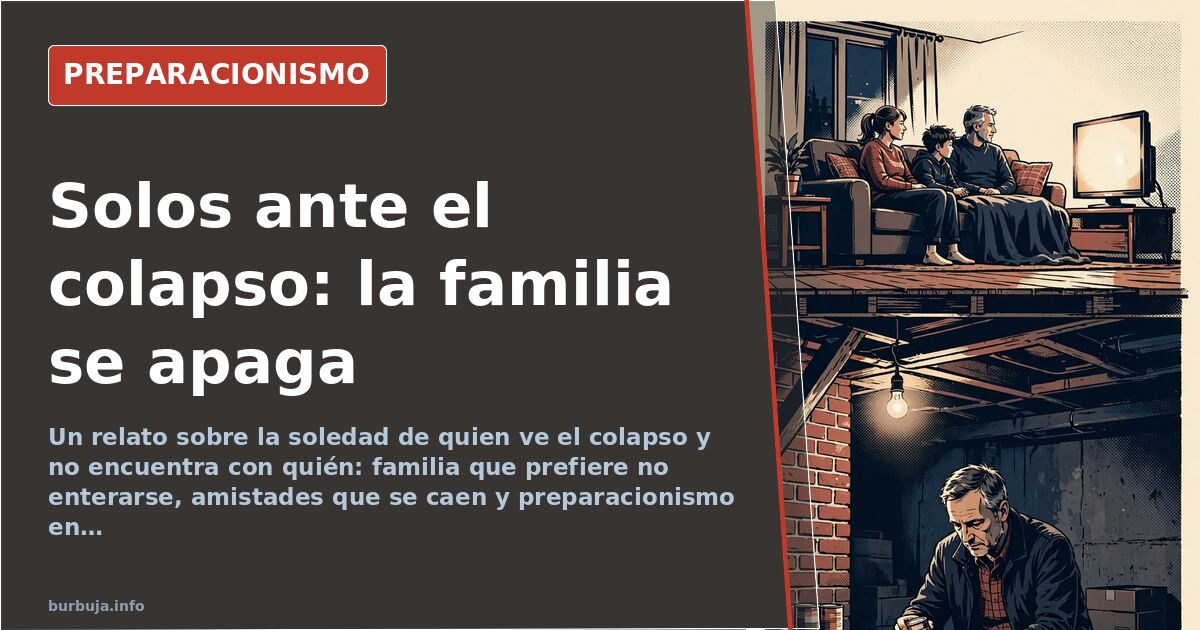
A man recounts a family meal where, upon discussing impending crises in food, transport, and housing, someone said, "I won't worry until it happens; let me enjoy life, I can't do anything anyway." The others nodded in silence. He felt utterly alone. This is the starting point of a 192-response thread that maps contemporary loneliness: that of the prepared, the distrustful, and those who expect nothing from anyone.
Family That Prefers Not to Know
The initial premise isn't an abstract complaint but a domestic scene: a small family, mostly women, where the only response to analysis of deterioration is voluntary disconnection. "I can't do anything," one says. The rest stay silent. The author interprets this as collective surrender: most prefer not to be bitter until the problem knocks at the door.
From there, the diagnosis expands. Friends live "as if there were no tomorrow": parties, substances, eternal adolescent behavior. Finding worthwhile people becomes an exception. An uncomfortable comparison emerges: migrant families with lower incomes retain a sense of community lost here. The envy isn't economic. It's emotional.
Friendships That Break When You Stop Drinking
The conversation quickly fills with concrete cases. One participant shares cutting ties with much of their circle: those who appear only when things go wrong, those competing over possessions, and those inviting someone undergoing anxiety treatment to parties where they cannot drink. Friendship often rests on incompatible life rhythms.
The pattern repeats: relationships work while interests align and break when one changes. Some state bluntly that human relations are based on interest and convenience. Others ask an uncomfortable question: if everything is about money, what happens when you fail?
The Village That No Longer Greets
One of the most cited passages contrasts rural Galicia of childhood with today's cities. Previously, neighbors were an extension of family: helping each other, knowing each other, greeting each other. Today, cars pass by without even saying hello. Economic development brought independence and, with it, indifference.
The recurring explanation is social engineering: a society designed for individualism, where no one needs anyone else, so no one takes responsibility for others. Not a new thesis, but the material grounds it in daily details: pre-cooked meals instead of grandmothers' stews, envy instead of affection. Some argue family has deteriorated since the pandemic.
Preparing Alone or With Others
This occurs in a prepping forum, highlighting central tension. Some advocate finding like-minded people: shooting ranges, retreats, local groups. Others reply existing groups just share news and lament, each doing their own thing. Real preparation, when it comes, is individual or familial.
Proposals emerge to create subforums by community so locals can meet. They don't gain traction. What does gain traction is the warning that being a lone wolf in scarcity scenarios is bad strategy: you need loyal, multidisciplinary groups. Nearly impossible, they concede, but not impossible.
Money as Sole Bond and Family as Refuge
One harsh current argues best company is oneself and whoever can pay. Loneliness, in this view, isn't tragedy but a shield contract. Against this, another insists solution is authentic lifelong family, and children provide meaning nothing else replaces. Some defend having children past 35; others call bringing them into these conditions irresponsible.
Discussion shifts to demographics: system pushes against forming families, and late starters condemn themselves to adolescence in their fifties. Loneliness here isn't just mood. It's economic and demographic variable.
Chosen Solitude vs. Burdensome Loneliness
Not everyone experiences it equally. Someone describes living in village, working alone in mountains, seeing two or three friends monthly, little family contact. Calls it partly chosen solitude: sometimes abyss, sometimes self-discovery. Another confesses feeling unnatural returning home alone after eight or nine PM. Humans aren't made to live alone, though they endure it.
Thread closure offers no solution. Remains sense problem isn't lack of people, but lack of people willing to sustain something without immediate return. With such material, any conclusion would be pretense.
A man recounts a family meal where, upon discussing impending crises in food, transport, and housing, someone said, "I won't worry until it happens; let me enjoy life, I can't do anything anyway." The others nodded in silence. He felt utterly alone. This is the starting point of a 192-response thread that maps contemporary loneliness: that of the prepared, the distrustful, and those who expect nothing from anyone.
Family That Prefers Not to Know
The initial premise isn't an abstract complaint but a domestic scene: a small family, mostly women, where the only response to analysis of deterioration is voluntary disconnection. "I can't do anything," one says. The rest stay silent. The author interprets this as collective surrender: most prefer not to be bitter until the problem knocks at the door.
From there, the diagnosis expands. Friends live "as if there were no tomorrow": parties, substances, eternal adolescent behavior. Finding worthwhile people becomes an exception. An uncomfortable comparison emerges: migrant families with lower incomes retain a sense of community lost here. The envy isn't economic. It's emotional.
Friendships That Break When You Stop Drinking
The conversation quickly fills with concrete cases. One participant shares cutting ties with much of their circle: those who appear only when things go wrong, those competing over possessions, and those inviting someone undergoing anxiety treatment to parties where they cannot drink. Friendship often rests on incompatible life rhythms.
The pattern repeats: relationships work while interests align and break when one changes. Some state bluntly that human relations are based on interest and convenience. Others ask an uncomfortable question: if everything is about money, what happens when you fail?
The Village That No Longer Greets
One of the most cited passages contrasts rural Galicia of childhood with today's cities. Previously, neighbors were an extension of family: helping each other, knowing each other, greeting each other. Today, cars pass by without even saying hello. Economic development brought independence and, with it, indifference.
The recurring explanation is social engineering: a society designed for individualism, where no one needs anyone else, so no one takes responsibility for others. Not a new thesis, but the material grounds it in daily details: pre-cooked meals instead of grandmothers' stews, envy instead of affection. Some argue family has deteriorated since the pandemic.
Preparing Alone or With Others
This occurs in a prepping forum, highlighting central tension. Some advocate finding like-minded people: shooting ranges, retreats, local groups. Others reply existing groups just share news and lament, each doing their own thing. Real preparation, when it comes, is individual or familial.
Proposals emerge to create subforums by community so locals can meet. They don't gain traction. What does gain traction is the warning that being a lone wolf in scarcity scenarios is bad strategy: you need loyal, multidisciplinary groups. Nearly impossible, they concede, but not impossible.
Money as Sole Bond and Family as Refuge
One harsh current argues best company is oneself and whoever can pay. Loneliness, in this view, isn't tragedy but a shield contract. Against this, another insists solution is authentic lifelong family, and children provide meaning nothing else replaces. Some defend having children past 35; others call bringing them into these conditions irresponsible.
Discussion shifts to demographics: system pushes against forming families, and late starters condemn themselves to adolescence in their fifties. Loneliness here isn't just mood. It's economic and demographic variable.
Chosen Solitude vs. Burdensome Loneliness
Not everyone experiences it equally. Someone describes living in village, working alone in mountains, seeing two or three friends monthly, little family contact. Calls it partly chosen solitude: sometimes abyss, sometimes self-discovery. Another confesses feeling unnatural returning home alone after eight or nine PM. Humans aren't made to live alone, though they endure it.
Thread closure offers no solution. Remains sense problem isn't lack of people, but lack of people willing to sustain something without immediate return. With such material, any conclusion would be pretense.
Summary of a discussion on Burbuja.info - Foro de economía, actualidad y política., translated from Spanish and reviewed before publication. Read the full discussion (192 replies).
More summaries
-
Cuba: The Prepper's Collapse Lab
Fuel runs out and hunger spreads in Cuba. The real case for preppers: looting, oxen, and lessons for Europe.
-
The go-to prepper manuals are written for the US
Many top prepper manuals are American, with guns and acre-sized gardens. F. Castillo's is adapted to Spain.
-
World War III conscription: desert, hide or fight?
In a potential World War III scenario, the dilemma is whether to join the front, desert, or hide. This article examines the arguments and precedents cited in this debate.
-
Zuckerberg's Hawaii Bunker: 465 m² for the End Times
Mark Zuckerberg's 465 m² bunker in Hawaii features armored doors and self-sufficiency. Why choose a volcanic Pacific island?
-
Spain's fertility crisis: Half of women won't become mothers
Online forum discusses Tinder, declining birth rates, and reluctance to start families in Spain.
-
From CETME to MG3: Which Firearms Leave a Mark?
While heavy firepower impresses, the .22 LR carbine wins praise. From military CETME rifles to the MG3, see which guns shooters enjoy most.