
Spain hits record 48.3M population driven by foreign-born residents
Spain reaches a historic 48.3 million inhabitants, with 133,092 of the quarter's new residents born abroad.
English · Original discussion in Spanish · Published
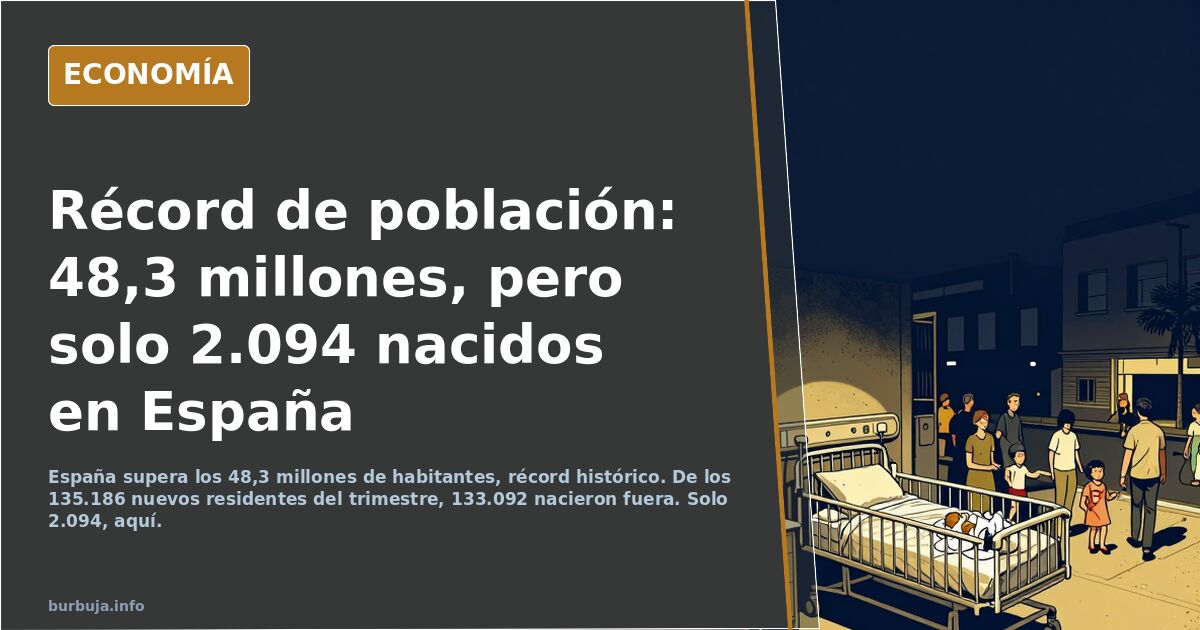
Spain sets population record at 48.3 million, but only 2,094 new residents were born locally
As of July 1, 2023, Spain surpassed 48.3 million inhabitants, marking an all-time high in its historical series, according to provisional data from the INE (National Statistics Institute). This milestone comes with a caveat: of the 135,186 residents added during the second quarter, 133,092 were born outside Spain. Only 2,094 were born within the country. While official statistics report growth, the demographic composition tells a different story.
The data challenging the "demographic winter" narrative
The INE clarifies in its note that the increase was «almost entirely due to the rise in people born abroad». By nationality, foreigners accounted for 100,394 additional people, while Spaniards contributed 34,792. The snapshot shows a country growing in total population even as its native base shrinks. Some argue the correct term is not "demographic winter" but "demographic replacement," noting that the distinction is substantive, not merely semantic. Others contend that without migration, Spain would face outright decline, with depopulated rural areas serving as a preview of what lies ahead.
The debate over terminology is significant. The concept of "demographic winter" was coined to describe sustained low birth rates leading to the aging of the original population. If growth relies solely on arrivals from abroad, the term falls short. This is where the controversy intensifies.
Balearic Islands, Catalonia, and Madrid: where growth concentrates
All autonomous communities, including Ceuta and Melilla, gained population in the second quarter. The largest relative increases occurred in the Balearic Islands (0.58%), Catalonia (0.51%), and Madrid (0.45%). At the other extreme, Extremadura (0.01%), Asturias (0.03%), Ceuta (0.06%), Castilla y León (0.08%), and Galicia (0.09%) saw minimal change. The pattern is familiar: regions with greater economic dynamism and higher housing pressure absorb most of the influx.
This concentration has consequences. In neighborhoods where the flow is noticeable, social dynamics shift. Some describe walking through their cities and counting more foreign-born residents than native Spaniards, with the elderly native population increasingly concentrated in care homes. This is a subjective impression rather than an INE statistic, yet it circulates strongly in local conversations.
The calculation circulating in public discourse: how many fewer Spaniards?
Official statistics do not break down how many native-born Spaniards are lost each quarter, but the natural balance is inferred in forums. A calculation circulating in debates estimates that if those born abroad are excluded, real growth in the native population is virtually zero or negative. The figure of 2,094 new residents born in Spain versus 133,092 born abroad is the data point most frequently cited to support this thesis.
Projections discussed in these circles suggest that by mid-century, births to children of immigrants or naturalized citizens will exceed those of native-born Spaniards. This is not an official prediction but a scenario built on current trends. Political debate hinges on this outlook: whether regulating immigration constitutes far-right extremism or simply flow management.
Clashing frameworks: replacement, substitution, or simple turnover?
At the heart of the issue lies a battle over language. One strand of analysis insists that what is happening is demographic replacement: the original population declines and is substituted by another of different origin. Another rejects this label as alarmist, preferring terms like "turnover" or simply "migration movement." The disagreement cannot be resolved with data because the numbers remain constant for everyone: 48.3 million inhabitants, 135,186 more in one quarter, 133,092 of them born abroad.
The INE does not offer value judgments. It publishes figures and dates. Interpretation is left to the reader. And there, everyone pulls the blanket toward themselves.
What doesn't fit the growth narrative
The population record coexists with a sustained drop in birth rates. Births in Spain have declined for years, and the trend shows no sign of bottoming out. Total population rises only because more people enter than leave or are born. The uncomfortable question is how much of this growth is sustainable without straining housing, services, and the labor market.
Some point out that many recent arrivals work in the informal economy, making their net fiscal contribution debatable. Others respond that without them, there would be no one to pay pensions for an increasingly aging population. The debate remains open and cannot be settled with a single headline about records.
The data is stubborn: Spain has never had so many inhabitants. The fine print reveals that those born here contributed just 2,094 of the 135,186 new residents this quarter. With such proportions, the question isn't whether there is a demographic winter, but who is turning up the heat.
As of July 1, 2023, Spain surpassed 48.3 million inhabitants, marking an all-time high in its historical series, according to provisional data from the INE (National Statistics Institute). This milestone comes with a caveat: of the 135,186 residents added during the second quarter, 133,092 were born outside Spain. Only 2,094 were born within the country. While official statistics report growth, the demographic composition tells a different story.
The data challenging the "demographic winter" narrative
The INE clarifies in its note that the increase was «almost entirely due to the rise in people born abroad». By nationality, foreigners accounted for 100,394 additional people, while Spaniards contributed 34,792. The snapshot shows a country growing in total population even as its native base shrinks. Some argue the correct term is not "demographic winter" but "demographic replacement," noting that the distinction is substantive, not merely semantic. Others contend that without migration, Spain would face outright decline, with depopulated rural areas serving as a preview of what lies ahead.
The debate over terminology is significant. The concept of "demographic winter" was coined to describe sustained low birth rates leading to the aging of the original population. If growth relies solely on arrivals from abroad, the term falls short. This is where the controversy intensifies.
Balearic Islands, Catalonia, and Madrid: where growth concentrates
All autonomous communities, including Ceuta and Melilla, gained population in the second quarter. The largest relative increases occurred in the Balearic Islands (0.58%), Catalonia (0.51%), and Madrid (0.45%). At the other extreme, Extremadura (0.01%), Asturias (0.03%), Ceuta (0.06%), Castilla y León (0.08%), and Galicia (0.09%) saw minimal change. The pattern is familiar: regions with greater economic dynamism and higher housing pressure absorb most of the influx.
This concentration has consequences. In neighborhoods where the flow is noticeable, social dynamics shift. Some describe walking through their cities and counting more foreign-born residents than native Spaniards, with the elderly native population increasingly concentrated in care homes. This is a subjective impression rather than an INE statistic, yet it circulates strongly in local conversations.
The calculation circulating in public discourse: how many fewer Spaniards?
Official statistics do not break down how many native-born Spaniards are lost each quarter, but the natural balance is inferred in forums. A calculation circulating in debates estimates that if those born abroad are excluded, real growth in the native population is virtually zero or negative. The figure of 2,094 new residents born in Spain versus 133,092 born abroad is the data point most frequently cited to support this thesis.
Projections discussed in these circles suggest that by mid-century, births to children of immigrants or naturalized citizens will exceed those of native-born Spaniards. This is not an official prediction but a scenario built on current trends. Political debate hinges on this outlook: whether regulating immigration constitutes far-right extremism or simply flow management.
Clashing frameworks: replacement, substitution, or simple turnover?
At the heart of the issue lies a battle over language. One strand of analysis insists that what is happening is demographic replacement: the original population declines and is substituted by another of different origin. Another rejects this label as alarmist, preferring terms like "turnover" or simply "migration movement." The disagreement cannot be resolved with data because the numbers remain constant for everyone: 48.3 million inhabitants, 135,186 more in one quarter, 133,092 of them born abroad.
The INE does not offer value judgments. It publishes figures and dates. Interpretation is left to the reader. And there, everyone pulls the blanket toward themselves.
What doesn't fit the growth narrative
The population record coexists with a sustained drop in birth rates. Births in Spain have declined for years, and the trend shows no sign of bottoming out. Total population rises only because more people enter than leave or are born. The uncomfortable question is how much of this growth is sustainable without straining housing, services, and the labor market.
Some point out that many recent arrivals work in the informal economy, making their net fiscal contribution debatable. Others respond that without them, there would be no one to pay pensions for an increasingly aging population. The debate remains open and cannot be settled with a single headline about records.
The data is stubborn: Spain has never had so many inhabitants. The fine print reveals that those born here contributed just 2,094 of the 135,186 new residents this quarter. With such proportions, the question isn't whether there is a demographic winter, but who is turning up the heat.
Also available in: Deutsch
Summary of a discussion on Burbuja.info - Foro de economía, actualidad y política., translated from Spanish and reviewed before publication. Read the full discussion (156 replies).
More summaries
-
Basque Country tourism outpaces Castilla y León
Forum debate compares Basque tourism with Castilla y León, citing French border proximity and high prices as key factors.
-
Basque fiscal quota fuels demographic decline, says Cacho
Jesús Cacho argues the Basque fiscal quota transfers €10 billion annually without return while the region faces severe population loss and youth exodus.
-
Taxing single men: a proposal that reopens fiscal debate
Taxing single men over 30 to fund incentives for families with children: the proposal that reopens fiscal debate on birth rates.
-
Abascal Accepts Wild Interview, Challenges Sánchez and Feijóo
Spain's Abascal accepts Jordi Wild's interview invite. Feijóo agrees too, while Sánchez stays silent amid the battle for youth votes.
-
Russian fitness influencer dies at 30 after 10,000-calorie daily diet challenge
Russian trainer Dmitry Nuyanzin passed away at age 30 after consuming 10,000 calories a day to prove his weight loss program's effectiveness.
-
First-person video of Nepal protests sparks debate on rioters' targets
A British tourist's footage of unrest in Nepal suggests protesters targeted only officials and police vehicles rather than local businesses.