
First-person video of Nepal protests sparks debate on rioters' targets
A British tourist's footage of unrest in Nepal suggests protesters targeted only officials and police vehicles rather than local businesses.
English · Original discussion in Spanish · Published
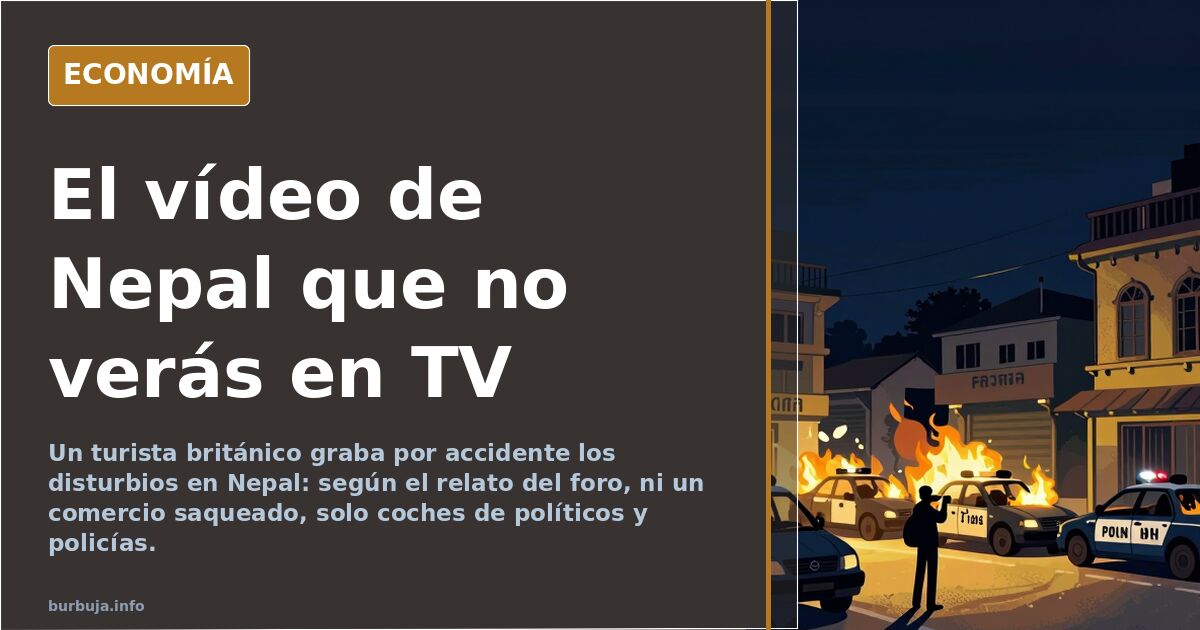
First-person video of Nepal protests sparks debate on rioters' targets
A British tourist accidentally filmed the unrest in Nepal, and the footage has become, according to supporters, the evidence many were waiting for: protesters did not touch a single shop, private vehicle, or storefront. They only targeted cars and motorcycles belonging to politicians and police, as well as government buildings. The most widely shared scene shows a parked motorcycle that remains untouched with its luggage intact after the chaos. For supporters, this detail summarizes their thesis: the people know who the enemy is.
What the Nepal video shows and what was destroyed
The video, recorded by a foreign tourist, moves through the interior of the parliamentary precinct. Burned motorcycles and cars are visible, along with a truck bearing the inscription NEPAL POLICE. The debate centers on a specific point: whether these vehicles belong to ordinary citizens or to public officials and officeholders. The dominant view in the thread is that everything occurred within the walls of the complex, in the outer parking lot, and that not a single act of vandalism against private property was recorded on the street.
There is one nuance that almost no one disputes: a fire truck ended up destroyed. For some, it was an avoidable error; for others, proof that the uprising was not as surgical as portrayed. The anecdote of the untouched motorcycle serves as a counterargument: the tourist leaves the vehicle, returns, and finds it exactly as it was, with the luggage inside.
The parallels with Europe discussed in the conversation
Comparisons with European protests appear repeatedly. The argument is that on the continent, any riot ends with looted shops and burned private vehicles, whereas in Nepal, the targets were exclusively institutional. The conclusion drawn is that it is not about poverty or lack of education, but the ability to identify the adversary.
Against this, a skeptical reading warns of a classic risk: cheering for revolutions without knowing who is behind them. Some also point out that Nepal is a landlocked country between China and India, and that any internal movement in this region has geopolitical implications that transcend street protests.
From monarchy to republic: the forgotten context
To understand the present, it is useful to remember the recent past. Nepal was a monarchy until relatively recently. A crime within the royal family, involving the crown prince, triggered an institutional crisis. An unpopular relative ascended the throne, Maoist guerrillas were activated, a civil war broke out, and the last king was eventually overthrown. A republic was established, and communists came to power. This is the foundation upon which any current revolt rests.
The floating question is whether what is seen in the video is a people united against a political caste or just another piece on a larger chessboard. The answer is not in the video.
The role of police, firefighters, and officials
The conversation shifts toward more uncomfortable ground: the status of public officials. One side maintains that any public employee is part of the state apparatus and will, if necessary, obey orders rather than defend the citizen. Others argue that a volunteer firefighter is not the same as an armed officer, and that grouping them all together is unfair.
An uncomfortable fact emerges: in the year with the most fires in recent decades, firefighters are asking for a pay rise. Several have already died in lithium battery fires. The debate over whether this makes them heroes or union negotiators remains open.
What can be learned from Nepal and what cannot
The broadest consensus is that there is something to emulate: the ability to avoid destroying one's own property. The disagreement is whether this stems from political awareness or simply a lack of opportunity. And the repeated warning: distrust any revolutionary narrative that arrives packaged from the outside.
The cautious prediction is simple: if the Nepali movement takes hold, it will cease to be a curious video and become a problem for someone. If it fails, it will remain nothing more than a tourist anecdote with a camera. There is no way to know yet which of the two is happening.
A British tourist accidentally filmed the unrest in Nepal, and the footage has become, according to supporters, the evidence many were waiting for: protesters did not touch a single shop, private vehicle, or storefront. They only targeted cars and motorcycles belonging to politicians and police, as well as government buildings. The most widely shared scene shows a parked motorcycle that remains untouched with its luggage intact after the chaos. For supporters, this detail summarizes their thesis: the people know who the enemy is.
What the Nepal video shows and what was destroyed
The video, recorded by a foreign tourist, moves through the interior of the parliamentary precinct. Burned motorcycles and cars are visible, along with a truck bearing the inscription NEPAL POLICE. The debate centers on a specific point: whether these vehicles belong to ordinary citizens or to public officials and officeholders. The dominant view in the thread is that everything occurred within the walls of the complex, in the outer parking lot, and that not a single act of vandalism against private property was recorded on the street.
There is one nuance that almost no one disputes: a fire truck ended up destroyed. For some, it was an avoidable error; for others, proof that the uprising was not as surgical as portrayed. The anecdote of the untouched motorcycle serves as a counterargument: the tourist leaves the vehicle, returns, and finds it exactly as it was, with the luggage inside.
The parallels with Europe discussed in the conversation
Comparisons with European protests appear repeatedly. The argument is that on the continent, any riot ends with looted shops and burned private vehicles, whereas in Nepal, the targets were exclusively institutional. The conclusion drawn is that it is not about poverty or lack of education, but the ability to identify the adversary.
Against this, a skeptical reading warns of a classic risk: cheering for revolutions without knowing who is behind them. Some also point out that Nepal is a landlocked country between China and India, and that any internal movement in this region has geopolitical implications that transcend street protests.
From monarchy to republic: the forgotten context
To understand the present, it is useful to remember the recent past. Nepal was a monarchy until relatively recently. A crime within the royal family, involving the crown prince, triggered an institutional crisis. An unpopular relative ascended the throne, Maoist guerrillas were activated, a civil war broke out, and the last king was eventually overthrown. A republic was established, and communists came to power. This is the foundation upon which any current revolt rests.
The floating question is whether what is seen in the video is a people united against a political caste or just another piece on a larger chessboard. The answer is not in the video.
The role of police, firefighters, and officials
The conversation shifts toward more uncomfortable ground: the status of public officials. One side maintains that any public employee is part of the state apparatus and will, if necessary, obey orders rather than defend the citizen. Others argue that a volunteer firefighter is not the same as an armed officer, and that grouping them all together is unfair.
An uncomfortable fact emerges: in the year with the most fires in recent decades, firefighters are asking for a pay rise. Several have already died in lithium battery fires. The debate over whether this makes them heroes or union negotiators remains open.
What can be learned from Nepal and what cannot
The broadest consensus is that there is something to emulate: the ability to avoid destroying one's own property. The disagreement is whether this stems from political awareness or simply a lack of opportunity. And the repeated warning: distrust any revolutionary narrative that arrives packaged from the outside.
The cautious prediction is simple: if the Nepali movement takes hold, it will cease to be a curious video and become a problem for someone. If it fails, it will remain nothing more than a tourist anecdote with a camera. There is no way to know yet which of the two is happening.
Also available in: Deutsch
Summary of a discussion on Burbuja.info - Foro de economía, actualidad y política., translated from Spanish and reviewed before publication. Read the full discussion (101 replies).
More summaries
-
Russia and China back Iran with silent proxy war strategy
Russia and China avoid direct combat in Iran but supply tech, intel, and missiles. Diplomatic silence serves as a strategic attrition tactic against the US.
-
Russia and China: Rightward Shift Suspected as Tactical Maneuver
Russia's 12% income tax and China's reforms respecting Mao fuel the theory that Moscow and Beijing's right turn is tactical, not ideological.
-
Red-flag march through Madrid returns to Puerta del Sol
A march with red flags through Madrid returns to Puerta del Sol amid debate over who is behind it
-
Two official Audi A6 cars remain unsold in A Coruña for years
Two 2008 official Audi A6 are still unsold in A Coruña: the auction asks €10,000 while the market pays between €5,000 and €8,000. The administrative table…
-
Frozen wages and housing: the private sector pay debate in Spain
Two decades of frozen salaries, absorbed collective bargaining raises and housing eating up pay: the diagnosis of private employment in Spain.
-
Analyst once known for censorship projects 169 seats for the right
A controversial analyst uses CIS microdata to project 169 seats for the right-wing bloc in Spain, though the D'Hondt method complicates the outcome.