
Russian fitness influencer dies at 30 after 10,000-calorie daily diet challenge
Russian trainer Dmitry Nuyanzin passed away at age 30 after consuming 10,000 calories a day to prove his weight loss program's effectiveness.
English · Original discussion in Spanish · Published
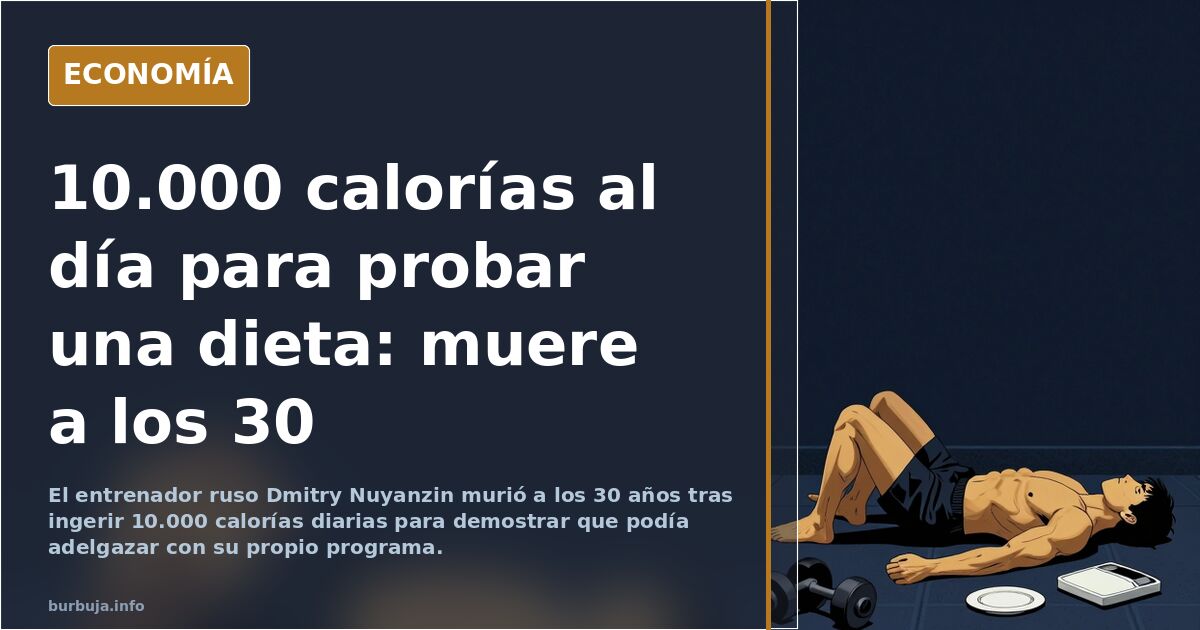
Consuming 10,000 calories a day to prove weight loss: death at age 30
Can eating too much kill you? Russian trainer and content creator Dmitry Nuyanzin, a graduate of the Orenburg Olympic Reserve School and the Saint Petersburg National University of Fitness, set out to gain 25 kilograms to demonstrate how quickly he could lose them using his own program. He was consuming around 10,000 calories daily, consisting of pastries, dumplings with mayonnaise, pizzas, burgers, and fries. In one month, he gained 13 kilograms, and by mid-November, he exceeded 100 kilograms. His heart failed while he was sleeping. He was 30 years old.
The news, published by Antena 3 citing Daily Mail and the Russian channel Ostorozhno Novosti, has peine the debate regarding extreme rapid weight change challenges. It has sparked a wave of reactions ranging from dark humor to reasonable doubt about the actual cause of death.
The details of the challenge and the cause of death
Nuyanzin himself set the rules: he would give 10,000 rubles (about 110 euros) to anyone weighing over 100 kilograms who managed to lose 10% of their body weight by New Year's Eve. "I'm going to lose weight alongside my trinc, so this will be twice as exciting!" he wrote. He documented the process on social media: breakfasts of cakes, lunches of dumplings covered in mayonnaise, and dinners of fast food.
During the final days of his weight gain, he began to feel unwell, suspended his training, and told his trinc he would see a doctor. He never trinc through. Initial medical reports point to cardiac arrest while sleeping, possibly due to the extreme strain placed on his heart. Three days later, he was buried in Orenburg.
A heart unable to cope: the most common explanation
The most widely circulated hypothesis is mechanical: a heart that functions well in a 75-kilogram body suddenly has to move 100 kilograms within a month, all while being loaded with fats that clog the veins. The effort is brutal and lacks any adaptation time. People who weigh over 100 kilograms usually reach that weight after years of poor habits; attempting to emulate it in months is something else entirely.
Some add the glycemic factor: burgers, ultra-processed cakes, pastries, and sugary sodas cause glucose to spike. Death during sleep is consistent with severe hyperglycemia. Unmanaged hypertension, which often shows no symptoms, is also being suggested.
"It's hard to believe he died just from gaining 13 kilos"
Skeptics are not buying the narrative. They argue that gaining 13 kilograms does not kill anyone; there must have been underlying coronary pathology, drugs, gym steroids, or simple coincidence. Some recall that these types of challenges were performed over a decade ago without fatal outcomes, warning that the news is prone to sensationalism.
On the opposing side, the argument for a causal link is direct: if he hadn't done the challenge, he would still be alive. Moving from a normal diet to 10,000 calories is like suddenly starting to run marathons. The body is not prepared. And as the old saying goes, heavy meals can lead to heavy consequences.
The attention economy and the lack of nutrition education
Beyond this specific case, the episode leaves us with two ideas. The first is that social media rewards excess: dying while doing what you love most to grab attention is a cruel but accurate summary. The second is that no one taught us how to eat. It is one of the truly essential things missing from education, and exercise alone achieves little weight loss: almost everything is diet.
An uncomfortable question remains. How many people who watched the challenge have actually taken action regarding their own weight? Some probably have. The method, certainly, has proven to end cravings forever. And the deceased will definitely not be gaining any more kilos.
Can eating too much kill you? Russian trainer and content creator Dmitry Nuyanzin, a graduate of the Orenburg Olympic Reserve School and the Saint Petersburg National University of Fitness, set out to gain 25 kilograms to demonstrate how quickly he could lose them using his own program. He was consuming around 10,000 calories daily, consisting of pastries, dumplings with mayonnaise, pizzas, burgers, and fries. In one month, he gained 13 kilograms, and by mid-November, he exceeded 100 kilograms. His heart failed while he was sleeping. He was 30 years old.
The news, published by Antena 3 citing Daily Mail and the Russian channel Ostorozhno Novosti, has peine the debate regarding extreme rapid weight change challenges. It has sparked a wave of reactions ranging from dark humor to reasonable doubt about the actual cause of death.
The details of the challenge and the cause of death
Nuyanzin himself set the rules: he would give 10,000 rubles (about 110 euros) to anyone weighing over 100 kilograms who managed to lose 10% of their body weight by New Year's Eve. "I'm going to lose weight alongside my trinc, so this will be twice as exciting!" he wrote. He documented the process on social media: breakfasts of cakes, lunches of dumplings covered in mayonnaise, and dinners of fast food.
During the final days of his weight gain, he began to feel unwell, suspended his training, and told his trinc he would see a doctor. He never trinc through. Initial medical reports point to cardiac arrest while sleeping, possibly due to the extreme strain placed on his heart. Three days later, he was buried in Orenburg.
A heart unable to cope: the most common explanation
The most widely circulated hypothesis is mechanical: a heart that functions well in a 75-kilogram body suddenly has to move 100 kilograms within a month, all while being loaded with fats that clog the veins. The effort is brutal and lacks any adaptation time. People who weigh over 100 kilograms usually reach that weight after years of poor habits; attempting to emulate it in months is something else entirely.
Some add the glycemic factor: burgers, ultra-processed cakes, pastries, and sugary sodas cause glucose to spike. Death during sleep is consistent with severe hyperglycemia. Unmanaged hypertension, which often shows no symptoms, is also being suggested.
"It's hard to believe he died just from gaining 13 kilos"
Skeptics are not buying the narrative. They argue that gaining 13 kilograms does not kill anyone; there must have been underlying coronary pathology, drugs, gym steroids, or simple coincidence. Some recall that these types of challenges were performed over a decade ago without fatal outcomes, warning that the news is prone to sensationalism.
On the opposing side, the argument for a causal link is direct: if he hadn't done the challenge, he would still be alive. Moving from a normal diet to 10,000 calories is like suddenly starting to run marathons. The body is not prepared. And as the old saying goes, heavy meals can lead to heavy consequences.
The attention economy and the lack of nutrition education
Beyond this specific case, the episode leaves us with two ideas. The first is that social media rewards excess: dying while doing what you love most to grab attention is a cruel but accurate summary. The second is that no one taught us how to eat. It is one of the truly essential things missing from education, and exercise alone achieves little weight loss: almost everything is diet.
An uncomfortable question remains. How many people who watched the challenge have actually taken action regarding their own weight? Some probably have. The method, certainly, has proven to end cravings forever. And the deceased will definitely not be gaining any more kilos.
Also available in: Deutsch
Summary of a discussion on Burbuja.info - Foro de economía, actualidad y política., translated from Spanish and reviewed before publication. Read the full discussion (101 replies).
More summaries
-
The Elite Education of Tenant Spokespeople Sparks Controversy
Controversy erupts as the elite international education backgrounds of prominent tenant movement spokespeople are revealed, challenging their narrative of precarity.
-
South American Immigration and the Redefinition of Basque Identity
Analysis of how South American and other immigrant groups are reshaping Basque identity amidst intense political polarization in Spain.
-
Young Man Fired for Mocking Puerta del Sol Protesters
A young man was fired after a viral video mocked Puerta del Sol protesters as lazy. The case sparks debate on fair dismissal and free speech in Spain.
-
Civil baptism sparks debate over secular replacement rituals
The civil baptism mimics religious sacraments by having public officials read children's rights, fueling a debate on the purpose of secular ceremonies.
-
From Queen to Bad Bunny: How music reflects cultural decline
Popular music has shifted from requiring prodigious vocals to rewarding autotune as the record industry prioritizes algorithms over talent.
-
Rising food prices in Spain: eggs at €3.70 and chicken at €5/kg
As grocery prices soar, with eggs reaching €3.70 and chicken hitting €5/kg, Spanish consumers report a significant drop in purchasing power.