
Basque fiscal quota fuels demographic decline, says Cacho
Jesús Cacho argues the Basque fiscal quota transfers €10 billion annually without return while the region faces severe population loss and youth exodus.
English · Original discussion in Spanish · Published
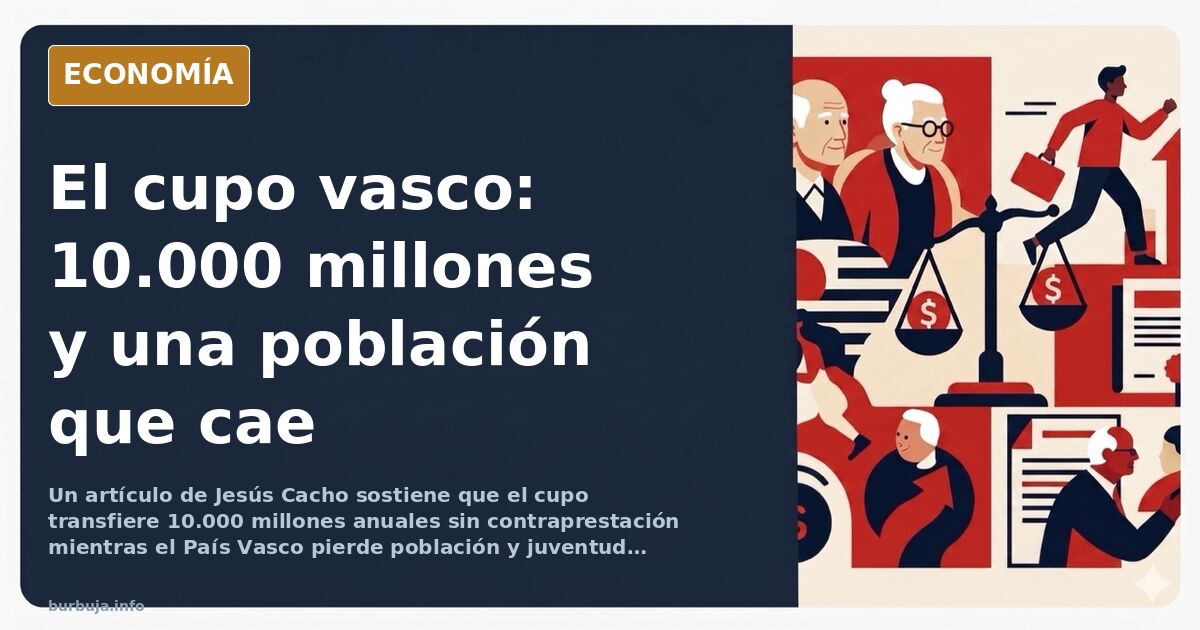
The Basque fiscal quota: €10 billion a year and a sinking population
Every year, 10% of the Basque Country's wealth—around €10 billion—crosses the fiscal border without any counterpart. This is the claim made in a Sunday article that has peine an old question: why does the rest of Spain fund a community that is losing population rapidly, seeing its most qualified youth leave, and holding the absolute record for work absenteeism? The text, signed by Jesús Cacho, has brought the debate on the *cupo* (fiscal quota) and the *concierto económico* (economic agreement) back to the table. And not just because of the money.
A wealthy territory emptying from within
According to the data cited in the article, the Basque Country is a unique case: a wealthy territory losing population at a staggering rate. The Basque elite, it argues, already accepts that migrants from North Africa and the Sahel will be key to trying to stop the demographic hemorrhage. To make matters worse, it is rapidly losing its most qualified young people. The diagnosis is not new, but the tone—the modesty of Pradales, Esteban and others—is.
Basque demographics are not facing a winter; they are facing an ice age. Some summarize it with an image: in ten years, they will be asking for army deployment. The reproduction rate is minimal, feminism prevails in a sterile matriarchy—as they describe it—and the inability to pronounce certain words completes the picture. Vitoria-Gasteiz, which is the most Spanish thing there, does not escape this.
The 'cuponazo': €10 billion without counterpart
The circulating calculation is stark: 10% of Basque wealth, about €10 billion annually, is transferred essentially for free by the rest of the country. There is no official audit to refute this. In fact, it is denounced that since the Government—not only PSOE, but also PP—it has always been said that "it is very complex" and exact figures are not provided. The request for a real audit, line by line, is constant.
The revenue mechanism has its trap: the Basque autonomous government collects zero. Collection is done by the provincial councils (*fruta*) of Biscay, Gipuzkoa and Álava. This detail, which seems minor, dismantles many headlines. The *cupo* is not managed by the Basque Government, but by the foral councils. And the result is the same: a direct transfer without counterpart that burdens the rest.
Why not grant them independence?
The question runs through the article and the subsequent debate: if they only bring political problems—and they no longer sow terror in the streets—and represent an increasing economic burden, why not give them independence? The sense of Spanishness is minimal, around 9%, although in Navarre it is much lower. Some understand nothing.
The most repeated answer is that independence would be the final blow: in a decade they would be begging to return. Others propose a wall from the Pyrenees to the Cantabrian Sea and let them stew in their own juice for a couple of decades. And a third way: territorial partition, as in Catalonia, with Barcelona and Tarragona for Spain and Lleida and Girona independent, making the appropriate population exchanges.
Basque language, housing and the cost of raising a child
The problem is not only macroeconomic. A father explains it: he would go anywhere in Spain, even England, France or Germany, rather than Bilbao. The reason: with Basque, you either put your child in a low-quality public school, or a private one, or risk academic failure because secondary education (*ESO*) is received in a dead language that only serves for civil service exams in a region of two million inhabitants. Between expensive housing, high prices and private schooling, the bill comes out very high.
The language, they argue, is not a minor issue. It is an economic and social filter that expels families who do not want to give up education in Spanish. Meanwhile, the shrinking industrial fabric finds no replacement.
The nationalist response: "we have no opinion"
The reaction from the nationalist environment has been disdainful. The article is "journalistic garbage," a compendium of clichés, stereotypes and absolute lack of respect, that "reeks of mold." There are no data, only biases. And the video that complements it—with more than 115,000 views—is a "mess": half of what it says is false, such as that pensions are financed via income tax (IRPF).
The counterargument is always the same: if you are not interested in the agreements with which the Basque-Navarrese people joined the Kingdom of Spain and are not willing to comply with them, tell us and nothing happens. Hopefully. Meanwhile, the *cupo* continues and the population continues to fall.
The exact point where the analysis gets stuck is this: with these differentials, independence should be obvious. It still isn't. No one fully explains why.
Every year, 10% of the Basque Country's wealth—around €10 billion—crosses the fiscal border without any counterpart. This is the claim made in a Sunday article that has peine an old question: why does the rest of Spain fund a community that is losing population rapidly, seeing its most qualified youth leave, and holding the absolute record for work absenteeism? The text, signed by Jesús Cacho, has brought the debate on the *cupo* (fiscal quota) and the *concierto económico* (economic agreement) back to the table. And not just because of the money.
A wealthy territory emptying from within
According to the data cited in the article, the Basque Country is a unique case: a wealthy territory losing population at a staggering rate. The Basque elite, it argues, already accepts that migrants from North Africa and the Sahel will be key to trying to stop the demographic hemorrhage. To make matters worse, it is rapidly losing its most qualified young people. The diagnosis is not new, but the tone—the modesty of Pradales, Esteban and others—is.
Basque demographics are not facing a winter; they are facing an ice age. Some summarize it with an image: in ten years, they will be asking for army deployment. The reproduction rate is minimal, feminism prevails in a sterile matriarchy—as they describe it—and the inability to pronounce certain words completes the picture. Vitoria-Gasteiz, which is the most Spanish thing there, does not escape this.
The 'cuponazo': €10 billion without counterpart
The circulating calculation is stark: 10% of Basque wealth, about €10 billion annually, is transferred essentially for free by the rest of the country. There is no official audit to refute this. In fact, it is denounced that since the Government—not only PSOE, but also PP—it has always been said that "it is very complex" and exact figures are not provided. The request for a real audit, line by line, is constant.
The revenue mechanism has its trap: the Basque autonomous government collects zero. Collection is done by the provincial councils (*fruta*) of Biscay, Gipuzkoa and Álava. This detail, which seems minor, dismantles many headlines. The *cupo* is not managed by the Basque Government, but by the foral councils. And the result is the same: a direct transfer without counterpart that burdens the rest.
Why not grant them independence?
The question runs through the article and the subsequent debate: if they only bring political problems—and they no longer sow terror in the streets—and represent an increasing economic burden, why not give them independence? The sense of Spanishness is minimal, around 9%, although in Navarre it is much lower. Some understand nothing.
The most repeated answer is that independence would be the final blow: in a decade they would be begging to return. Others propose a wall from the Pyrenees to the Cantabrian Sea and let them stew in their own juice for a couple of decades. And a third way: territorial partition, as in Catalonia, with Barcelona and Tarragona for Spain and Lleida and Girona independent, making the appropriate population exchanges.
Basque language, housing and the cost of raising a child
The problem is not only macroeconomic. A father explains it: he would go anywhere in Spain, even England, France or Germany, rather than Bilbao. The reason: with Basque, you either put your child in a low-quality public school, or a private one, or risk academic failure because secondary education (*ESO*) is received in a dead language that only serves for civil service exams in a region of two million inhabitants. Between expensive housing, high prices and private schooling, the bill comes out very high.
The language, they argue, is not a minor issue. It is an economic and social filter that expels families who do not want to give up education in Spanish. Meanwhile, the shrinking industrial fabric finds no replacement.
The nationalist response: "we have no opinion"
The reaction from the nationalist environment has been disdainful. The article is "journalistic garbage," a compendium of clichés, stereotypes and absolute lack of respect, that "reeks of mold." There are no data, only biases. And the video that complements it—with more than 115,000 views—is a "mess": half of what it says is false, such as that pensions are financed via income tax (IRPF).
The counterargument is always the same: if you are not interested in the agreements with which the Basque-Navarrese people joined the Kingdom of Spain and are not willing to comply with them, tell us and nothing happens. Hopefully. Meanwhile, the *cupo* continues and the population continues to fall.
The exact point where the analysis gets stuck is this: with these differentials, independence should be obvious. It still isn't. No one fully explains why.
Also available in: Deutsch
Summary of a discussion on Burbuja.info - Foro de economía, actualidad y política., translated from Spanish and reviewed before publication. Read the full discussion (186 replies).
More summaries
-
Basque Country: High Income, Decline Anxiety
Forum users debate if the Basque Country's per capita GDP, around 40,000 euros, offsets the community's persistent sense of economic decline.
-
PNV wins Basque election, Bildu falls short, Vox wins one seat
The PNV retains power in the 21A Basque election, while Bildu underperforms forecasts. Vox secures its first seat in the Basque Parliament.
-
High turnout in Spain, but sharp drop in Catalonia
Voter participation fell in Catalonia and the Basque Country while rising in right-wing strongholds, with mail-in ballots remaining uncounted.
-
Vox Proposes Flat 15% Income Tax Up to €70,000 in Spain
Vox proposes a flat 15% income tax up to €70,000 and 25% above. Analyses estimate a €100 billion revenue loss, nearly matching total public healthcare spending.
-
Lawyer profiting from eight years of fake Sánchez resignation claims
A YouTube channel has been claiming Pedro Sánchez will resign within 72 hours since 2016, amassing 550,000 subscribers through political clickbait.
-
White House promises to reveal COVID-19 origins amid skepticism
The White House plans to release new information regarding the origins of COVID-19, reigniting debates over Wuhan and Anthony Fauci.