
Spain hikes diesel tax by 11.33 cents via decree
Diesel prices rise 11.33 cents per liter under a new decree, effective April 1, with professional fuel exempt.
English · Original discussion in Spanish · Published
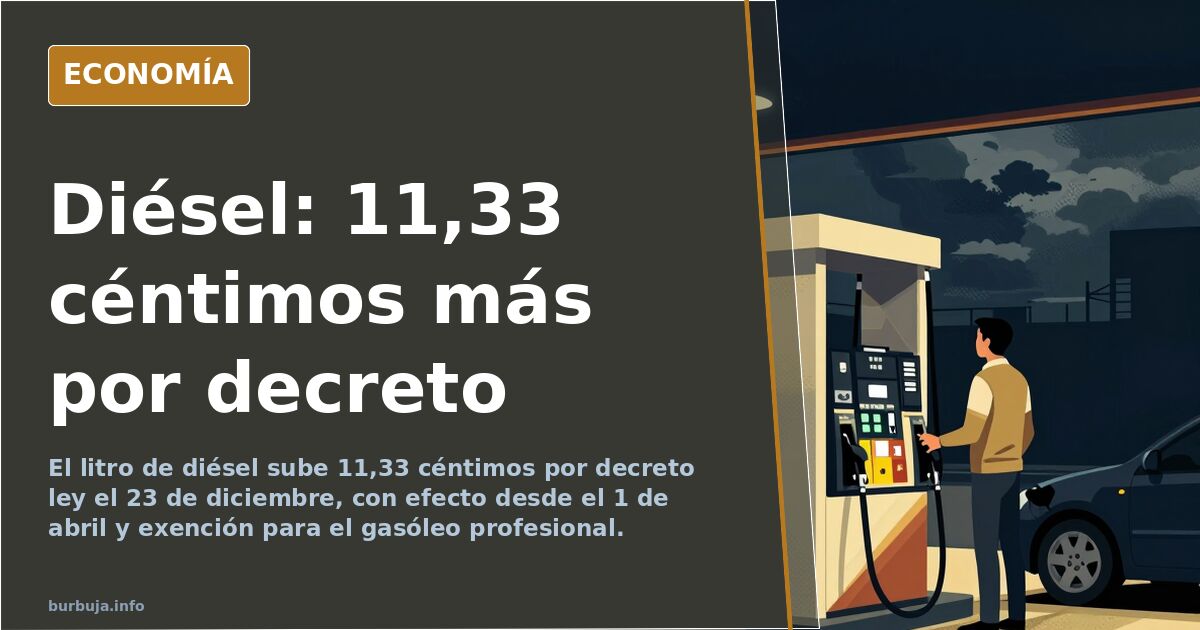
Spanish Treasury raises diesel tax by 11.33 cents via decree law
Diesel will cost 11.33 cents more per liter starting April 1. The Spanish Treasury (Hacienda) will approve the measure through a decree law on December 23, according to La Vanguardia. The text excludes professional diesel, a distinction that theoretically separates hauliers from commuters filling up their tanks. The stated goal is to penalize diesel use and achieve "moderation of greenhouse gas emissions."
The hike does not come alone. It is the latest squeeze on a fuel that has already seen half a dozen price increases in the last six years, as noted in public debate. And it arrives via a route that bypasses ordinary parliamentary procedure: the decree law. A previous attempt failed in the Senate because it was tied to other measures; now it is revived separately, with sufficient majority support to pass.
What exactly does the diesel tax hike target?
The tax applies to the liter, not to the vehicle or the taxpayer. Anyone refueling automotive diesel pays the 11.33 cents; anyone refueling professional diesel does not. This administrative boundary generates the most controversy, as it leaves out transporters but includes anyone using a car for work commutes.
The official argument is environmental. The counterargument circulating in debates is technical: modern diesel engines emit less CO2 than their gasoline equivalents. If the real problem is particulates and nitrogen oxides, a per-liter tax does not distinguish between an engine with a particle filter and one without. It taxes the fuel, not the emission.
Particle filters and the aging vehicle fleet
For years, diesels have incorporated particle filters that accumulate and burn off residues. Cars without such filters are now a minority, and those emitting the most smoke are typically vehicles pre-2010 or urban fleets with minimal maintenance. The ITV (vehicle inspection test) should be the real filter, raising doubts about how some vehicles belching black smoke at traffic lights pass inspection.
The vehicle fleet does not renew itself by decree. A twenty-year-old car worth €1,000 is not replaced just because the liter rises eleven cents; it is replaced when there is money to do so. Meanwhile, those who cannot afford a new car pay the increase, and those who can also pay, but it hurts them less.
Low-emission zones: the map differs in cities versus towns
Traffic restrictions concentrate where population and traffic concentrate. In rural areas, there are no jams and fewer people. The problem arises when a worker lives in a village and works in an industrial estate served by one bus a day, or none. There, the car is not a luxury: it is the only way to get there.
Some argue that public transport covers more than it seems, especially in metropolitan areas. Against this weighs the fact that much industrial and primary sector production occurs far from urban centers, and that work also consumes diesel. Low-emission zones (ZBE) are designed in the city, but the economy supporting them starts in the countryside.
Who pays for the energy transition?
Official discourse presents the hike as a step toward decarbonization. The practical effect is that the cost of this transition falls on private vehicle users, while professional transport remains exempt. This is not criticism of the measure for being green, but of who gets the bill.
The conversation quickly shifts to public spending. If taxes rise, the reasonable question is what they fund. The answer given on the street is rarely "health and education," but a list of programs and structures whose utility is debated. This is the terrain where the diesel price hike stops being a fiscal measure and becomes a political issue.
European precedent: Belgium and Switzerland did it first
In Belgium, diesel is more expensive than gasoline, and in Switzerland, it exceeds two euros per liter at many stations. The reference serves two purposes: it shows the measure is possible and that it is not a Spanish exception. It also reminds us that the Treasury does not set fuel prices alone; crude oil, refining, margins, and taxes do, in varying order.
The eleven-cent increase will add to an already high price. Diesel at €1.70 per liter becomes, with the new tax bracket, a number nobody wants to calculate mentally. And the full calculation, breaking down taxes, refining, and distribution line by line, reveals a difference that surprises those who only look at the pump.
What might happen after April 1?
The decree law is approved on December 23 and takes effect on April 1. Between these dates, there is room for the text to change, fall, or be negotiated. Recent experience suggests that fuel tax measures tend to stick, and exemptions tend to expand when affected sectors push back.
If the pattern repeats, the diesel hike will be trinc by a gasoline increase to maintain revenue neutrality, and then a tax on electric cars due to their weight. There is no technical reason for this sequence; there is a fiscal reason. Meanwhile, taxpayers who need a car for work will continue paying for everyone else's transition.
Also available in: Deutsch
Summary of a discussion on Burbuja.info - Foro de economía, actualidad y política., translated from Spanish and reviewed before publication. Read the full discussion (181 replies).
More summaries
-
Madrid Court Cancels Low Emission Zones Due to Flawed Economic Report
The TSJM cancels Madrid’s Low Emission Zones, striking down Centro and Plaza Elíptica due to an insufficient economic impact assessment. The ruling is subject to appeal before the Supreme Court.
-
UK's Low Emission Zones Hit by Mass Non-Payment of Fines Amid Camera Failures
Tens of thousands of fines for London's ULEZ remain unpaid as cameras are reportedly out of service, highlighting logistical and judicial challenges.
-
Low Emission Zones (ZBE) in Autumn: 'B' Stickers Lose Value, 'Eco' Hybrids Gain
Spanish Low Emission Zones (ZBE) are delayed until autumn. 'B' stickers become less valuable, while 'Eco' hybrid cars gain traction.
-
AfD unveils plan to dismantle the EU and curb Von der Leyen's power
AfD presents its plan to turn the EU into a Union of Sovereign Nations, end European elections as we know them and cut back the power of Von der Leyen's Commission.
-
Fabian socialism: the gradual path that shaped Wells and Orwell
The Fabian Society was founded in 1884 as a breakaway from a utopian group and went on to create the Labour Party. Its coat of arms features a wolf in sheep's clothing.
-
The AI hoax claiming God is being built and we're trapped inside it
An unproven message claims an elite is using AI to build a simulated reality. The conversation drifts toward Sumerians, the Antichrist and distrust of financial power.