
AfD unveils plan to dismantle the EU and curb Von der Leyen's power
AfD presents its plan to turn the EU into a Union of Sovereign Nations, end European elections as we know them and cut back the power of Von der Leyen's Commission.
English · Original discussion in Spanish · Published
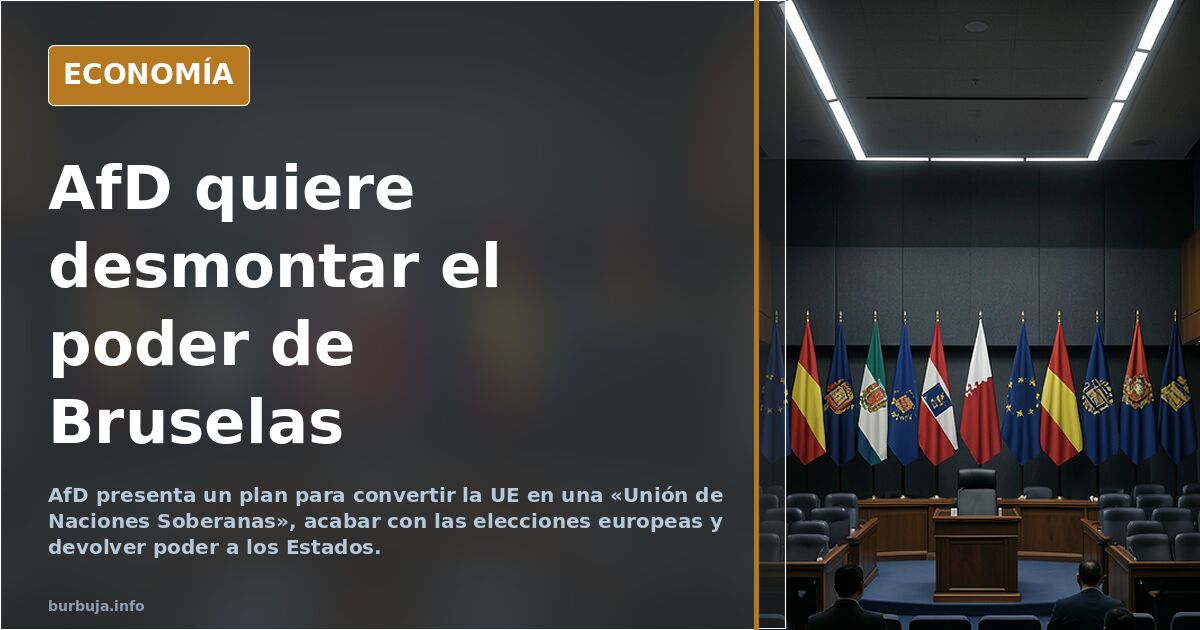
AfD proposes emptying Brussels and returning power to the states
A document titled "Our new deal for Europe" proposes turning the European Union into a "Union of Sovereign Nations". The proposal from Alternative for Germany (AfD) includes ending European elections as we know them and curbing the power of the Commission led by Ursula von der Leyen. The announcement has peine the debate over whether the party seeks to reform the EU or blow it up from within.
What exactly does the AfD plan propose?
The text, circulated on social media, points to a radical reorganisation: less bureaucracy in Brussels, more powers for national parliaments and an institutional architecture that would no longer hold "superiority" over national courts. The proposal does not yet detail the legal mechanism to carry out this upheaval, and that is where scepticism begins. Some see the plan as mere window dressing: "It seems to change the EU's legal form to leave everything as it is," notes one comment, which points out that the party was founded demanding an exit from the euro and has now given that up.
The German far right's pragmatic turn
The most striking point is the renunciation of leaving the single currency. For a party that built part of its narrative on exiting the euro, the shift is remarkable. The prevailing reading in the conversation is that Germany gains nothing from leaving the euro at this point, and that the real goal is to renegotiate the framework without breaking it. It is the leopard-changing-spots thesis: change something so that nothing changes. The same suspicion extends to other European figures, such as Meloni or Le Pen, accused of moderating as soon as they smell power.
Von der Leyen in the crosshairs
The plan comes at a delicate moment for the Commission president. EU courts have recently ruled against Von der Leyen for concealing text messages with Pfizer CEO Albert Bourla during vaccine negotiations. The EU General Court annulled the Commission's decision to deny access to those SMS messages. The case, driven by a New York Times journalist, does not question vaccination policy, but it does question transparency. That open flank fuels the political offensive against Brussels.
The suspicion of controlled dissent
Not everyone buys the narrative that AfD is a real threat to the system. One current of opinion holds that the party is part of the game: "AfD is the system and will continue with Agenda 2030," claims one comment that labels it globalist. The presence of a lesbian leader married to a foreign woman, or the creation of an association of German Jews affiliated with the party, are used in the conversation as proof that there is no real rupture. It is the controlled-dissent thesis, common on the fringes of public debate.
Who wins if the EU breaks apart
Geopolitics comes fully into play. Some argue that the destruction of the Union benefits the United States and Russia alike, and that Moscow was comfortable with European fragmentation until the war in Ukraine. On the other side, the thesis that a neutral, horizontal Europe, free of the current bureaucratic ballast, could offer a currency to compete with the dollar. Time will tell whether AfD is the instrument to dismantle that "leviathan" or just another piece of its upkeep.
The unsettling detail: the party that promised to leave the euro now promises to reform it. Consistency, in politics, is a scarce commodity.
Also available in: Deutsch
Summary of a discussion on Burbuja.info - Foro de economía, actualidad y política., translated from Spanish and reviewed before publication. Read the full discussion (42 replies).
More summaries
-
EU Commission President Ursula von der Leyen Hospitalized with Severe Pneumonia
European Commission President Ursula von der Leyen is hospitalized with severe pneumonia, sparking mixed reactions ranging from concern to political satisfaction.
-
European Commission demands Spain raise bar VAT to 21%
The European Commission proposes raising hospitality VAT in Spain from 10% to 21%, with an estimated €7 billion in revenue. Is cheap café culture coming to an end?
-
European Commission cuts AC for staff but not for commissioners
The European Commission switched off air conditioning on floors 1 to 7 of the Berlaymont building but kept cooling running on the floors of Von der Leyen and the commissioners.
-
Walmart retires employee with flowers after 44 years
Gayle retired from Walmart after 44 years with a flower bouquet. The gesture reignites debate on workplace recognition and pension plans.
-
Spanish productivity up 30% since 2008, but wages stay frozen: where's the surplus going?
Spain's productivity has grown since 2008 but wages only rose 10%: 8% of GDP goes to shareholders and rentiers. An analysis.
-
Madrid's Casa de Campo littered with used condoms from cruisers
Casa de Campo in Madrid: the financial cost of dirty cruising. The City Council runs a daily clean-up operation for condoms while the waste tax rises.