
Spain has no Krugerrand: why the FNMT ignores bullion coins
Spain's FNMT sells commemorative coins with markups that can double the metal's value, while other countries issue low-premium bullion coins. The Spanish anomaly explained.
English · Original discussion in Spanish · Published
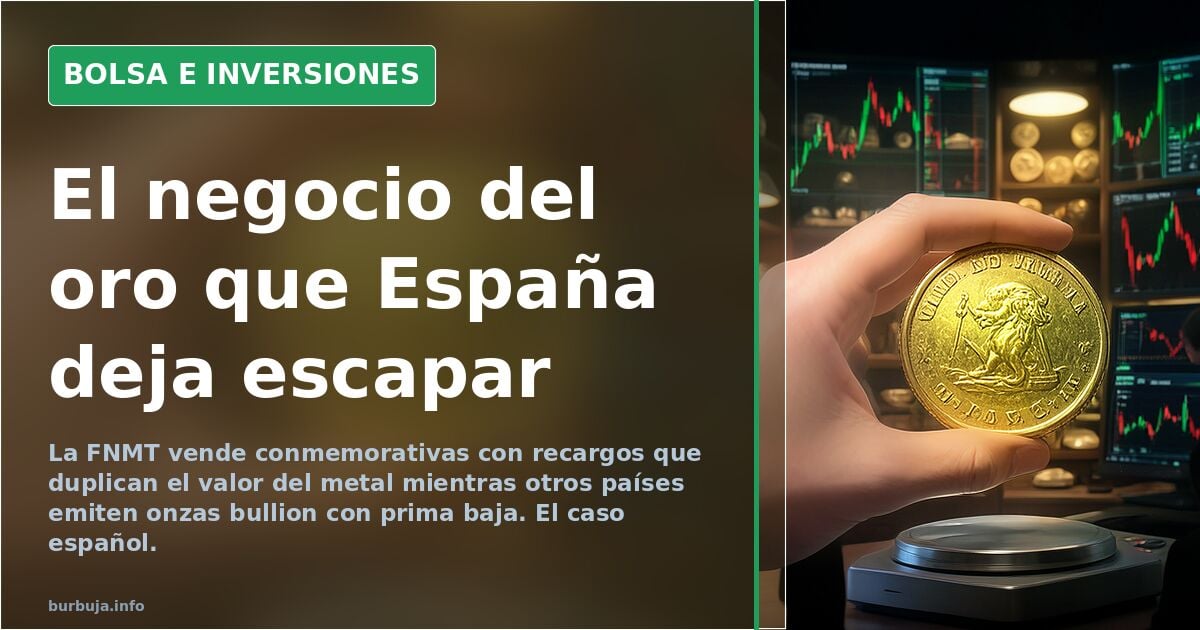
Spain has no Krugerrand, and nobody can explain why
Spain sells gold at clean bullion value and buys foreign investment coins at a premium. That is the anomaly running through a discussion of almost eleven years about why the Fábrica Nacional de Moneda y Timbre (FNMT, Spain's national mint) does not issue a gold or silver bullion ounce on decent terms: a product with an affordable premium over the metal's value, a durable design and large mintages, in the style of the South African Krugerrand, the American Gold Eagle, the Austrian Philharmonic or the British Sovereign. The original proposal is simple: if Spaniards who want to invest in metals could do so in a national coin, the profit would stay in the country and the national symbol would be reinforced. Almost a decade later, the FNMT still has not produced one.
What a bullion coin is and why the premium matters
A bullion coin is a piece of precious metal whose price closely tracks the international quotation (the spot price), with a small manufacturing and distribution margin. It is not numismatic: it is not bought for rarity but for ounces. The investor pays for the metal plus a percentage. That percentage, the premium, is what separates an investment coin from a collectible commemorative.
The central argument of the Spanish case is that the FNMT does the opposite. Its commemorative issues are sold with markups that, according to the examples cited, can double or triple the intrinsic value of the metal. A 27-gram silver piece, 925 fineness, with a 10-euro face value, was offered at 45 euros plus VAT; a 6.75-gram gold piece with a 100-euro face value, at 375 euros. The buyer pays for design, case and certificate, not for ounces.
The practical consequence is that such a product does not work as an investment. When the collector wants to sell, the market offers the metal, not the markup. Leftover stock ends up with wholesalers at metal price, without box or certificate, and from there in second-hand stalls. Gold, on the other hand, is spared: it trades close to spot.
The counterargument: it is not the FNMT's business
The strongest objection raised is that bullion coins are issued mainly by countries that produce precious metals, and Spain is not one. Issuing an investment coin requires heavy investment, enormous mintages and years of presence for the international market to accept it. It is not reasonable to expect a country that stopped minting peso coinage a century ago to start now.
That argument has an obvious hole: Austria and the United Kingdom are not mining powers either, and they sell bullion successfully. The Austrian Philharmonic has been on the market for barely a quarter of a century; the Armenian Noah's Arks or the Somalian Elephants are struck at private German mints under the emblem of other states. What moves the buyer is not the mine: it is the design, the assurance of fineness and the ease of resale.
Design as a problem and as an excuse
Criticism of the design is recurrent and not trivial. Spanish commemorative production is described as an accumulation of figures and horizontal inscriptions that breaks the symmetry, in contrast to the clean look of foreign pieces. The irony about the "artist" who designs stamps and coins appears several times, and it is recalled that in a stamp series on civic values, the one devoted to creativity was a blank sheet.
There is a concrete proposal that avoids the problem: invent nothing. Reuse the historic obverse of Hispania, the coat of arms or the portrait of the king, and as the reverse a durable motif. The columnarios are mentioned, "the first global coin", from which the dollar sign derives, along with the bison of Altamira. The idea is that the design already exists and would be hard to ruin.
The clue of the ecus and the 2,000-peseta silver coins
Spain has already issued something similar. Between 1989 and 1998, ecus were struck, in silver and gold, with one troy ounce of metal and 900 fineness. They stopped being produced, and nobody gives a clear explanation of why. It is the most uncomfortable precedent for anyone claiming the product does not fit the Spanish tradition.
There was also a legion of buyers of the 2,000-peseta silver coins. The observation that keeps coming up is that this generation never came back for more. If the commemorative business were so profitable, it is hard to understand why the recurring buyer has disappeared. And if it is not, it is hard to understand why it continues.
Who decides and why nothing changes
The institutional explanation circulating is the politicization of the entity and the lack of political direction for a product that would create a national symbol. The FNMT is a state-owned commercial entity with its own assets and treasury, and its declared objective is not to encourage citizens to accumulate metal near market price, but to increase profits. With that incentive, the high markup is rational.
There is a suspicion that remains just that, a suspicion: that the opacity about mintages and accounts makes it impossible to know whether the model works. It is recalled that the FNMT went to court to avoid giving data on an issue. Without public figures, the discussion about profitability moves in the realm of intuition.
What would happen if one were issued
The optimistic calculation says a Spanish bullion coin would sell: to national investors, to tourists as a souvenir with intrinsic value, and to foreign buyers who already accumulate ounces from other countries. It would be distributed through numismatic shops and Banco de España branches, saving shipping costs. The pessimistic scenario is that, given the track record of design and prices, the market would not take it seriously.
The proposal for a citizen petition came to nothing. The FNMT's contact email was sought and no answer was found. Almost eleven years after the initial proposal, the question remains open: if the metal is worth what it is worth and minting is not expensive, someone is pocketing the difference. The only thing left is to find out who.
Also available in: Deutsch
Summary of a discussion on Burbuja.info - Foro de economía, actualidad y política., translated from Spanish and reviewed before publication. Read the full discussion (56 replies).
More summaries
-
Sovereign vs Krugerrand: Expert Picks for Gold Buying
The Sovereign holds 7.32g of pure gold, the Krugerrand 31.104g. Premiums and liquidity determine the best choice for savings.
-
Exchanging Banco de España 12 euro silver coins: metal value falls short of face value
A forum user recounts exchanging 4,800 euros worth of Banco de España 12 euro coins. The metal value does not exceed the face value and on the secondary market they have…
-
Krugerrand, Maple or Philharmonic: Which Gold Coin Resells Best
Krugerrands and Maples sell easily; Somali Elephants have low liquidity. The key factor is not the issuing country, but market depth.
-
Pablo Gil trader reviews: respect and bearish bias
Two years warning of a stock market crash that hasn't come: opinions on Pablo Gil, the YouTube trader, split between respect and bias.
-
Spanish bond soars 200 basis points even as the ECB keeps buying
Spain's ten-year bond yield has jumped 200 basis points while the ECB is still buying. Germany has gone from -0.5% to 1% and the US is above 3%. It looks ugly.
-
Andorrano jeweller: silver ounces wrapped in cling film
999 fine silver ounces sent wrapped in transparent film when an order doesn't fill a full tube: the clash between competitive prices and packaging that tarnishes the coins.