
Krugerrand, Maple or Philharmonic: Which Gold Coin Resells Best
Krugerrands and Maples sell easily; Somali Elephants have low liquidity. The key factor is not the issuing country, but market depth.
English · Original discussion in Spanish · Published
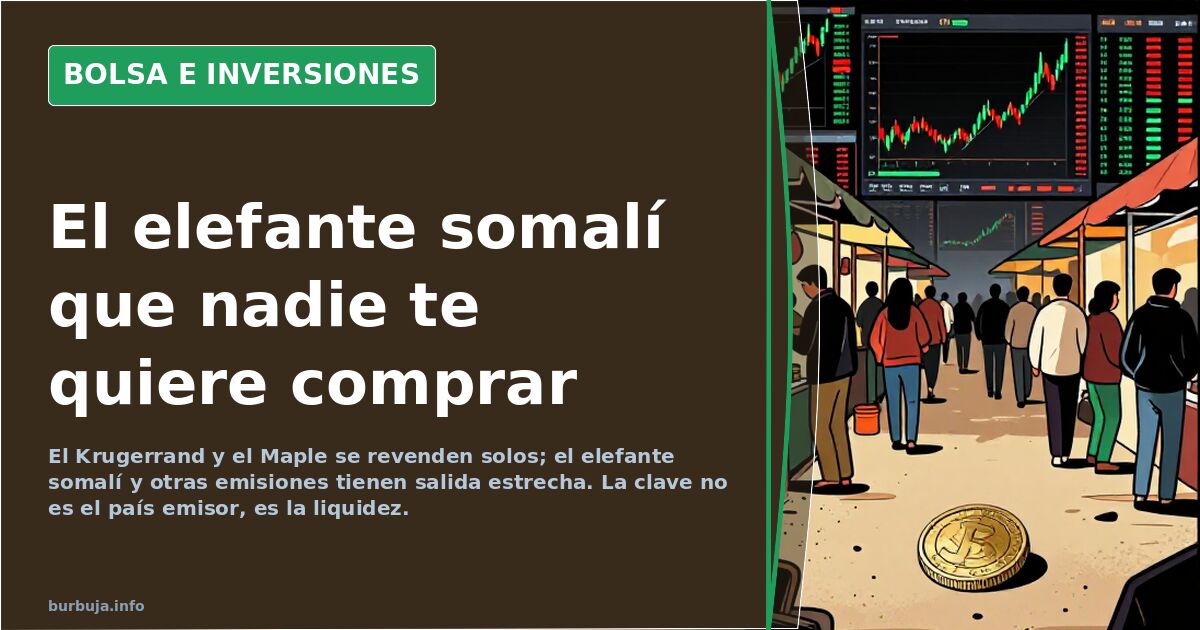
Krugerrand, Maple or Philharmonic: The Gold Coin That Actually Sells
An investor buys an ounce of gold only to discover that the problem wasn't the entry price, but the exit strategy. The question sparking debate is simple yet specific: why do the South African Krugerrand, Canadian Maple Leaf, Austrian Philharmonic, and American Eagle command a premium over others, while issues like the Somali Elephant, Chinese Panda, Australian Kangaroo, Britannia, or American Buffalo trade at a lower tier? The recurring answer has nothing to do with purity or design: it depends on who will buy it from you later.
Why the Krugerrand Dominates Despite Being South African
The most common argument cites age and buyer networks. According to one participant, the Krugerrand is the oldest troy ounce coin, boasting a global market no subsequent issue has replicated. Holders can sell it in any shop worldwide without explanation. The Canadian Maple Leaf ranks second in this hierarchy due to volume and recognition.
A reasonable objection arises: South Africa isn't an economic powerhouse, yet its coin is the most demanded. The conclusion drawn is that here, the issuer's solvency matters less than the liquidity</I> of the product. An ounce of gold is an ounce of gold in Johannesburg as well as in Guangzhou.
The Somali Elephant and Others: Limited Exit Options
The Somali Elephant is frequently cited as an example of poor resale value. One participant notes the issue is recent with limited circulation, making it hard to resell. The Austrian Philharmonic, though major, is younger and less traded than the Krugerrand or Maple.
Opposing this view, some argue German shops buy the Elephant at the same price as the Philharmonic, claiming the lack of market is an unverified prejudice. The practical advice offered is revealingly simple: check which coins shops are buying and at what price. That buy-back list is the real proof of what appreciates and what doesn't.
Pandas, Buffalos and Kangaroos: The Collector's Premium
The Chinese Panda and American Buffalo often carry a notable premium over metal value, indicating collector demand supports the price. The open question is whether this premium reflects actual resale potential or just limited mintage and thematic appeal.
Regarding the Elephant, a nuance is noted: according to one participant, it's the first time minted in one-ounce size (though fractions existed), requiring market expansion. This results in a lower exit price. The question remains if this premium will converge with the Panda's or lag behind.
The Collectible Coin Business and Its Contracts
The discussion shifts to sales models promising returns far exceeding metal appreciation. Claims include 20% gains in months and a rule stating selected coins haven't dropped in price for 40 years. Comparisons to Afinsa stamps appear immediately, warning that pyramid schemes survive only while there are buyers at the base.
The tensest point is the refusal to publish a standard contract. It is argued that private agreements between two parties cannot be shared without mutual consent, countered by claims that the seller had already granted permission to a buyer. The dispute escalates and ends without the document being shown.
One fact stands out: the world's most famous coin comes from a fragile economy, while the least known may come from centuries-old mints. Ultimately, the market doesn't reward the issuer. It rewards whoever buys your coin when you want to sell.
An investor buys an ounce of gold only to discover that the problem wasn't the entry price, but the exit strategy. The question sparking debate is simple yet specific: why do the South African Krugerrand, Canadian Maple Leaf, Austrian Philharmonic, and American Eagle command a premium over others, while issues like the Somali Elephant, Chinese Panda, Australian Kangaroo, Britannia, or American Buffalo trade at a lower tier? The recurring answer has nothing to do with purity or design: it depends on who will buy it from you later.
Why the Krugerrand Dominates Despite Being South African
The most common argument cites age and buyer networks. According to one participant, the Krugerrand is the oldest troy ounce coin, boasting a global market no subsequent issue has replicated. Holders can sell it in any shop worldwide without explanation. The Canadian Maple Leaf ranks second in this hierarchy due to volume and recognition.
A reasonable objection arises: South Africa isn't an economic powerhouse, yet its coin is the most demanded. The conclusion drawn is that here, the issuer's solvency matters less than the liquidity</I> of the product. An ounce of gold is an ounce of gold in Johannesburg as well as in Guangzhou.
The Somali Elephant and Others: Limited Exit Options
The Somali Elephant is frequently cited as an example of poor resale value. One participant notes the issue is recent with limited circulation, making it hard to resell. The Austrian Philharmonic, though major, is younger and less traded than the Krugerrand or Maple.
Opposing this view, some argue German shops buy the Elephant at the same price as the Philharmonic, claiming the lack of market is an unverified prejudice. The practical advice offered is revealingly simple: check which coins shops are buying and at what price. That buy-back list is the real proof of what appreciates and what doesn't.
Pandas, Buffalos and Kangaroos: The Collector's Premium
The Chinese Panda and American Buffalo often carry a notable premium over metal value, indicating collector demand supports the price. The open question is whether this premium reflects actual resale potential or just limited mintage and thematic appeal.
Regarding the Elephant, a nuance is noted: according to one participant, it's the first time minted in one-ounce size (though fractions existed), requiring market expansion. This results in a lower exit price. The question remains if this premium will converge with the Panda's or lag behind.
The Collectible Coin Business and Its Contracts
The discussion shifts to sales models promising returns far exceeding metal appreciation. Claims include 20% gains in months and a rule stating selected coins haven't dropped in price for 40 years. Comparisons to Afinsa stamps appear immediately, warning that pyramid schemes survive only while there are buyers at the base.
The tensest point is the refusal to publish a standard contract. It is argued that private agreements between two parties cannot be shared without mutual consent, countered by claims that the seller had already granted permission to a buyer. The dispute escalates and ends without the document being shown.
One fact stands out: the world's most famous coin comes from a fragile economy, while the least known may come from centuries-old mints. Ultimately, the market doesn't reward the issuer. It rewards whoever buys your coin when you want to sell.
Also available in: Deutsch
Summary of a discussion on Burbuja.info - Foro de economía, actualidad y política., translated from Spanish and reviewed before publication. Read the full discussion (109 replies).
More summaries
-
Physical Gold: The VAT-Free Insurance Premiuming at 5%
Physical gold acts as insurance, not investment, with a 2-5% premium and VAT exemption for bullion coins like Krugerrand, Maple, or Philharmonic.
-
Spain's $975 Gold Coin Isn't the Krugerrand Sold at Munters
The $975 Somali elephant coin differs from Munters' $1001 Krugerrand. Buyback terms determine if it is a bargain or a trap.
-
Silver Bullion: Panda Costs €23, Philharmonic €19
One ounce of pure silver sells for €18–€23 depending on the coin. Overspot premiums, Maple purity, and customs explain the price gap.
-
Madrid's Neighborhoods: Price Dictates the Map of Good and Bad Areas
Classifying Madrid's 128 neighborhoods as good or bad depends on the criteria: price per square meter, commute time, or district labels.
-
Big Tech layoffs driven by end of cheap money, not AI
Google employed 186,779 people while the sector cut jobs. The end of cheap capital, not AI, explains Big Tech reductions.
-
Spain's IBEX crash: Investor targets IAG at €3.50, Occidental at €5
As Spain's IBEX falls below 6,000 points, an investor outlines a buying strategy for IAG and Occidental with 60% cash reserves.