
Spain: Gasoline tops €1.70 as diesel prices surge
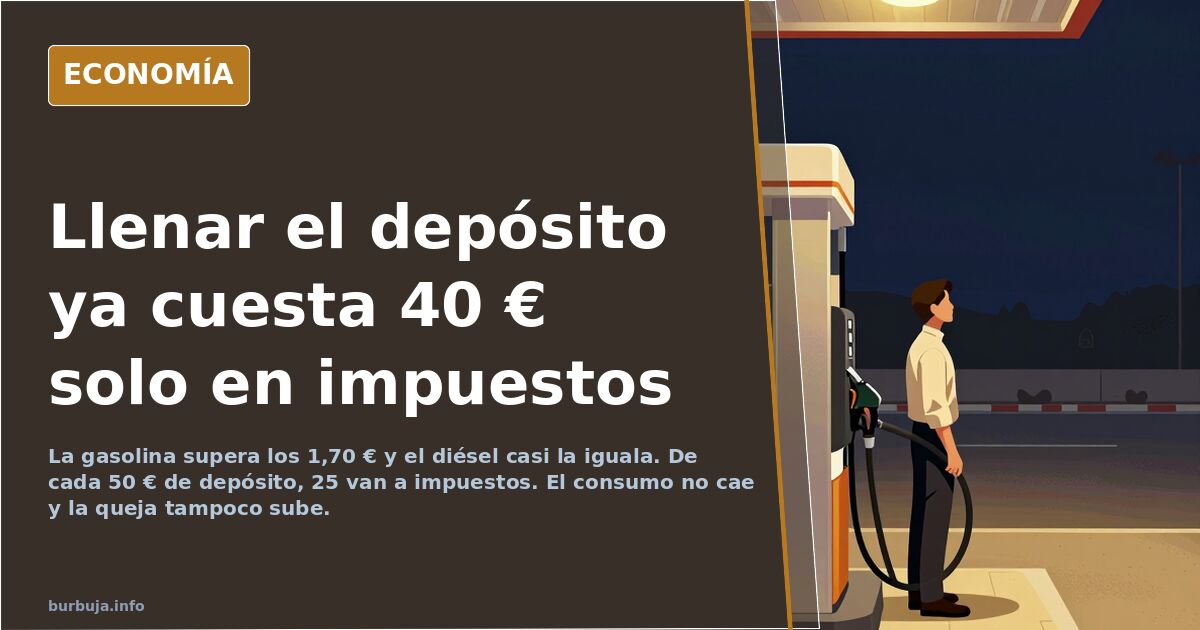
Gasoline exceeds €1.70 and diesel nearly matches it. Half of every €50 tank goes to taxes. Consumption holds steady despite rising costs.
English · Original discussion in Spanish · Published
Gasoline tops €1.70 as diesel prices surge
95-octane gasoline has once again exceeded €1.70 per liter at Spanish service stations, while diesel—historically the cheaper option—is closing in on parity. At a branded Repsol station in León, diesel cost €1.57 per liter; at a Cepsa station, 95-octane was priced at €1.79 and diesel at €1.74. With crude oil hovering around $87 per barrel and production declining, drivers are bearing the brunt.
The striking aspect is not the price itself, but the public silence. There are no protests, no trucker strikes, and no media uproar comparable to other social issues. Summer vacations may have peine anger, but autumn brought no relief: in October, when pump prices typically ease after the holiday season, diesel continued to rise.
How much of each liter goes to the state
The breakdown is stark. Gasoline carries a 52% tax burden, while diesel bears 48%. In practical terms, half of every €50 spent on fuel goes to public coffers. For each liter of gasoline at €1.70, the treasury collects 88 cents. This is not opinion; it is arithmetic at the pump.
Some argue the issue is not solely fiscal. Diesel has lost its historical advantage: the gap with gasoline has narrowed to just five cents, with some stations showing near-parity. Diesel, long considered the tax-advantaged underdog, has surged. With winter approaching, increased demand for heating and transport diesel adds further pressure.
A detailed calculation, broken down by liter and full tank, reveals surprising differences when considering real-world consumption of older vehicles in urban settings.
Why diesel is no longer cheaper than gasoline
The differential between the two fuels has compressed to levels unseen in years. In one León station, diesel was €1.57; at a Cepsa, 95-octane was €1.79 and diesel €1.74. Only five cents separate what was once a twenty-cent gap. Analysts point to international supply cuts for diesel and rising winter demand for heating oil as key drivers.
The result is an uncomfortable paradox. Diesel faces lower taxation than gasoline—48% versus 52%—yet it is nearly matching it at the pump. Those who bought diesel cars to save money find those savings evaporated. Meanwhile, owners of older gasoline cars, consuming 15 liters per 100 km in mixed use and up to 20 in the city, see filling the tank become an act of faith.
Low-cost pumps as a lifeline
Price disparities between stations are real and measurable. Filling up at a branded station versus a low-cost provider can differ by €10 per tank. Last week, Alcampo sold 95-octane at €1.62; in early 2021, Ballenoil offered it at €0.999 per liter. Today, that same liter exceeds €1.70 in many areas, representing a cumulative increase of nearly 50% in just two years.
The question remains whether seeking out cheap pumps is worthwhile. Daily users say yes, without hesitation. Quality differences are negligible, but price differences are significant. In Andorra, diesel was recently priced at €1.26, including reserve jugs. The geographic variation in prices creates a map of grievances rarely discussed publicly.
The unexplained social silence
This phenomenon is puzzling. Despite rising fuel costs, soaring supermarket prices, high electricity bills, and mortgage pressures, streets remain calm. Some suggest Spaniards have exceptional tolerance: they not only swallow the frog but savor it. Others cite learned resignation after years of false alarms. A third view argues that frustration is channeled into other causes rather than fuel prices.
In reality, roads remain busy, terraces are full, and beach apartments are booked months in advance. Consumption hasn’t dropped, nor has public complaint risen. It’s a strange equilibrium: wallets suffer, but life goes on.
Where fuel prices are heading
With oil at $87 and gasoline above €1.70, if barrels exceed $100, what will liter prices be? Forecasts suggest 98-octane is already hitting €2.00 at some branded stations, with 95-octane at €1.90. At an average urban consumption of 10 liters per 100 km, €20 buys only 100 kilometers. The round numbers are alarming.
The problem isn’t just today’s price, but the trend. Diesel has shifted from economical fuel to competing closely with gasoline. Taxes aren’t falling, production isn’t rising, and winter is tightening its grip. Under these conditions, the same consumers continue to pay the bill.
Analysis hits an uncomfortable point: if prices rise and consumption doesn’t fall, the market shows no signs of correction. No one knows when this tension will break.
95-octane gasoline has once again exceeded €1.70 per liter at Spanish service stations, while diesel—historically the cheaper option—is closing in on parity. At a branded Repsol station in León, diesel cost €1.57 per liter; at a Cepsa station, 95-octane was priced at €1.79 and diesel at €1.74. With crude oil hovering around $87 per barrel and production declining, drivers are bearing the brunt.
The striking aspect is not the price itself, but the public silence. There are no protests, no trucker strikes, and no media uproar comparable to other social issues. Summer vacations may have peine anger, but autumn brought no relief: in October, when pump prices typically ease after the holiday season, diesel continued to rise.
How much of each liter goes to the state
The breakdown is stark. Gasoline carries a 52% tax burden, while diesel bears 48%. In practical terms, half of every €50 spent on fuel goes to public coffers. For each liter of gasoline at €1.70, the treasury collects 88 cents. This is not opinion; it is arithmetic at the pump.
Some argue the issue is not solely fiscal. Diesel has lost its historical advantage: the gap with gasoline has narrowed to just five cents, with some stations showing near-parity. Diesel, long considered the tax-advantaged underdog, has surged. With winter approaching, increased demand for heating and transport diesel adds further pressure.
A detailed calculation, broken down by liter and full tank, reveals surprising differences when considering real-world consumption of older vehicles in urban settings.
Why diesel is no longer cheaper than gasoline
The differential between the two fuels has compressed to levels unseen in years. In one León station, diesel was €1.57; at a Cepsa, 95-octane was €1.79 and diesel €1.74. Only five cents separate what was once a twenty-cent gap. Analysts point to international supply cuts for diesel and rising winter demand for heating oil as key drivers.
The result is an uncomfortable paradox. Diesel faces lower taxation than gasoline—48% versus 52%—yet it is nearly matching it at the pump. Those who bought diesel cars to save money find those savings evaporated. Meanwhile, owners of older gasoline cars, consuming 15 liters per 100 km in mixed use and up to 20 in the city, see filling the tank become an act of faith.
Low-cost pumps as a lifeline
Price disparities between stations are real and measurable. Filling up at a branded station versus a low-cost provider can differ by €10 per tank. Last week, Alcampo sold 95-octane at €1.62; in early 2021, Ballenoil offered it at €0.999 per liter. Today, that same liter exceeds €1.70 in many areas, representing a cumulative increase of nearly 50% in just two years.
The question remains whether seeking out cheap pumps is worthwhile. Daily users say yes, without hesitation. Quality differences are negligible, but price differences are significant. In Andorra, diesel was recently priced at €1.26, including reserve jugs. The geographic variation in prices creates a map of grievances rarely discussed publicly.
The unexplained social silence
This phenomenon is puzzling. Despite rising fuel costs, soaring supermarket prices, high electricity bills, and mortgage pressures, streets remain calm. Some suggest Spaniards have exceptional tolerance: they not only swallow the frog but savor it. Others cite learned resignation after years of false alarms. A third view argues that frustration is channeled into other causes rather than fuel prices.
In reality, roads remain busy, terraces are full, and beach apartments are booked months in advance. Consumption hasn’t dropped, nor has public complaint risen. It’s a strange equilibrium: wallets suffer, but life goes on.
Where fuel prices are heading
With oil at $87 and gasoline above €1.70, if barrels exceed $100, what will liter prices be? Forecasts suggest 98-octane is already hitting €2.00 at some branded stations, with 95-octane at €1.90. At an average urban consumption of 10 liters per 100 km, €20 buys only 100 kilometers. The round numbers are alarming.
The problem isn’t just today’s price, but the trend. Diesel has shifted from economical fuel to competing closely with gasoline. Taxes aren’t falling, production isn’t rising, and winter is tightening its grip. Under these conditions, the same consumers continue to pay the bill.
Analysis hits an uncomfortable point: if prices rise and consumption doesn’t fall, the market shows no signs of correction. No one knows when this tension will break.
Also available in: Deutsch
Summary of a discussion on Burbuja.info - Foro de economía, actualidad y política., translated from Spanish and reviewed before publication. Read the full discussion (134 replies).
More summaries
-
Gasoline 95 at €2.019 in Repsol vs €1.68 in low-cost
Gasoline 95 costs €2.019 per liter at a neighborhood Repsol while low-cost stations hold at €1.68. Diesel pressures and Euribor adds strain.
-
Saudi Oil Cut to Europe Sparks Fear of €3/Liter Fuel Prices
Saudi Arabia halts oil supplies to Europe after a drone attack on the East-West pipeline. Barrel prices surge, raising fears of €3 per liter fuel costs.
-
Which celebrity will offer a home to the evicted woman?
Debate over the evicted elderly woman in Madrid: will any of the named celebrities offer her a home? Wyoming is attributed 19 properties.
-
Honduran builder in Spain: €60 daily wage, 9-to-18 shift
Noé Leonardo, a Honduran construction worker in Madrid, earns €60 per day. The collective agreement sets €19,537 annually for helpers. Is this wage dumping or luck?
-
Spain's CIS poll shows PSOE nearly matching PP and Vox combined
A leaked calculation suggests the Spanish polling agency gives PSOE almost as many seats as PP and Vox combined, sparking fraud accusations.
-
Joselito Ham Sandwich Priced at 18.95 Euros: The Calculation That Exposes It
A Joselito ham sandwich costs 18.95 euros in airports and gas stations. An online calculation shows that same money buys 12 homemade sandwiches.