
Joselito Ham Sandwich Priced at 18.95 Euros: The Calculation That Exposes It
A Joselito ham sandwich costs 18.95 euros in airports and gas stations. An online calculation shows that same money buys 12 homemade sandwiches.
English · Original discussion in Spanish · Published
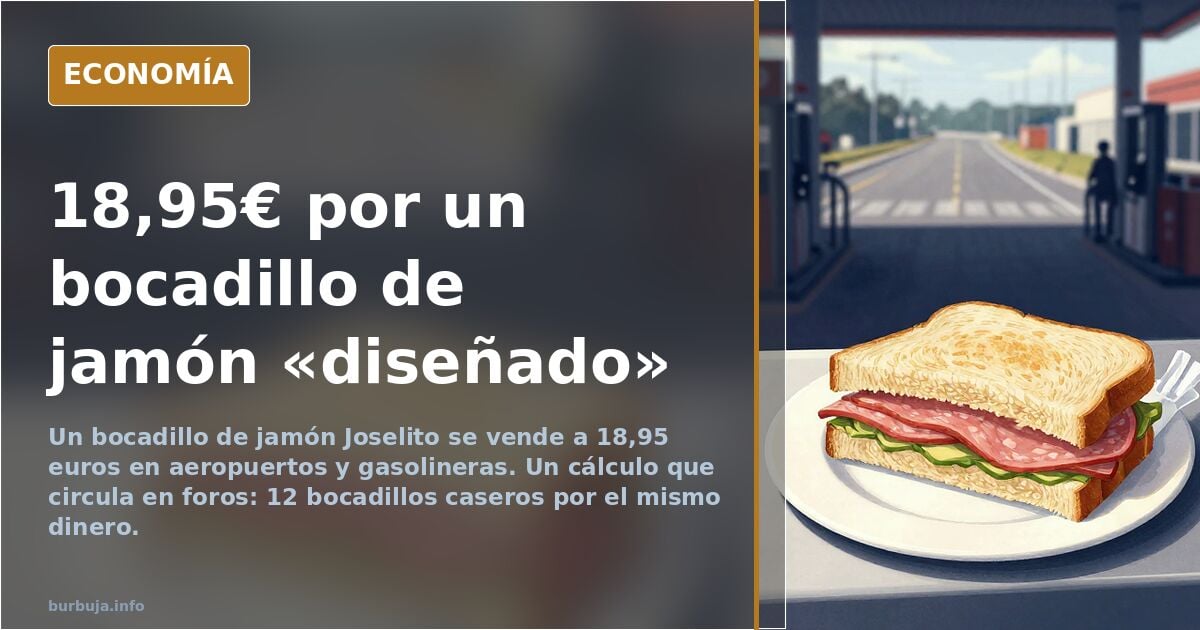
A ham sandwich for 18.95 euros: the calculation that exposes it
What does a ham sandwich really cost? The answer depends on where you buy it. In airports and gas stations, a sourdough baguette with Joselito ham, extra virgin olive oil, pepper, and crushed pistachios is sold for 18.95 euros as a celebrity chef creation. This price raises an uncomfortable question: is it a premium product or a tax on the distracted?
The calculation that exposes the price
The most common comparison comes from a simple exercise. According to a calculation circulating online, with 18.95 euros you can buy 19 packets of 40 grams of Navidul ham —about 760 grams in total— and, adding bread and oil, you get about 1.50 euros per sandwich. That is, the same money would buy twelve homemade sandwiches. This is not a whim: it is the fastest way to measure the markup of a product sold in a captive environment where the customer has no alternatives.
Some argue the comparison is unfair. Joselito ham comes from Guijuelo, and its price per kilo far exceeds that of a supermarket brand. This argument has merit: an industrial cut is not the same as a cured ham with designation of origin. The discussion, therefore, is not just about price, but about what you are paying for: the product, the packaging, or the chef's name?
Why is it sold in airports and gas stations?
The sales channel is key to the model. A quality ham sandwich is not eaten on a plastic tray with added pepper and pistachios to differentiate it from the standard. Critics point out that the pistachio acts as a secret ingredient: a detail that justifies the story and, by extension, the price. In an airport, the customer does not compare; they pay and move on. That is the business.
The chef's trajectory fuels suspicions that the product relies on its media hype. According to some participants, available data point to a failure in London and the closure of the Dubai location, while in Spain the name still works as a commercial hook. Comparing it to high-end Madrid cuisine —where the signature dish might be a squid sandwich— reveals the distance between the narrative and the result.
Price as a symptom, not an anecdote
The case of the 18.95 euro sandwich is not an isolated fact. It is the tip of a model where the chef's name becomes the main raw material. The bread, ham, and oil are the support; what you pay for is the signature. And as long as the product is sold in airports and gas stations, the customer's calculation will not be about cost, but about haste.
The question is not whether the sandwich is good. The question is how much of that price is food and how much is narrative. With the numbers on the table, the answer leaves little room for doubt.
What does a ham sandwich really cost? The answer depends on where you buy it. In airports and gas stations, a sourdough baguette with Joselito ham, extra virgin olive oil, pepper, and crushed pistachios is sold for 18.95 euros as a celebrity chef creation. This price raises an uncomfortable question: is it a premium product or a tax on the distracted?
The calculation that exposes the price
The most common comparison comes from a simple exercise. According to a calculation circulating online, with 18.95 euros you can buy 19 packets of 40 grams of Navidul ham —about 760 grams in total— and, adding bread and oil, you get about 1.50 euros per sandwich. That is, the same money would buy twelve homemade sandwiches. This is not a whim: it is the fastest way to measure the markup of a product sold in a captive environment where the customer has no alternatives.
Some argue the comparison is unfair. Joselito ham comes from Guijuelo, and its price per kilo far exceeds that of a supermarket brand. This argument has merit: an industrial cut is not the same as a cured ham with designation of origin. The discussion, therefore, is not just about price, but about what you are paying for: the product, the packaging, or the chef's name?
Why is it sold in airports and gas stations?
The sales channel is key to the model. A quality ham sandwich is not eaten on a plastic tray with added pepper and pistachios to differentiate it from the standard. Critics point out that the pistachio acts as a secret ingredient: a detail that justifies the story and, by extension, the price. In an airport, the customer does not compare; they pay and move on. That is the business.
The chef's trajectory fuels suspicions that the product relies on its media hype. According to some participants, available data point to a failure in London and the closure of the Dubai location, while in Spain the name still works as a commercial hook. Comparing it to high-end Madrid cuisine —where the signature dish might be a squid sandwich— reveals the distance between the narrative and the result.
Price as a symptom, not an anecdote
The case of the 18.95 euro sandwich is not an isolated fact. It is the tip of a model where the chef's name becomes the main raw material. The bread, ham, and oil are the support; what you pay for is the signature. And as long as the product is sold in airports and gas stations, the customer's calculation will not be about cost, but about haste.
The question is not whether the sandwich is good. The question is how much of that price is food and how much is narrative. With the numbers on the table, the answer leaves little room for doubt.
Also available in: Deutsch
Summary of a discussion on Burbuja.info - Foro de economía, actualidad y política., translated from Spanish and reviewed before publication. Read the full discussion (34 replies).
More summaries
-
A 20-Euro Breakfast at Spain’s AP-68 Service Area: The Breakdown
Coffee, Iberian ham sandwich, and wine total 20 euros at the AP-68 service area near Zaragoza, sparking debate on highway pricing and inflation.
-
Madrid's impossible reality: soaring prices, tourism and migration pressure
Rents skyrocketing, tourist pressure and a capital that pushes out its residents: why Madrid has become unaffordable for those who live there.
-
Spain's IMV to top €1,600 in 2027: how it compares to working
Spain's IMV to top €1,600 for the first time in 2027, reaching over 893,000 households: how it compares to a job
-
Seville baby death: accident or murder?
A 16-month-old baby died in Seville after being scalded with boiling water by her mother's partner. Police are investigating whether it was an accident or homicide.
-
Vitoria-Gasteiz, Spain's Green Capital Faces Urban Decay
Vitoria-Gasteiz, the European Green Capital in Spain, suffers visible urban deterioration: graffiti, dead trees and questioned political management.
-
Spain's Housing Obsession: Why Mortgages Dominate Life
Analysis of Spain's property obsession, exploring camper vans and office rentals as alternatives to lifelong mortgages.