
Spain fines caravan dwellers on private land
In Spain, living in a caravan on owned land triggers fines, while squatters avoid penalties through vulnerability protocols.
English · Original discussion in Spanish · Published
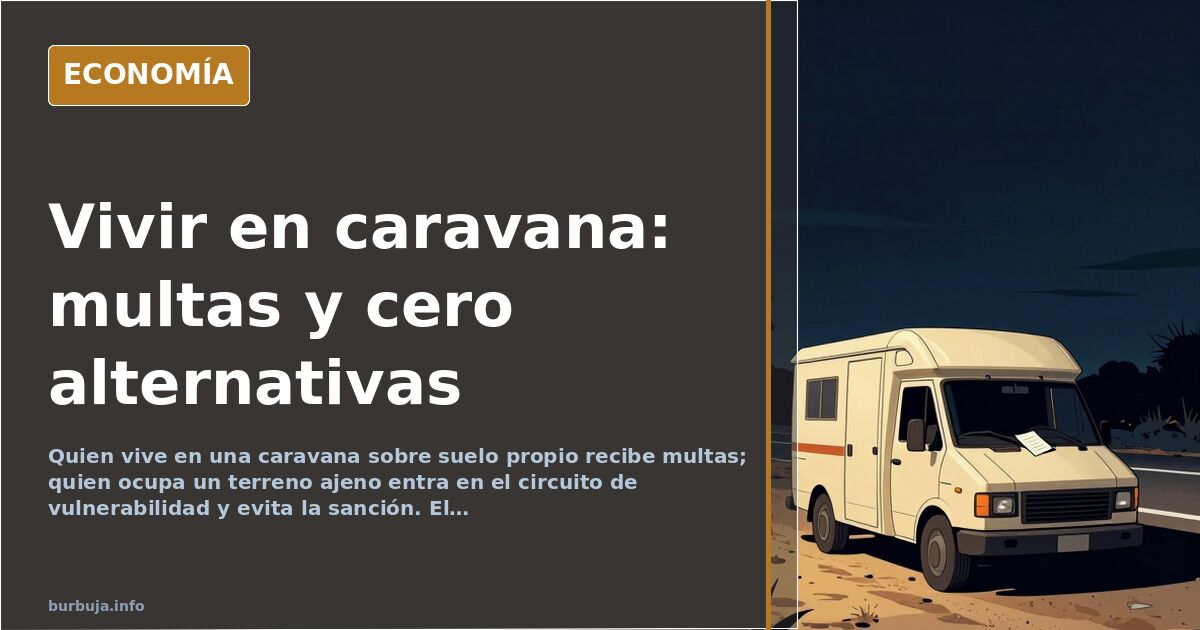
Caravan fines: The bias of municipal control
The conversation opens with an administrative contradiction: those living in caravans on their own land receive fines, while those occupying foreign land enter the vulnerability circuit and escape sanctions. The underlying thesis is that the criterion is not need, but revenue capacity. The caravan pays VAT upon purchase and the manufacturer pays taxes, yet the vehicle owner generates no recurring income for the town hall: no property tax (IBI), no waste fee, no metered water consumption. Squatters, conversely, trigger social protocols that discourage enforcement.
What happens if you live in a caravan on your own land?
The most detailed case involves private land. If the soil is yours, expect a fine immediately; if the land is occupied, the conflict shifts to the private owner and the municipality looks away. Some describe caravan neighborhoods settled for years on other people's plots without local intervention. The logic is simple: owned land is a traceable fiscal address, hence seizable. Occupied land is an administrative limbo where sanctions find no recipient.
Can you seize assets from someone without a salary?
Here the analysis becomes technical. The Minimum Wage (SMI) and Vital Minimum Income are non-seizable, so fines against recipients remain ineffective. Only a percentage of surplus above the SMI in payroll can be retained. The perverse consequence highlighted is this: if debts accumulate and do not expire as expected, it incentivizes remaining without declared income to avoid seizure. Some argue traffic fine debts eventually become unrecoverable and files are archived due to administrative inefficiency.
The municipal business of traffic sanctions
A specific figure appears: €4 million annually from €600,000 worth of fines. This data illustrates that sanctions are not just deterrence, but a revenue line. Those living in vans in coastal zones occupy shaded parking for weeks, consume nothing locally, and pay no waste fees. They contribute nothing economically to the town hall, which explains the pressure more than aesthetics. Videos of van lifers in paradise amplify the phenomenon, pushing councils to tighten ordinances.
The Americanization of the problem
Comparisons with the US appear frequently. Living in a caravan is widespread in the world's richest country, yet here it carries a stigma of poverty. The argument suggests Spain, poor decades ago, poorly tolerates low-cost housing solutions. Cultural references include the film Nomadland and its central quote: "I have somewhere to go, I just don't have a home." The parallel is not accidental: nomadic necessity arrived earlier in the US and now lands here with the same wrapper of precariousness and misunderstood freedom.
Tolerated shantytowns and housing price control
The most uncomfortable reading connects fines to the real estate market. The goal may not be addressing vulnerability, but maintaining or raising housing prices. If caravan or van living normalized, part of the demand would stop pressuring rents. Sanctions act as a barrier to a lifestyle competing with bricks. Meanwhile, a neighbor accumulates €15,000 in community debt for years, still living in the apartment because auctioning it takes too long and he has no accounts in his name. The impunity protecting delinquent owners does not protect caravan dwellers.
The conversation hits a deadlock: if the fine cannot be collected, it does not deter; if it can be collected, it punishes the poorest. Meanwhile, housing prices keep rising.
Also available in: Deutsch
Summary of a discussion on Burbuja.info - Foro de economía, actualidad y política., translated from Spanish and reviewed before publication. Read the full discussion (113 replies).
More summaries
-
Vidal claims 9% US tax rate, sparking fiscal debate
César Vidal states he pays 9% taxes in the US versus 50% in Spain. Federal brackets and living costs complicate this comparison.
-
Spain's Minimum Income: 82.5% of Recipients Are Spanish
Spain's Court of Audit reports that 82.5% of Minimum Vital Income beneficiaries are Spanish nationals, while non-EU citizens account for 14%.
-
Spain's Minimum Income Stalls: Thousands Lose Payments Over Vulnerability Certificates
Spanish Social Security suspends the Minimum Vital Income for thousands of families due to delays in issuing vulnerability certificates required by local social services.
-
Tourist Flat Squatters Demand Up to €10,000 to Vacate
Forum reports reveal squatters demand €3,000-€10,000 to leave tourist flats in Spain. Overburdened courts and organized gangs worsen the crisis.
-
Volvo to cut 2,500 jobs as China slumps and US tariffs bite
Volvo announces 2,500 layoffs as the Chinese market collapses and US tariffs on Polestar shut the American door for its electric cars.
-
Barcelona looting and riots: the 'Blocus' threat echoing France
Lootings in Barcelona and the 'Blocus' group planning more chaos: 128 arrests and the shadow of a coordinated operation across Europe.