
Spain: €750 in cents raises questions over bank coin-counting fee
A Spanish customer paid a €750 fine in one-cent coins, sparking debate over the €15 handling fee and the math behind it.
English · Original discussion in Spanish · Published
The €15 fee that doesn't add up for 75,000 coins
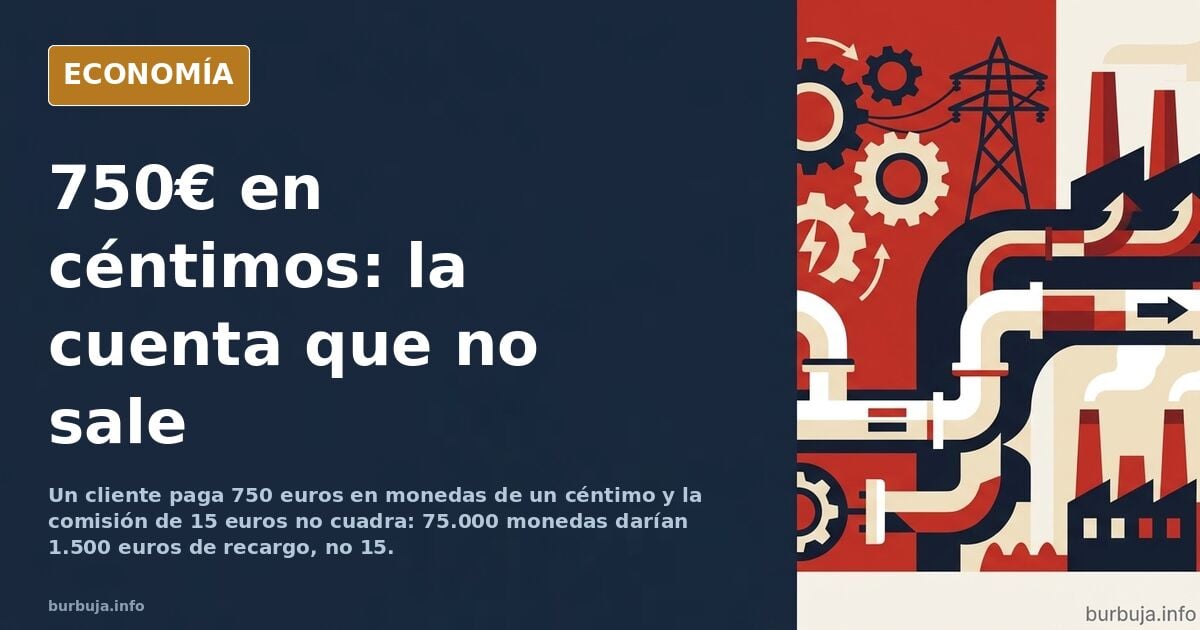
A €750 fine paid in one-cent coins. The scene is described by a former banking deputy director on social media: an angry client, a bursting bag, and a final commission of €15. The problem is the arithmetic. If the bank charges €10 for every 500 coins counted, counting 75,000 one-cent coins —the €750— would result in a €1,500 commission, not €15. Some argue the story only holds if the coins were one-euro pieces: 750 coins, €15 surcharge. And then the story loses all its charm.
How much do €750 in one-cent coins weigh?
A one-cent coin weighs 2.3 grams. Multiplied by 75,000 units, the result is 172.5 kilos. Someone would have to enter a bank branch carrying that weight in a single bag, as the story claims. The scene, as told, requires physical strength bordering on the supernatural. The detail is not minor: if the client had arrived with 750 one-euro coins, the weight would drop to about six kilos, perfectly manageable. The story changes completely.
Coin counting fees: are they legal?
The Banco de España (Bank of Spain) regulates this matter. According to the rules cited in the discussion, the coin limit applies to banks, the entity can outsource the counting service, and it can charge for it. What the regulation establishes is that they are not obliged to accept any volume without cost. Some argue that this service is provided to the administration issuing the fine, not to the citizen, and therefore should be free for the payer. Against this is the argument that the bank is not part of the sanction and does not have to assume the cost of counting it.
Counting machines: the excuse that doesn't hold water
There are automatic counters capable of processing a bundle of coins in minutes, separating them by denomination. The discussion confirms this: there are machines that count coins and banks have them. This dismantles the argument that manual counting was the only way. If the entity has the machine, the real cost of the service is minimal and the €10 fee per 500 coins seems designed more to deter than to cover an expense. The question is whether the bank wants to count or wants the client to leave.
Paying a fine: bank's obligation or client's?
Coins are legal tender and must be accepted, but the discussion introduces an important nuance: the bank is not obliged to count coins for free. Anyone paying a fine needs proof of payment. Without that paper, the payment is not recorded. This leaves the citizen in a weak position: they depend on the entity to close the procedure. The alternative is to use a supermarket coin counter, which takes around a 10% commission for the service. The client always pays, one way or another.
The story that doesn't stand up
The story has all the ingredients of a viral tale: an angry client, a clever revenge, and a final lesson. But the numbers don't match. Either they were 750 one-euro coins, or the commission wasn't €15, or the episode never peine as described. The coincidence between 750 one-euro coins and a €15 commission is too exact to be chance. Some argue the most likely version is that someone counted 750 euro coins, not 75,000 cents, and the story was embellished to make it more epic.
The sarracena drawn from the episode —beware of arrogance— is debatable. What is clear is that paying a fine with small change is an exercise in endurance that rarely comes free. And next time, if anyone wants to do it, they should check how heavy their anger is in kilos.
Also available in: Deutsch
Summary of a discussion on Burbuja.info - Foro de economía, actualidad y política., translated from Spanish and reviewed before publication. Read the full discussion (106 replies).
More summaries
-
Hidden costs of cash change: fees for depositing coins
Paying €2.85 with a €10 bill leaves small change that ends up in a drawer, revealing the hidden cost of cash payments.
-
Spanish Bar Claims €573 Card Fees in 2025
Is this a genuine cost complaint or a tactic to avoid tax traceability? We analyze the debate.
-
Bank of Spain Sold Silver Below Market: An Arbitrage Chronicle
Spain's 12-euro silver coins were sold at face value while their intrinsic silver content was worth more, offering risk-free returns of up to 14%.
-
Spain's PP and investment funds: who opened the door to rental business
Analysis suggests Rajoy's 2013 law deregulated rents. The PP maintains this model and rejects designated tension zones.
-
Spain's Sánchez agrees to Jordi Wild interview and his campaign panics
Sánchez has accepted an interview on Jordi Wild's podcast with live fact-checking. His campaign fears an unscripted face-off and suspicions of a pre-agreed script.
-
Europe registers 400,000 EVs in September, but just three countries drive the growth
Europe topped 400,000 electric cars in September, but Germany, France and the UK account for more than half of sales. Diesel holds its ground in Spain's used car market.