
Hidden costs of cash change: fees for depositing coins
Paying €2.85 with a €10 bill leaves small change that ends up in a drawer, revealing the hidden cost of cash payments.
English · Original discussion in Spanish · Published
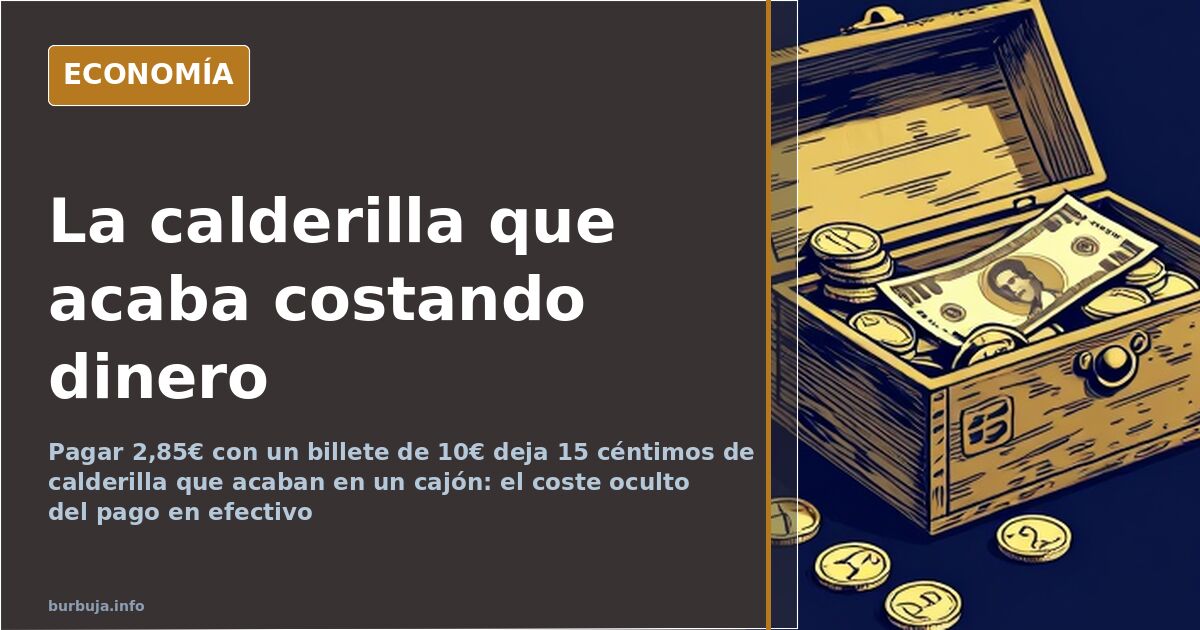
Paying €2.85 with a €10 bill: the small change that actually costs money
A €10 bill on the counter and a bill of €2.85. The expected change is a €5 note, a €2 coin, and fifteen cents in smaller coins. On paper, no one has lost anything. In practice, that handful starts a journey that ends at the bottom of a drawer, and that drawer has a cost. The thesis held here is uncomfortable because it is modest: if even the smallest payment were made by card, not a cent would be lost. And incidentally, it would annoy those who operate off the books.
Small change isn't spent; it's saved. The €2 coin becomes junk through use. The wallet gets heavy and cumbersome, and unclaimed change ends up sleeping for years in a glass jar. No one signs off on the loss, but the loss is there.
Why small change becomes a financial problem
The issue isn't inflation or exchange rates: it's friction. Some summarize this with a domestic example. In a large purchase, change comes in notes; in a small purchase, it comes as a handful of coins that only serve to fatten the drawer. The most repeated method is paying exact amounts with what one has on hand: if the bill is €2.34 and you have four cents in your pocket, you pay them so nothing accumulates.
Others have industrialized the method. Saving small change in a jar and forming stacks of one euro held together with tape; taking them later to the wholesale market, where they are received gratefully. Or letting the piggy bank fill itself and discovering, months later, an involuntary saving. Against this, the harshest response: anyone who can't manage four coins has a problem, not a loss.
How much does it cost to deposit coins at the bank?
More than people think. The circulating version places until 2005 as the era when you could walk in with a jar of coins under your arm and leave without losing anything. Then came a rule allowing entities to refuse deposits if they exceed fifty coins, and beyond that threshold, counting fees appear. The interpretation is literal: the money isn't lost, you're charged for it.
The mechanical alternative offers little comfort either. Counting machines installed in some supermarkets retain around 10% of the deposited amount. With these numbers, small change stops being minor money and behaves like a liability shaped like metal.
Paying by card isn't free either: fees, data, and privacy
Each card transaction has a cost for the merchant, and that cost ends up on the customer's bill. In some online stores, the surcharge for paying by card or certain platforms is explicit, while transfers come with no added cost. Added to this is a price that doesn't appear on the ticket: the digital footprint.
I have nothing to hide is the phrase that dismisses the objection, and also the most debated. Counterarguments cite memories of the corralito (Argentina's 2001 banking freeze) and blocked accounts, along with the horizon of central bank digital currencies, CBDCs, projected without a firm date but with a specific name. The immediate reply: mobile phones already provide far more information than any card.
When do rewards cards truly pay off?
For some, the calculation is pure arithmetic. A card with €90 annual fees returns €50 in cashback from hotel bookings, so the joke stays at €40. Added to this are about 40,000 points annually which, converted, amount to roughly €400 or equate to two nights in a five-star hotel with rates of €500 to €1,000 per night. Conclusion: those who pay in cash pay more.
The nuance almost no one brings up is volume. Those points are generated with high and sustained spending; without it, the annual fee is paid anyway and the reward balance doesn't compensate. Comfort, however, is enjoyed from the first coffee.
Tax fraud as an argument: who is targeted?
Here the conversation heats up. One side argues that digital payment leaves no margin for professionals who don't declare income, pointing to the hospitality sector as where evasion reaches highest levels, and adds a lateral advantage: without cash, tips don't disappear along the way. The counter-replica points to the size of the target. Chasing the small change of the petty trader while major fraud runs rampant is a way of picking the wrong adversary.
No one denies that cash is the last reasonably anonymous space in daily life. What is debated is whether that anonymity is worth its cost, and who pays the bill for maintaining it.
With these elements, the question isn't whether small change weighs down the pocket. It's how much of one's own financial life is surrendered in exchange for not counting coins. Where is the boundary between convenience and control?
A €10 bill on the counter and a bill of €2.85. The expected change is a €5 note, a €2 coin, and fifteen cents in smaller coins. On paper, no one has lost anything. In practice, that handful starts a journey that ends at the bottom of a drawer, and that drawer has a cost. The thesis held here is uncomfortable because it is modest: if even the smallest payment were made by card, not a cent would be lost. And incidentally, it would annoy those who operate off the books.
Small change isn't spent; it's saved. The €2 coin becomes junk through use. The wallet gets heavy and cumbersome, and unclaimed change ends up sleeping for years in a glass jar. No one signs off on the loss, but the loss is there.
Why small change becomes a financial problem
The issue isn't inflation or exchange rates: it's friction. Some summarize this with a domestic example. In a large purchase, change comes in notes; in a small purchase, it comes as a handful of coins that only serve to fatten the drawer. The most repeated method is paying exact amounts with what one has on hand: if the bill is €2.34 and you have four cents in your pocket, you pay them so nothing accumulates.
Others have industrialized the method. Saving small change in a jar and forming stacks of one euro held together with tape; taking them later to the wholesale market, where they are received gratefully. Or letting the piggy bank fill itself and discovering, months later, an involuntary saving. Against this, the harshest response: anyone who can't manage four coins has a problem, not a loss.
How much does it cost to deposit coins at the bank?
More than people think. The circulating version places until 2005 as the era when you could walk in with a jar of coins under your arm and leave without losing anything. Then came a rule allowing entities to refuse deposits if they exceed fifty coins, and beyond that threshold, counting fees appear. The interpretation is literal: the money isn't lost, you're charged for it.
The mechanical alternative offers little comfort either. Counting machines installed in some supermarkets retain around 10% of the deposited amount. With these numbers, small change stops being minor money and behaves like a liability shaped like metal.
Paying by card isn't free either: fees, data, and privacy
Each card transaction has a cost for the merchant, and that cost ends up on the customer's bill. In some online stores, the surcharge for paying by card or certain platforms is explicit, while transfers come with no added cost. Added to this is a price that doesn't appear on the ticket: the digital footprint.
I have nothing to hide is the phrase that dismisses the objection, and also the most debated. Counterarguments cite memories of the corralito (Argentina's 2001 banking freeze) and blocked accounts, along with the horizon of central bank digital currencies, CBDCs, projected without a firm date but with a specific name. The immediate reply: mobile phones already provide far more information than any card.
When do rewards cards truly pay off?
For some, the calculation is pure arithmetic. A card with €90 annual fees returns €50 in cashback from hotel bookings, so the joke stays at €40. Added to this are about 40,000 points annually which, converted, amount to roughly €400 or equate to two nights in a five-star hotel with rates of €500 to €1,000 per night. Conclusion: those who pay in cash pay more.
The nuance almost no one brings up is volume. Those points are generated with high and sustained spending; without it, the annual fee is paid anyway and the reward balance doesn't compensate. Comfort, however, is enjoyed from the first coffee.
Tax fraud as an argument: who is targeted?
Here the conversation heats up. One side argues that digital payment leaves no margin for professionals who don't declare income, pointing to the hospitality sector as where evasion reaches highest levels, and adds a lateral advantage: without cash, tips don't disappear along the way. The counter-replica points to the size of the target. Chasing the small change of the petty trader while major fraud runs rampant is a way of picking the wrong adversary.
No one denies that cash is the last reasonably anonymous space in daily life. What is debated is whether that anonymity is worth its cost, and who pays the bill for maintaining it.
With these elements, the question isn't whether small change weighs down the pocket. It's how much of one's own financial life is surrendered in exchange for not counting coins. Where is the boundary between convenience and control?
Also available in: Deutsch
Summary of a discussion on Burbuja.info - Foro de economía, actualidad y política., translated from Spanish and reviewed before publication. Read the full discussion (169 replies).
More summaries
-
Germany: Over Half of Purchases Paid in Cash
In Germany, over 50% of transactions are paid in cash, with the average wallet holding €150. The primary driver is financial privacy.
-
Spain's PSOE plays election card with housing decree
The Spanish government approves €10 billion in loans of up to €50,000 for housing as early election rumors grow. The IBEX surged on the news.
-
Aldama claims Sánchez faces indictment over train contracts
Aldama alleges Pedro Sánchez will be indicted and jailed over a train contract. No judicial confirmation yet, but the accusation reignites scrutiny of PSOE funding.
-
Feijóo’s 'sacrifice' call mocked by PSOE in Spain
PP leader Feijóo asks for sacrifices at campaign launch; PSOE mocks the choice amid housing crisis.
-
Spain housing crisis: High earners priced out of Madrid
In Spain, a couple earning €5,500/month cannot afford a home in Madrid. Prices hit €550k and rents €2k, driven by migration and inflation.
-
Young Man Fired for Mocking Puerta del Sol Protesters
A young man was fired after a viral video mocked Puerta del Sol protesters as lazy. The case sparks debate on fair dismissal and free speech in Spain.