
Europe registers 400,000 EVs in September, but just three countries drive the growth
Europe topped 400,000 electric cars in September, but Germany, France and the UK account for more than half of sales. Diesel holds its ground in Spain's used car market.
English · Original discussion in Spanish · Published
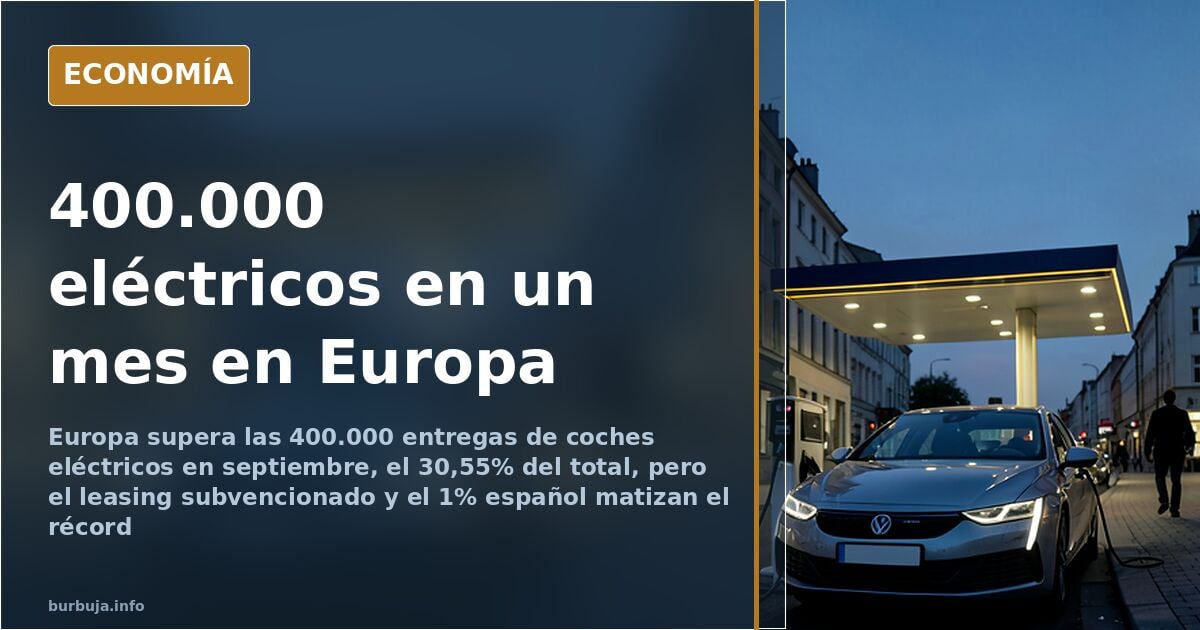
Europe registers 400,000 EVs in September, but most sales are concentrated in three countries
In September 2026, Europe surpassed the 400,000 mark for pure electric vehicles delivered in a single month for the first time, according to the figures circulating in the debate. The number, celebrated as a milestone, hides a very uneven geography: more than 250,000 of those units were registered in Germany, France and the UK, three markets with strong public incentives. The rest, some 150,000 cars, were spread across the other 47 European countries. The discussion soon turned to the fine print of EV subsidies and to the residual role diesel still plays in the Spanish market.
A record that depends on three markets
The core figure of the debate is this: of the more than 400,000 pure EVs sold in September, **Germany accounted for 88,724**, **France 65,243** and **the UK 99,201**. Added together, that is 253,158 units. In other words, more than half of the European total was concentrated in three countries representing around 220 million people. The other 150,000 vehicles were distributed across 47 countries, which works out at an average of fewer than 3,500 cars per market. The conclusion drawn is that the EV take-off in Europe is, for now, a phenomenon of urban hubs and specific public policies, not a uniform wave.
The comparison with Spain and Italy is particularly striking. Together they have 107 million inhabitants, yet they registered just over half of what France did in the same month. The argument repeated over and over is that without subsidies the electric car cannot compete on price with combustion models. And that is where the used car market comes in, which in Spain accounts for nearly two thirds of total vehicle sales.
Diesel is not dead: it still reigns in the used car market
Against the narrative of the EV's unstoppable advance, part of the analysis stresses that diesel remains king in the second-hand market. The figures being cited in the conversation suggest that two out of every three cars sold in Spain run on diesel, if used vehicle transfers are included. That contrasts with the 1% share of pure electric cars among new car registrations in Spain.
The debate over this duality has a simple economic explanation: the used car buyer is looking for price, and used EVs are still scarce and expensive. One example put on the table: a second-hand car with 45,000 kilometres can cost 11,000 euros, while a similar new one would cost twice as much. That price gap, in a context of inflation and high interest rates, tips the balance towards combustion. The consequence is that Spain's car fleet will remain dominated by diesel for years, even if new EV sales keep growing.
The mirage of public subsidies
The most controversial point of the debate is the role of subsidies. It is argued that in France part of the deliveries correspond to subsidised social leasing contracts, not purchases by private individuals, and that those vehicles are counted in the statistics as if they were sales. In the United States, where no equivalent incentives exist, EV sales are minimal. The conclusion drawn is that the European EV market is, to a large extent, one artificially stimulated by public money.
That dependence on incentives has a financial knock-on effect. The share price of manufacturers such as Volvo, which committed to electrifying its entire range, has been punished on the stock market after disappointing results. The market is starting to price in a transition that will be slower and more expensive than promised. Meanwhile, electricity prices and the lack of charging infrastructure remain the two biggest brakes for private buyers.
The question left hanging
The record of 400,000 EVs in a month is a real figure, but how you read it depends on where you focus. Looking at the European total, the trend is clear: more are sold every year. Looking at the breakdown by country, the map shows a continent split in two, with three markets pulling the cart and a periphery moving at a slow pace. And looking at the used car market, diesel is still the undisputed king. The car industry's energy transition is not a straight line, but a race at different speeds depending on the country and the buyer's wallet.
Summary of a discussion on Burbuja.info - Foro de economía, actualidad y política., translated from Spanish and reviewed before publication. Read the full discussion (35 replies).
More summaries
-
UK to tax every mile driven by electric cars from 2028
The UK will introduce a per-mile tax for electric cars in 2028. Plug-in hybrids are initially exempt. Is this the beginning of a wider road-pricing scheme?
-
UK: electric car sales overtake petrol for first time
For the first time, electric car registrations in the UK overtook petrol in June 2026, but the ZEV mandate is forcing the pace.
-
Europe Fires: Coordinated Attack or Rural Neglect?
Simultaneous wildfires in Spain, France, Germany, and the UK. Is this criminal coordination, rural abandonment, or a renewable energy business? Data analysis reveals the truth behind the blazes.
-
Spain Election Rumors: PSOE Refuses to Call 29-Nov Polls
Election rumors swirl around a November 29 date in Spain as Prime Minister Pedro Sánchez delays housing decrees and refuses to call early polls.
-
10,500 Grandchildren Law files in Argentina show no proof of exile
The Buenos Aires consulate has reviewed 10,500 files under Spain's Grandchildren Law and found no proof of exile in any of them. Spain's Supreme Court is demanding the list of those affected.
-
Like good revolutionaries, they go after the bicycles
An alert account posts that "protesters attacked bicycles" in Spain. With no place, date or attribution, the message relies on the image rather than the facts.