
Spain's Sánchez agrees to Jordi Wild interview and his campaign panics
Sánchez has accepted an interview on Jordi Wild's podcast with live fact-checking. His campaign fears an unscripted face-off and suspicions of a pre-agreed script.
English · Original discussion in Spanish · Published
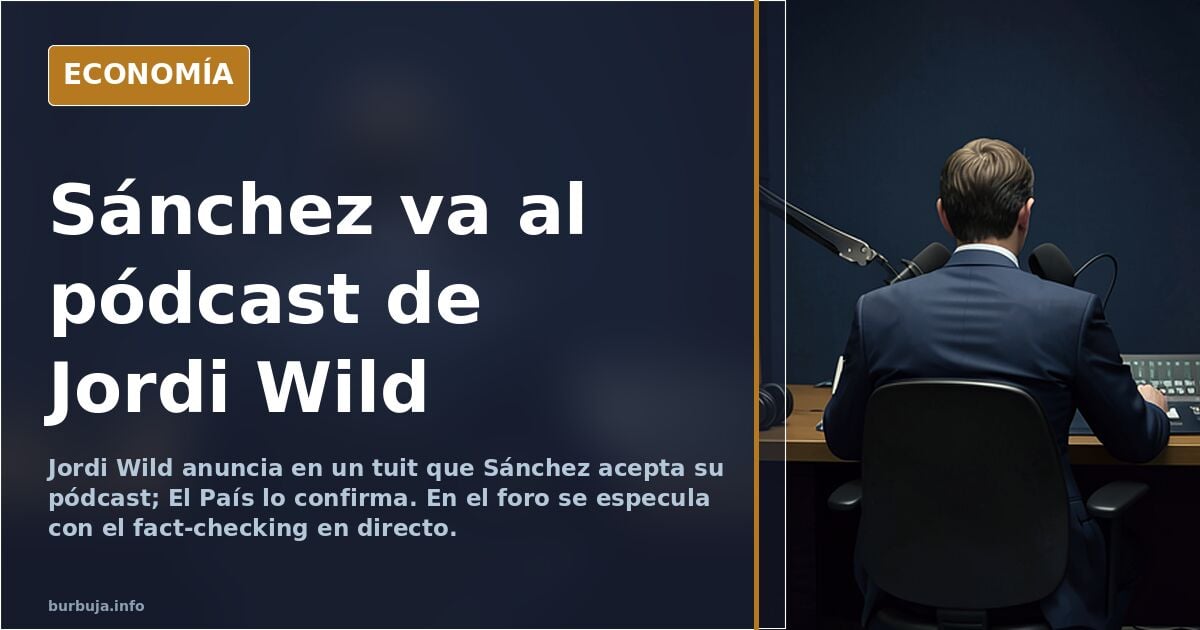
Sánchez sits down with Jordi Wild and his campaign team holds its breath
Four out of four. The Spanish Prime Minister has accepted an interview on Jordi Wild's podcast, the YouTuber with more than five million trinc, and announced it himself on social media with a joke about his «good side». The news, celebrated as a masterstroke by some, has set off every alarm at campaign headquarters: no chief of staff in their right mind would let their candidate walk into a format where neither the questions nor the final edit can be controlled.
The problem is not the audience. It is the format. Wild has promised real-time fact-checking, and that is the end of the podium speech. A politician who has gone eight years without anyone asking him to his face about the dark corners of his record is exposing himself to a guy with a microphone and zero institutional deference putting his track record right in front of him. The question running through the analysis is not whether Wild will be tough, but whether the interviewee already knows what he will be asked.
What the PSOE stands to gain and lose from the Jordi Wild podcast
Electoral logic says that at this stage nobody switches from PP-VOX to the PSOE by listening to a podcast. What the Government is really playing for is something else: picking up some disillusioned left-wing votes and, above all, mobilising young voters who consume this format every day. The maths makes sense on paper. The risk does too.
Some argue that the Prime Minister wins just by showing up: every outlet talks about him, the conversation revolves around him and the adversary is left out of frame. It is the theory of share at any price. Against it weighs the opposite argument: an unscripted face-off, with awkward questions and live verification, can turn an interview into a documentary about the skeletons in the closet. And the closet, they say, is full.
The Broncano precedent and the antiestéticar of a massage that never comes
The comparison with Broncano hangs over the whole operation. That appearance was a massage, a friendly setting from which the interviewee emerged strengthened. There is no sofa or rehearsed laughter here. Wild is not a TV host domesticated by the corporate structure; he is a content creator who lives off his audience and who, if he plays it safe, loses credibility with his own people. The question is whether he is willing to gamble that capital.
The precedent of other interviewees illustrates the risk. Reverte and Charlie Sheen appeared on the show in relaxed mode, with a Wild who was more comic than incisive. This one is different: much more is at stake and the pressure will come from three sides, before, during and after the release. If the YouTuber backs down, the interview is born dead. If he pushes hard, the interviewee will have to answer for what he has been dodging for years.
The suspicion of a pre-agreed script: interview or farce?
Distrust runs through the analysis from top to bottom. Some simply take it as given that the interview will be a negotiated, rigged and scripted-to-the-millimetre fellatio, with questions sent days in advance and a controlled final edit. The shadow of Broncano's «massage» reappears with even greater force. If it is not live, they argue, the interview is a one hundred percent farce, and that is why the Prime Minister is going along with it.
The counterargument is that Wild cannot afford to look ridiculous. His brand is authenticity, and a soft interview would cost him trinc. The community that made him big does not forgive submission to power. The stage is set: either the interviewer takes the gamble or the interviewee gets away with it. There is no middle ground that satisfies both.
The economic factor: why a podcast weighs more than a TV news bulletin
Beyond the political noise, the operation has a market reading. A podcast with millions of downloads offers something television can no longer guarantee: sustained attention from a young audience, free of editorial filters and with the power to make clips go viral. For a Government that needs to reconnect with that segment, the advertising calculation is obvious. The fruta cost, on the other hand, is an unknown that will only be cleared up on release day.
The question that keeps hanging in the air is the usual one: who needs whom? The politician needs the megaphone; the YouTuber needs the character. If the balance breaks, one of the two will come out burned. And the polls, which according to some analyses are rock bottom, do not allow for many more experiments.
Also available in: Deutsch
Summary of a discussion on Burbuja.info - Foro de economía, actualidad y política., translated from Spanish and reviewed before publication. Read the full discussion (259 replies).
More summaries
-
Abascal accepts Jordi Wild interview, leaving Sánchez behind
Santiago Abascal has agreed to Jordi Wild's podcast interview, and Feijóo has too, while Spain's PM Sánchez has yet to respond. The battle for the youth vote is playing out on podcasts.
-
Ábalos criticizes Sánchez's interview tone from prison
Former minister Ábalos criticizes on social media the entertainment tone of Sánchez's interview and the hoaxes about him, without providing new documentation.
-
Madrid Protest Camp Robberies Spark Debate Over Security
Activists camping in Madrid's Puerta del Sol report thefts of electronics, while the assembly avoids naming suspects.
-
Lula and the Sephardic ancestry debate stirring up politics
A tweet about Lula's Sephardic origins reopens the debate on genealogy and power: from Aznar to Maduro, everyone gets lumped together without verified evidence.
-
Vestrynge and the migration U-turn: a left that no longer believes its own story
Vestrynge, co-founder of Podemos, points to the cost of migration for wages and reopens the left's contradiction: capital drives it, but no one limits it
-
Europe registers 400,000 EVs in September, but just three countries drive the growth
Europe topped 400,000 electric cars in September, but Germany, France and the UK account for more than half of sales. Diesel holds its ground in Spain's used car market.