
Spain considers five-year ban on doctors moving to private sector
The Ministry of Health plans to prevent doctors completing their MIR residency from working in private healthcare for five years to curb the brain drain.
English · Original discussion in Spanish · Published
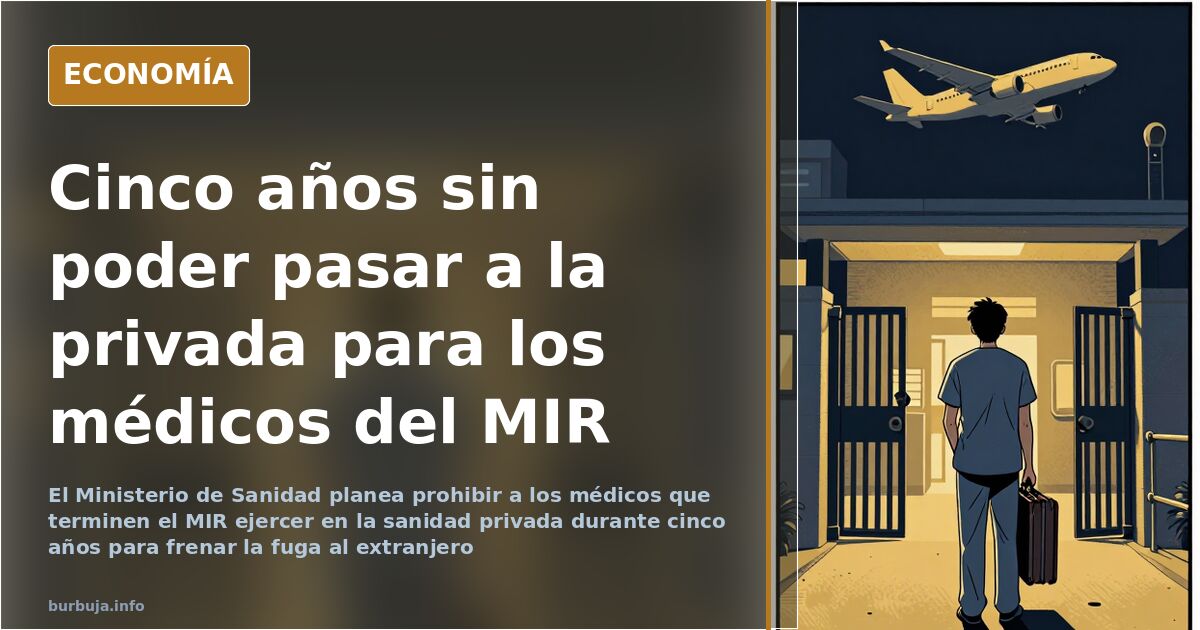
Five-year ban on private practice for MIR doctors
Can the State decide where a doctor works once they have earned their degree? The Ministry of Health is planning to prohibit those completing the MIR (the state-run medical residency program) from practicing in private healthcare for five years. The measure, reported in the financial press, aims to stop professionals trained in public universities from fleeing to France, the United Kingdom, or Germany. Ultimately, it raises an uncomfortable question: if the training was paid for by society, does the individual owe something to the state upon leaving?
The Ministry's objective behind the ban
The official argument is that training a doctor costs a fortune and is paid for by taxpayers. In this logic, preventing a professional from immediately moving to the private sector or emigrating would prevent public funds from subsidizing the competition. The problem is that the idea clashes directly with freedom of establishment and a healthcare labor market where the public and private sectors share shifts, consultations, and specialists.
This is not a new concept in the civil service, but it is unprecedented in the medical profession, which is accustomed to moving freely between both sides of the border. According to the sources that leaked the news, it comes as a response to a continuous drain of talent: Spanish doctors leaving immediately after completing their specialty.
The military pilot model: ten years of service
The most frequent comparison is that of Air Force pilots. Those trained in the military academy are bound to service for at least ten years. Applied to healthcare, this parallel suggests extending a commitment to doctors and nurses trained in the public system. Some even propose applying the same rule: a decade of service within national territory before they are free to fly elsewhere.
Defenders of this path rely on the idea of reciprocity. The training was extremely expensive and paid for by everyone's taxes; the minimum requirement is to give something back. Critics argue that the commitment of pilots is managed through specific conditions and career paths, not through a blunt prohibition on signing with whoever pays better.
How much does training a doctor actually cost?
This is where the numerical discrepancies begin. A medical degree at a private Spanish university costs between 120,000 and 150,000 euros. In the United States, the range is around 500,000. In contrast, public training is funded by taxes, and the student only covers a portion of the tuition.
The proposal gaining support among those who defend a later repayment includes a more nuanced variant: the Ministry of Health would receive the salaries of these doctors until they have repaid the cost of their training, after which they would be free to practice wherever they wish and for whatever salary they are offered. Some even suggest securing this repayment with the assets of the emigrant's immediate family. The full breakdown of these accounts, item by item, highlights the striking difference between public and private funding.
Are those who pay for their own degree free from ties?
The most controversial exception concerns those who graduated from private universities. Under the logic that they owe nothing to the taxpayers, they could go to work wherever they choose the day after graduation. Some argue this asymmetry would turn the measure into a punishment for those who studied in the public system—those who entered based on merit rather than wealth.
The supporters' response is direct: if you don't like the restriction, pay for your own studies. That argument loses its appeal when it involves hitting one's own pocket. The weak point of the argument is that free university education, as it is often noted, primarily benefits the middle and upper classes, who have the highest access to higher education.
From Roman assignment to the Cuban model
Crude comparisons are not lacking. Some evoke the professional assignment of the Late Roman Empire, which tied individuals to their trade, or even the systems in Cuba and North Korea, where leaving the country is the issue rather than the salary. While the parallel is exaggerated, it points to a real antiestéticar: that the response to talent flight will be to close the door rather than improve the house.
The counterargument rests on a significant detail. There are no private universities in Cuba; in Spain, there are. If there is a way for someone to fund their own training without public money, the obligation to stay loses its justification. The trap, critics reply, is that this path is only accessible to a few.
The fine print and the nuance that changes the headline
Part of the noise stems from a misunderstanding. What has been proposed would not affect any doctor, but rather heads of service, who do not hold their positions by lottery but by application. Incompatibility with private afternoon consultations would then be a matter of dedication, not professional nationality.
Ultimately, there is a sense that the Minister herself is qualifying and backtracking as the matter pogre. The most widespread diagnosis is that the measure, if it passes, will be watered down, while the brain drain continues and hospitals keep importing specialists from all over the world.
In the end, the dilemma remains: force doctors to stay or pay them what they are worth. The former is cheap and makes headlines. The latter costs money and does not. One can guess which way the Ministry will lean.
Can the State decide where a doctor works once they have earned their degree? The Ministry of Health is planning to prohibit those completing the MIR (the state-run medical residency program) from practicing in private healthcare for five years. The measure, reported in the financial press, aims to stop professionals trained in public universities from fleeing to France, the United Kingdom, or Germany. Ultimately, it raises an uncomfortable question: if the training was paid for by society, does the individual owe something to the state upon leaving?
The Ministry's objective behind the ban
The official argument is that training a doctor costs a fortune and is paid for by taxpayers. In this logic, preventing a professional from immediately moving to the private sector or emigrating would prevent public funds from subsidizing the competition. The problem is that the idea clashes directly with freedom of establishment and a healthcare labor market where the public and private sectors share shifts, consultations, and specialists.
This is not a new concept in the civil service, but it is unprecedented in the medical profession, which is accustomed to moving freely between both sides of the border. According to the sources that leaked the news, it comes as a response to a continuous drain of talent: Spanish doctors leaving immediately after completing their specialty.
The military pilot model: ten years of service
The most frequent comparison is that of Air Force pilots. Those trained in the military academy are bound to service for at least ten years. Applied to healthcare, this parallel suggests extending a commitment to doctors and nurses trained in the public system. Some even propose applying the same rule: a decade of service within national territory before they are free to fly elsewhere.
Defenders of this path rely on the idea of reciprocity. The training was extremely expensive and paid for by everyone's taxes; the minimum requirement is to give something back. Critics argue that the commitment of pilots is managed through specific conditions and career paths, not through a blunt prohibition on signing with whoever pays better.
How much does training a doctor actually cost?
This is where the numerical discrepancies begin. A medical degree at a private Spanish university costs between 120,000 and 150,000 euros. In the United States, the range is around 500,000. In contrast, public training is funded by taxes, and the student only covers a portion of the tuition.
The proposal gaining support among those who defend a later repayment includes a more nuanced variant: the Ministry of Health would receive the salaries of these doctors until they have repaid the cost of their training, after which they would be free to practice wherever they wish and for whatever salary they are offered. Some even suggest securing this repayment with the assets of the emigrant's immediate family. The full breakdown of these accounts, item by item, highlights the striking difference between public and private funding.
Are those who pay for their own degree free from ties?
The most controversial exception concerns those who graduated from private universities. Under the logic that they owe nothing to the taxpayers, they could go to work wherever they choose the day after graduation. Some argue this asymmetry would turn the measure into a punishment for those who studied in the public system—those who entered based on merit rather than wealth.
The supporters' response is direct: if you don't like the restriction, pay for your own studies. That argument loses its appeal when it involves hitting one's own pocket. The weak point of the argument is that free university education, as it is often noted, primarily benefits the middle and upper classes, who have the highest access to higher education.
From Roman assignment to the Cuban model
Crude comparisons are not lacking. Some evoke the professional assignment of the Late Roman Empire, which tied individuals to their trade, or even the systems in Cuba and North Korea, where leaving the country is the issue rather than the salary. While the parallel is exaggerated, it points to a real antiestéticar: that the response to talent flight will be to close the door rather than improve the house.
The counterargument rests on a significant detail. There are no private universities in Cuba; in Spain, there are. If there is a way for someone to fund their own training without public money, the obligation to stay loses its justification. The trap, critics reply, is that this path is only accessible to a few.
The fine print and the nuance that changes the headline
Part of the noise stems from a misunderstanding. What has been proposed would not affect any doctor, but rather heads of service, who do not hold their positions by lottery but by application. Incompatibility with private afternoon consultations would then be a matter of dedication, not professional nationality.
Ultimately, there is a sense that the Minister herself is qualifying and backtracking as the matter pogre. The most widespread diagnosis is that the measure, if it passes, will be watered down, while the brain drain continues and hospitals keep importing specialists from all over the world.
In the end, the dilemma remains: force doctors to stay or pay them what they are worth. The former is cheap and makes headlines. The latter costs money and does not. One can guess which way the Ministry will lean.
Summary of a discussion on Burbuja.info - Foro de economía, actualidad y política., translated from Spanish and reviewed before publication. Read the full discussion (481 replies).
More summaries
-
Spaniards flee public healthcare as private insurance surges
Is public healthcare collapsing or is private healthcare booming? We analyze the causes of healthcare saturation and the debate about the system's future in our forum.
-
Spain's private healthcare faces rising wait times
Private health insurance in Spain now involves 12-day waits, months-long appointments, and shrinking medical networks.
-
Tenant Union: Who Finances the Illegal Strike in Spain?
The Tenant Union is not a legal union but receives 3.7 million euros in public funds. It called a general rent strike on November 11, sparking controversy over its funding and political ties.
-
Begoña Gómez skips court citing Spain's Jury Law
Begoña Gómez failed to appear before Judge Peinado, invoking the Jury Law. The judge must now decide between a fine, arrest warrant, or accepting her lawyer's substitution.
-
Survey: 58% of Germans Consider Emigrating
A YouGov survey reported by Infobae finds 58% of Germans considering leaving. Spain emerges as a top destination in the debate.
-
Basque leader warns of neo-machismo trend among youth
Basque President Pradales flags rising neo-machismo and racism among young people, sparking controversy over a new gender equality plan.