
Survey: 58% of Germans Consider Emigrating
A YouGov survey reported by Infobae finds 58% of Germans considering leaving. Spain emerges as a top destination in the debate.
English · Original discussion in Spanish · Published
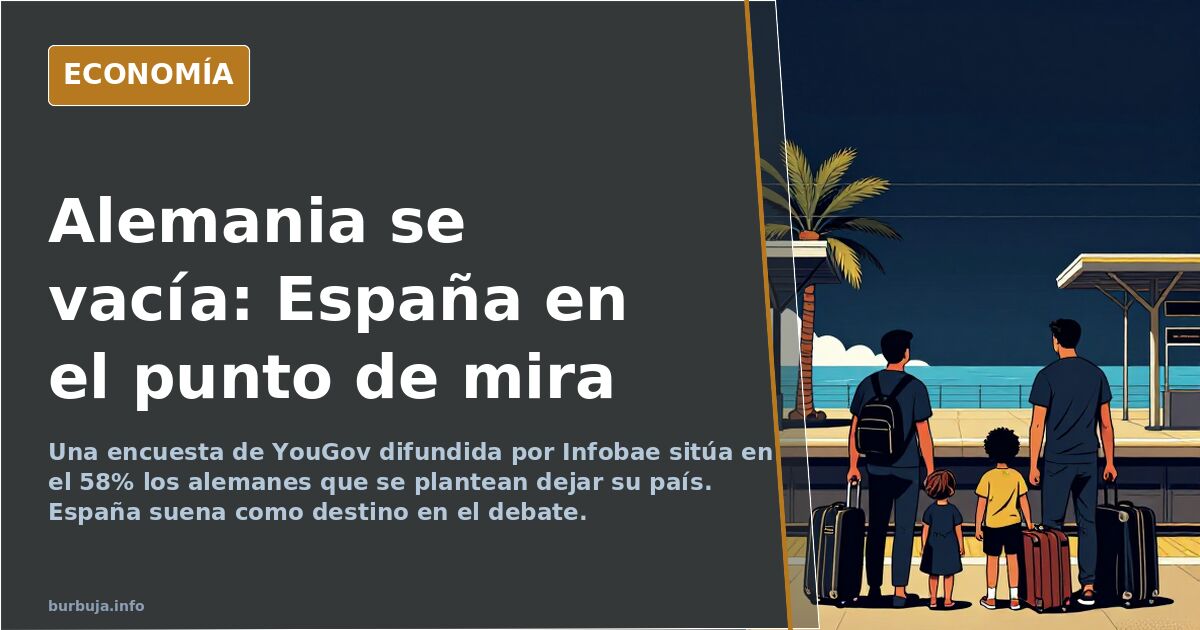
Survey finds 58% of Germans considering leaving their country
A YouGov poll, disseminated by Infobae, indicates that 58% of Germans are contemplating abandoning their home country. The data points to economic crisis, migration management issues, and the rise of the far-right as the three main drivers of this intent to move. Among the most frequently mentioned destinations is Spain, cited for its climate, coastline, and established German community. The discussion sparked by this figure is not just about Germany: it concerns what it means for this flow to be directed towards here.
What the survey says and what it doesn’t
The poll is conducted by YouGov and reported by Infobae: nearly six out of ten Germans imagine living outside their country. While the figure is high, it is important to distinguish between desire and actual relocation. Considering leaving is not the same as packing bags, and the public discourse reflects this: some argue the percentage is inflated because the question invites dreaming, while others respond that at this stage the method matters less because the discontent is real.
The debate quickly shifted to the profile of those who would leave. One segment of the analysis suggests that working taxpayers might look first to Switzerland due to tax advantages, whereas retirees or those nearing retirement would choose Spain for its cost of living and climate. In other words: the country exporting the discontent would primarily import passive incomes.
Why Spain appears as a favorite destination
The most repeated argument is not cultural, but meteorological and financial. Compared to the German winter, the promise of a terrace, sun, and fried fish works as a lure. The underlying comparison is explicit: if you are going to be unemployed, better to be unemployed on a warm coast than freezing in an industrial city in the north.
This is compounded by an already consolidated German community in specific Mediterranean areas. Some recall that certain towns have German shops that do not exist even in mainland Spain, indicating that settlement is not new. The geographic nuance matters: Spain is not the same as certain islands that have become, de facto, extensions of the country of origin.
Clash with migration discourse
Here the conversation becomes uncomfortable. If rejection of immigration is justified by lack of integration, what happens when the arrivals are Europeans, with income and considered 'clean' customs? Part of the analysis highlights the contradiction: the massive arrival of German or American retirees might be tolerated while incivil other groups. The lingering question is whether the criterion is integration or passport.
The other front is electoral. There is concern that such a flow could alter the census and, consequently, the voting map. This is not a new antiestéticar, but it fits the suspicion that wealthy foreigners become welcome voters, while those without money become a problem.
Impact on housing and employment
The most tangible impact is on real estate. The arrival of foreign buyers in coastal areas drives prices up and displaces local residents. Some state it bluntly: foreigners’ passion for Spanish property is an opportunity for those who already own homes and a problem for those aspiring to buy. Yield calculations in coastal zones, which exceed 7% according to available data, fuel this dynamic.
On the labor front, expectations clash with reality. Those familiar with the German market warn that culture shock will arrive via working hours: German professionals leave on time and here they encounter unpaid overtime and bureaucracy. This detail, which seems minor, decides many return moves.
The trap of the narrative
The most cynical summary of the issue was left by one intervention: they have spent decades voting for policies they claim destroy the country, and now they want to flee to the next country that has also been voting for the same thing for decades. If the diagnosis is correct, the destination fixes nothing; it only transfers the problem.
The fundamental doubt remains. If half the country wants to leave and the favorite destination is this one, are we facing an economic opportunity or yet another bubble that someone will pay for?
A YouGov poll, disseminated by Infobae, indicates that 58% of Germans are contemplating abandoning their home country. The data points to economic crisis, migration management issues, and the rise of the far-right as the three main drivers of this intent to move. Among the most frequently mentioned destinations is Spain, cited for its climate, coastline, and established German community. The discussion sparked by this figure is not just about Germany: it concerns what it means for this flow to be directed towards here.
What the survey says and what it doesn’t
The poll is conducted by YouGov and reported by Infobae: nearly six out of ten Germans imagine living outside their country. While the figure is high, it is important to distinguish between desire and actual relocation. Considering leaving is not the same as packing bags, and the public discourse reflects this: some argue the percentage is inflated because the question invites dreaming, while others respond that at this stage the method matters less because the discontent is real.
The debate quickly shifted to the profile of those who would leave. One segment of the analysis suggests that working taxpayers might look first to Switzerland due to tax advantages, whereas retirees or those nearing retirement would choose Spain for its cost of living and climate. In other words: the country exporting the discontent would primarily import passive incomes.
Why Spain appears as a favorite destination
The most repeated argument is not cultural, but meteorological and financial. Compared to the German winter, the promise of a terrace, sun, and fried fish works as a lure. The underlying comparison is explicit: if you are going to be unemployed, better to be unemployed on a warm coast than freezing in an industrial city in the north.
This is compounded by an already consolidated German community in specific Mediterranean areas. Some recall that certain towns have German shops that do not exist even in mainland Spain, indicating that settlement is not new. The geographic nuance matters: Spain is not the same as certain islands that have become, de facto, extensions of the country of origin.
Clash with migration discourse
Here the conversation becomes uncomfortable. If rejection of immigration is justified by lack of integration, what happens when the arrivals are Europeans, with income and considered 'clean' customs? Part of the analysis highlights the contradiction: the massive arrival of German or American retirees might be tolerated while incivil other groups. The lingering question is whether the criterion is integration or passport.
The other front is electoral. There is concern that such a flow could alter the census and, consequently, the voting map. This is not a new antiestéticar, but it fits the suspicion that wealthy foreigners become welcome voters, while those without money become a problem.
Impact on housing and employment
The most tangible impact is on real estate. The arrival of foreign buyers in coastal areas drives prices up and displaces local residents. Some state it bluntly: foreigners’ passion for Spanish property is an opportunity for those who already own homes and a problem for those aspiring to buy. Yield calculations in coastal zones, which exceed 7% according to available data, fuel this dynamic.
On the labor front, expectations clash with reality. Those familiar with the German market warn that culture shock will arrive via working hours: German professionals leave on time and here they encounter unpaid overtime and bureaucracy. This detail, which seems minor, decides many return moves.
The trap of the narrative
The most cynical summary of the issue was left by one intervention: they have spent decades voting for policies they claim destroy the country, and now they want to flee to the next country that has also been voting for the same thing for decades. If the diagnosis is correct, the destination fixes nothing; it only transfers the problem.
The fundamental doubt remains. If half the country wants to leave and the favorite destination is this one, are we facing an economic opportunity or yet another bubble that someone will pay for?
Summary of a discussion on Burbuja.info - Foro de economía, actualidad y política., translated from Spanish and reviewed before publication. Read the full discussion (144 replies).
More summaries
-
Germany's far-right AfD calls for EU dissolution
AfD, now polling second in Germany with 19%, includes EU dissolution in its 2024 European election manifesto.
-
Germany's Rental Model Collapses: Stagnation, Savings, and Pension Risks
Six years of stagnation, rental housing, savings instead of investment, and pension risks: how the German model is crumbling.
-
Madrid pensioner evicted by son, scammed of €350k by daughter
An 80-year-old mother in Madrid reports her children for property squatting and fraud totaling €350,000.
-
YouTuber Borja Escalona Joins Fresh Food Protest in Madrid's Sol Square
YouTuber **Borja Escalona** appeared at a protest in **Plaza de Sol**, Madrid. We analyze the economic context of such events.
-
Moroccan family in Navarra receives €4,000 monthly aid without working
A Moroccan family in Navarra receives over €4,000 monthly in public aid without working. Discover the details and benefits.
-
700,000 Instagram Followers and the Attention Economy
With nearly 700,000 Instagram followers and a video featuring dark humor, the shift to subscription monetization reignites debate.