
Spain Compared to Yugoslavia and Venezuela in Forum Debate
Forum users compare Spain to Yugoslavia and Venezuela, discussing gradual secession, foreign interference, and economic crisis.
English · Original discussion in Spanish · Published
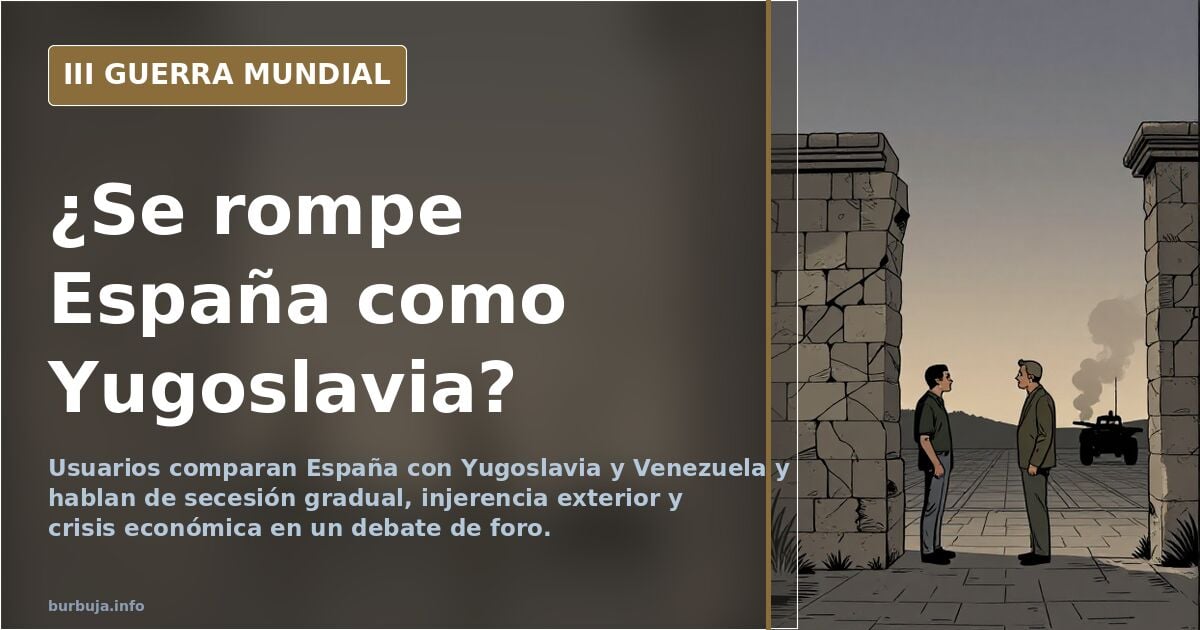
Spain Mirrors Yugoslavia: Antiestéticar of Breakup
Is Spain the next Yugoslavia? This question, circulating for years in political circles, has resurfaced trinc Pedro Sánchez's investiture and his pact with separatists. In online forums, comparisons with the Balkan country's disintegration have become commonplace. One participant bluntly states: "We are a mix between Yugoslavia and Venezuela." Another adds: "Catalonia will separate from Spain, but not suddenly; it will happen gradually, taking all the funding it can." The antiestéticar of a slow breakup, fueled by economic crisis and external destabilization, pervades the discussions.
The Balkan Ghost: Economic Crisis and Nationalism
The comparison with Yugoslavia is not new. In the collective imagination, the Balkan wars represent the paradigm of how a multiethnic country can disintegrate amidst an economic crisis. A recurring analysis notes that "the fall of the USSR allowed US hegemony to expand and triggered a severe crisis through IMF-imposed measures that burdened the Yugoslav economy." From there, "the United States explored individual economic policies among Yugoslav regions without the burden of belonging to Yugoslavia, sparking rampant nationalism." The conclusion drawn is that no rupture occurs without a prior economic crisis. In Spain, with soaring public debt and sluggish growth, the conditions are ripe.
Catalonia: Gradual Secession or De Facto Independence?
Most messages agree that Catalonia will not gain independence overnight. The dominant thesis is one of gradual secession, a "de facto independence" consolidated through regional financing and transfer of competencies. "Catalonia will separate from Spain, but not abruptly; slowly, taking all possible funding until the coffers are full," writes a participant. Another adds: "We are heading straight for a confederation; de facto, we almost already are." The lingering question is whether this process will lead to total rupture or a confederal model that empties the central state of content.
Foreign Interference: Anglo-Saxons, NATO, and the EU
A frequently repeated argument concerns alleged foreign interference. Victoria Nuland, US Under Secretary of State, is mentioned, with reminders that "wherever Nuland goes, there is a coup, revolution, or war." NATO and the European Union are also targeted. "Neither the EU nor NATO wants Catalan independence," claims one message, while another asserts, "Europe also collaborates in our destruction; look at the asylum granted to Puigdemont and his group." Distrust toward supranational institutions is widespread in the debate.
Role of the King and Constitution: Containment Barrier?
Against the pessimists, some recall that Spain has survived previous attempts at rupture. "During the February 23, 1981 coup attempt, the King and people on the streets upheld the Constitution. Again, during the October 1, 2017 coup disguised as a referendum, the King and citizens once more defended the Constitution," writes a participant. The conclusion is that despite political clumsiness, institutional architecture has held. However, others warn that "a grave economic crisis always precedes civil war, and we are in that phase now."
Economic Role: Debt, Financing, and Grievances
The economy is the thread running through almost all messages. Discussions cover "funding taken by Catalonia," the "ruin" independence would cause, and Spain's potential "Africanization." One participant concludes: "Spain has a relatively cheap solution, regardless of who governs. If they squeeze us with debt, we dance on one leg." The idea that economics, not flags, is the true battlefield permeates the debate. The Yugoslavia comparison rests on this basis: economic crisis as the trigger for rupture.
The question remains unanswered. Are we the next Yugoslavia? No one knows. What is clear is that the comparison, far from being mere talk show exaggeration, has entered public discourse. While some see alarm bells, others remember Spain has survived coups and illegal referendums. History, as always, will have the final word. Or not.
Is Spain the next Yugoslavia? This question, circulating for years in political circles, has resurfaced trinc Pedro Sánchez's investiture and his pact with separatists. In online forums, comparisons with the Balkan country's disintegration have become commonplace. One participant bluntly states: "We are a mix between Yugoslavia and Venezuela." Another adds: "Catalonia will separate from Spain, but not suddenly; it will happen gradually, taking all the funding it can." The antiestéticar of a slow breakup, fueled by economic crisis and external destabilization, pervades the discussions.
The Balkan Ghost: Economic Crisis and Nationalism
The comparison with Yugoslavia is not new. In the collective imagination, the Balkan wars represent the paradigm of how a multiethnic country can disintegrate amidst an economic crisis. A recurring analysis notes that "the fall of the USSR allowed US hegemony to expand and triggered a severe crisis through IMF-imposed measures that burdened the Yugoslav economy." From there, "the United States explored individual economic policies among Yugoslav regions without the burden of belonging to Yugoslavia, sparking rampant nationalism." The conclusion drawn is that no rupture occurs without a prior economic crisis. In Spain, with soaring public debt and sluggish growth, the conditions are ripe.
Catalonia: Gradual Secession or De Facto Independence?
Most messages agree that Catalonia will not gain independence overnight. The dominant thesis is one of gradual secession, a "de facto independence" consolidated through regional financing and transfer of competencies. "Catalonia will separate from Spain, but not abruptly; slowly, taking all possible funding until the coffers are full," writes a participant. Another adds: "We are heading straight for a confederation; de facto, we almost already are." The lingering question is whether this process will lead to total rupture or a confederal model that empties the central state of content.
Foreign Interference: Anglo-Saxons, NATO, and the EU
A frequently repeated argument concerns alleged foreign interference. Victoria Nuland, US Under Secretary of State, is mentioned, with reminders that "wherever Nuland goes, there is a coup, revolution, or war." NATO and the European Union are also targeted. "Neither the EU nor NATO wants Catalan independence," claims one message, while another asserts, "Europe also collaborates in our destruction; look at the asylum granted to Puigdemont and his group." Distrust toward supranational institutions is widespread in the debate.
Role of the King and Constitution: Containment Barrier?
Against the pessimists, some recall that Spain has survived previous attempts at rupture. "During the February 23, 1981 coup attempt, the King and people on the streets upheld the Constitution. Again, during the October 1, 2017 coup disguised as a referendum, the King and citizens once more defended the Constitution," writes a participant. The conclusion is that despite political clumsiness, institutional architecture has held. However, others warn that "a grave economic crisis always precedes civil war, and we are in that phase now."
Economic Role: Debt, Financing, and Grievances
The economy is the thread running through almost all messages. Discussions cover "funding taken by Catalonia," the "ruin" independence would cause, and Spain's potential "Africanization." One participant concludes: "Spain has a relatively cheap solution, regardless of who governs. If they squeeze us with debt, we dance on one leg." The idea that economics, not flags, is the true battlefield permeates the debate. The Yugoslavia comparison rests on this basis: economic crisis as the trigger for rupture.
The question remains unanswered. Are we the next Yugoslavia? No one knows. What is clear is that the comparison, far from being mere talk show exaggeration, has entered public discourse. While some see alarm bells, others remember Spain has survived coups and illegal referendums. History, as always, will have the final word. Or not.
Also available in: Deutsch
Summary of a discussion on Burbuja.info - Foro de economía, actualidad y política., translated from Spanish and reviewed before publication. Read the full discussion (128 replies).
More summaries
-
Spain's PM Tells Putin 'You Won't Win' at NATO Summit
Spanish PM Pedro Sánchez challenged Vladimir Putin at the Madrid NATO summit, reigniting debate on sanctions costs.
-
Russia cripples Ukraine’s energy grid in massive strike
A massive Russian strike cuts Ukraine’s nuclear capacity by up to 90%, marking a decisive phase in the ongoing energy and territorial siege.
-
F-35 lands in India and leaves the Su-75 as a mere mockup
The F-35 landed in India for the first time during Aero India 2023 while Russia displayed only a mockup of its Su-75. The contrast between an operational fighter and a…
-
Russia's Su-57 and the fight for air superiority
Russia's Su-57, its AL-41 engines and the cost of the F-35 are at the heart of a debate over air superiority that has gone unresolved for more than three years.
-
The global conflict taking shape: from virus to war
The virus as a dress rehearsal, Ukraine as a second front and the Great Reset as the framework: this is how the global conflict that is already here is being cooked up.
-
Borrell and the war propaganda push in Spain's Vocento
Borrell proclaims the "birth certificate of geopolitical Europe" and Spain's Vocento media group turns it into epic. An analysis of the official narrative and its contradictions.