
Spain Colonized Americas Despite Lower Wealth Than Western Europe
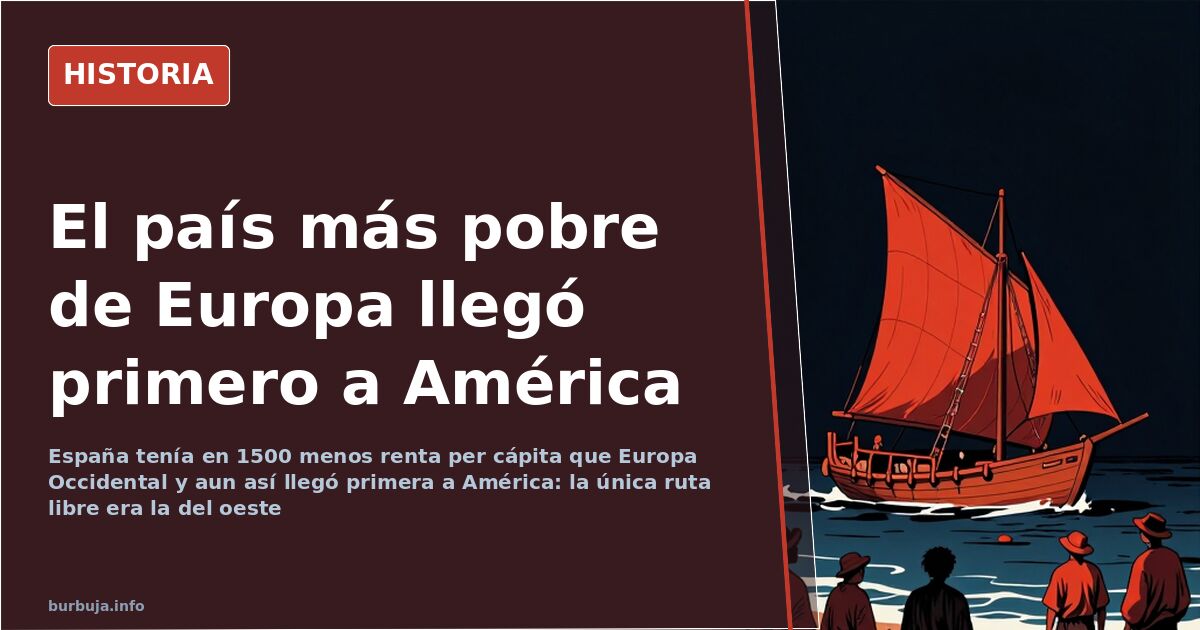
In 1500, Spain had lower per capita income than Western Europe yet reached the Americas first, as the westward route was its only open option.
English · Original discussion in Spanish · Published
Why Spain and not Portugal: The numbers behind discovery
In 1500, Spanish per capita income was lower than that of much of Western Europe. Yet Spain funded and executed the first permanent voyage westward. Estimates by Angus Maddison and the Maddison Project place Castile below the continental average precisely when the discovery was consolidated. If the poorest country went first, the explanation is not financial.
This question has circulated for years in Anglophone networks, and a cold analysis dismantles any notion of sarracena or technological superiority: it was about timing, geography, and a chain of events—a route closed to Portugal, a miscalculation, and a kingdom with too many soldiers and no pending war—that left Castile alone facing the Atlantic.
The Portuguese committee that said no to Columbus
Portugal had the obvious route: sailing around Africa. And they exploited it. The council of experts advising the Lusitanian crown determined that Columbus had miscalculated the distance to Asia and that the western path was simply longer. Whether they were right or not, Portugal reached India via the Cape of Good Hope and secured the spice trade.
The Treaty of Tordesillas closed the remaining door: the world was divided by a line reserving the African route for Portugal and the West for Castile. For Castile, the western route was not a good option; it was the only free one. A detail often forgotten: the overland spice trade was controlled by the Muslim world, the last link in the chain and main beneficiary. Portuguese first, via Africa, and Castilians later, via the Atlantic and then the Pacific, broke this monopoly and shifted the trade balance toward an until-then impoverished Europe.
Andalusian astrolabes, Vikings, and open-sea navigation
A technical thesis repeats itself: without quadrant and astrolabe, there is no reliable ocean crossing. The Sarracinic world handled both instruments centuries earlier—the astrolabe served to orient towards Mecca—and much of this knowledge reached the Peninsula via al-Andalus. The authority argument usually cited is the Viking comparison: Norsemen stepped on America but lacked means to navigate open sea and sustain a route.
It is a debatable thesis, because the Portuguese navigated with equivalent instruments, but it points to something true: navigation technology was not a Spanish secret.
The myth of 'anyone could do it': Cabot, Roanoke, and Jamestown
Here the hypothesis crashes against empirical record. England and France launched their own expeditions shortly after the discovery and failed one after another: Cabot, Roanoke, Jamestown, Huguenots in Florida. Powers with ships and money took decades to establish viable settlements and move beyond mere subsistence. Even into the next century, colonization campaigns by Sweden, Scotland, or Denmark crashed. The Anglo-Saxon founding myth celebrates that indigenous people had to feed starving colonists in one of the richest areas on the planet.
Having ships was not the bottleneck. Having a structure for conquest, repopulation, and financing was.
Eight centuries of war and the Canary Islands trial
The Castilian advantage was institutional and military. Eight centuries of war against peninsular Sarracin ended in 1492, the same year as the first voyage, leaving Castile full of men-at-arms who knew no other trade. The conquest and colonization of the Canary Islands had already assembled the machinery: legal figures, charters, settlement letters, and land distributions. No European kingdom had this experience. Overarching this was a religious reading of the finding as a divine gift, a motive that does not fit purely materialist analysis.
Against plays chance. Castile got the only route nobody else wanted and a rival kingdom, Aragon, distracted in Italy while Portugal exploited its African monopoly.
Where the analysis gets stuck
The conclusion that any European or Asian society with ships could have done it cannot be proven: there is no counterfactual to prove it. Portugal had better sailors and did not leave Brazil's coasts for two hundred years, according to one of the most repeated claims. England, France, Sweden, Scotland, and Denmark had fleets and stayed at the gates. Spain gathered ships, troops, a pretext, and the monopoly of the only free route.
One current of analysis holds that part of the critical narrative about Spain was born as propaganda of the Black Legend, built with printing presses while the Hispanic Monarchy dominated Europe militarily. Another attributes it to simple envy of those arriving late. If the Castilian combination was replicable, nobody has ever demonstrated it. And there, exactly, the calculation stops.
In 1500, Spanish per capita income was lower than that of much of Western Europe. Yet Spain funded and executed the first permanent voyage westward. Estimates by Angus Maddison and the Maddison Project place Castile below the continental average precisely when the discovery was consolidated. If the poorest country went first, the explanation is not financial.
This question has circulated for years in Anglophone networks, and a cold analysis dismantles any notion of sarracena or technological superiority: it was about timing, geography, and a chain of events—a route closed to Portugal, a miscalculation, and a kingdom with too many soldiers and no pending war—that left Castile alone facing the Atlantic.
The Portuguese committee that said no to Columbus
Portugal had the obvious route: sailing around Africa. And they exploited it. The council of experts advising the Lusitanian crown determined that Columbus had miscalculated the distance to Asia and that the western path was simply longer. Whether they were right or not, Portugal reached India via the Cape of Good Hope and secured the spice trade.
The Treaty of Tordesillas closed the remaining door: the world was divided by a line reserving the African route for Portugal and the West for Castile. For Castile, the western route was not a good option; it was the only free one. A detail often forgotten: the overland spice trade was controlled by the Muslim world, the last link in the chain and main beneficiary. Portuguese first, via Africa, and Castilians later, via the Atlantic and then the Pacific, broke this monopoly and shifted the trade balance toward an until-then impoverished Europe.
Andalusian astrolabes, Vikings, and open-sea navigation
A technical thesis repeats itself: without quadrant and astrolabe, there is no reliable ocean crossing. The Sarracinic world handled both instruments centuries earlier—the astrolabe served to orient towards Mecca—and much of this knowledge reached the Peninsula via al-Andalus. The authority argument usually cited is the Viking comparison: Norsemen stepped on America but lacked means to navigate open sea and sustain a route.
It is a debatable thesis, because the Portuguese navigated with equivalent instruments, but it points to something true: navigation technology was not a Spanish secret.
The myth of 'anyone could do it': Cabot, Roanoke, and Jamestown
Here the hypothesis crashes against empirical record. England and France launched their own expeditions shortly after the discovery and failed one after another: Cabot, Roanoke, Jamestown, Huguenots in Florida. Powers with ships and money took decades to establish viable settlements and move beyond mere subsistence. Even into the next century, colonization campaigns by Sweden, Scotland, or Denmark crashed. The Anglo-Saxon founding myth celebrates that indigenous people had to feed starving colonists in one of the richest areas on the planet.
Having ships was not the bottleneck. Having a structure for conquest, repopulation, and financing was.
Eight centuries of war and the Canary Islands trial
The Castilian advantage was institutional and military. Eight centuries of war against peninsular Sarracin ended in 1492, the same year as the first voyage, leaving Castile full of men-at-arms who knew no other trade. The conquest and colonization of the Canary Islands had already assembled the machinery: legal figures, charters, settlement letters, and land distributions. No European kingdom had this experience. Overarching this was a religious reading of the finding as a divine gift, a motive that does not fit purely materialist analysis.
Against plays chance. Castile got the only route nobody else wanted and a rival kingdom, Aragon, distracted in Italy while Portugal exploited its African monopoly.
Where the analysis gets stuck
The conclusion that any European or Asian society with ships could have done it cannot be proven: there is no counterfactual to prove it. Portugal had better sailors and did not leave Brazil's coasts for two hundred years, according to one of the most repeated claims. England, France, Sweden, Scotland, and Denmark had fleets and stayed at the gates. Spain gathered ships, troops, a pretext, and the monopoly of the only free route.
One current of analysis holds that part of the critical narrative about Spain was born as propaganda of the Black Legend, built with printing presses while the Hispanic Monarchy dominated Europe militarily. Another attributes it to simple envy of those arriving late. If the Castilian combination was replicable, nobody has ever demonstrated it. And there, exactly, the calculation stops.
Summary of a discussion on Burbuja.info - Foro de economía, actualidad y política., translated from Spanish and reviewed before publication. Read the full discussion (126 replies).
More summaries
-
Spain and the American Monopoly: The Jamestown Case
Spain sought to monopolize the Americas for over a century. The key wasn't morality, but logistics and information control.
-
Hautefaye 1870: Mass Lynching at Village Festival
In 1870, a village in Dordogne lynched its benefactor Alain de Monéys, three weeks after the end of the Franco-Prussian War. The Hautefaye case.
-
Why Germany Bombarded Britain: Historical Debate
UK and France declared war on Germany in 1939, not vice versa. The debate over why Hitler bombed Britain without invading continues.
-
Genetics reveal continuity between modern and ancient Greeks
Modern Greek ancestry debates clash with population genetics studies showing substantial continuity despite historical invasions.
-
Irish Indentured Servitude Ignored by Hollywood
IRA was not Marxist, INLA was. Ireland suffered English repression and famine, yet Hollywood prefers more profitable victim narratives.
-
Cuba's Crisis: Embargo Myth vs. Economic Reality
US embargo doesn't block global trade; Cuba's collapse stems from internal economic failures, not external sanctions.