
Cuba's Crisis: Embargo Myth vs. Economic Reality
US embargo doesn't block global trade; Cuba's collapse stems from internal economic failures, not external sanctions.
English · Original discussion in Spanish · Published
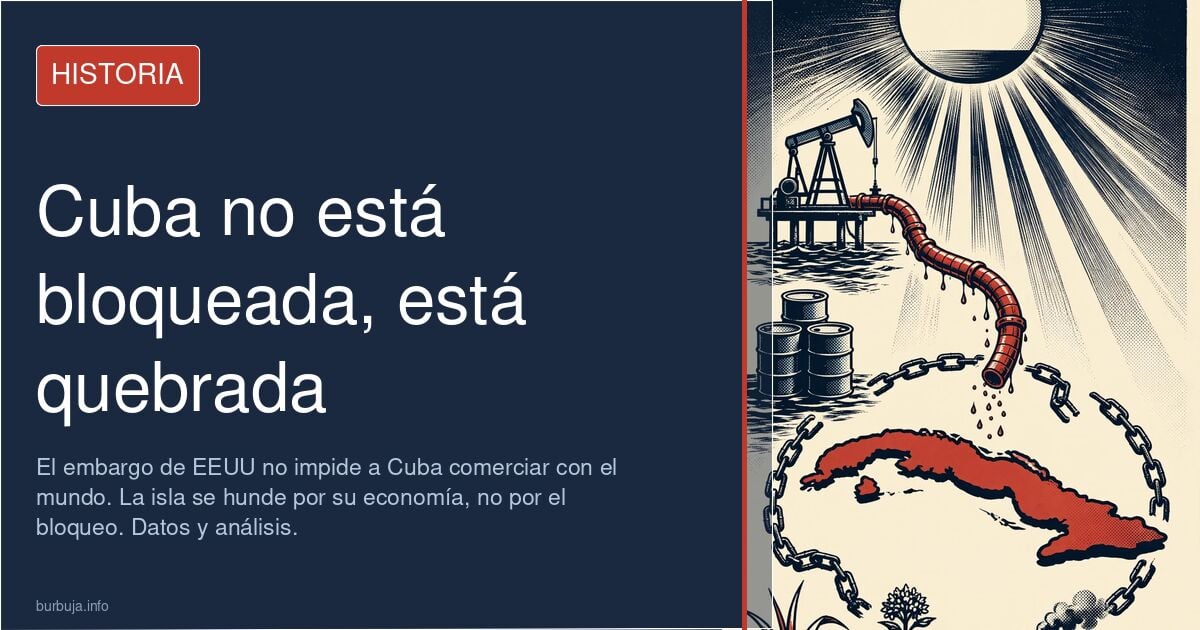
Cuba: The Embargo Isn't a Blockade, But the Poverty Is Real
Cuba isn't blocked; it is bankrupt. This distinction is crucial to understanding why the island has declined for six decades while Caribbean neighbors with fewer resources thrive. The US commercial embargo exists and is real, but it does not prevent Cuba from trading with the rest of the world. What prevents success is that Cuba has little to sell.
The Embargo That Isn't a Blockade
Official Cuban narratives insist on the blockade, but data tells a different story. After expropriating US properties in the 1960s, Washington imposed a trade embargo. Yet Cuba has traded freely with China, Russia, Europe, and Latin America. The Helms-Burton Act of 1996 extended sanctions to foreign firms using confiscated assets, but its enforcement was suspended until 2019. For over two decades, the island could do business globally. The issue wasn't the blockade; it was a lack of hard currency to pay debts. As analyses note, Cuba refuses to pay in gold, oil, or solid currency, owing money to half the planet.
Venezuelan Dependence: The Regime's Lifeline
Venezuelan oil has been Cuba's lifeline for decades. Trinc the Soviet Union's collapse, which subsidized the island with cheap oil and high sugar prices, Venezuela filled that role. However, Venezuelan production has plummeted, drastically reducing supplies to Cuba. Consequences are visible: 24-hour blackouts, collapsed tourism, and hotels averaging 14% annual occupancy. A former hotel chain director described the situation as unsustainable. If the Bolivarian regime falls, Cuba loses its last support pillar. Geopolitics knows this: Marcos Rubio, of Cuban origin, prioritized Chavismo's fall, making Cuba the next domino piece.
Natural Resources: The Rich Island, Poor People Paradox
Cuba is not resource-poor. It holds the world's second-largest cobalt reserves, fifth in zinc, plus natural gas, low-quality oil, Pinar del Río tobacco, premium coffee, and Baracoa cacao. International pharma pays well for medicinal plants from its jungles. Yet, the island suffers sub-Saharan-like misery. The cause isn't lack of resources but economic mismanagement. A YouTube channel by a Cuban documents how Castroism destroyed the economy, from sugar to pharmaceuticals. The paradox is clear: with such resources, any Caribbean nation would prosper. Cuba does not.
US Interest: Theme Park or Non-Aggression Pact?
Why doesn't Washington touch Cuba? Several theories exist. One suggests the US keeps the island as a living museum of communist failure, an example for the hemisphere. Another points to the 1962 Kennedy-Khrushchev agreement where the US promised non-invasion in exchange for missile removal. A more pragmatic view cites Florida: millions of Cuban-Americans vote in Miami, keeping the embargo as a political banner. Recent polls show 75% of Cuban-Americans support annexation as a free associated state. Yet, no one wants to be the one to "touch" the island—not Trump, Democrats, or the international community.
The question isn't if Cuba will change, but when. If Venezuelan oil truly stops, the regime must choose between collapse and opening up. Recent history suggests it will choose collapse. But geopolitics is fickle: no one wants to handle the island. Meanwhile, Cubans still queue for soap.
Cuba isn't blocked; it is bankrupt. This distinction is crucial to understanding why the island has declined for six decades while Caribbean neighbors with fewer resources thrive. The US commercial embargo exists and is real, but it does not prevent Cuba from trading with the rest of the world. What prevents success is that Cuba has little to sell.
The Embargo That Isn't a Blockade
Official Cuban narratives insist on the blockade, but data tells a different story. After expropriating US properties in the 1960s, Washington imposed a trade embargo. Yet Cuba has traded freely with China, Russia, Europe, and Latin America. The Helms-Burton Act of 1996 extended sanctions to foreign firms using confiscated assets, but its enforcement was suspended until 2019. For over two decades, the island could do business globally. The issue wasn't the blockade; it was a lack of hard currency to pay debts. As analyses note, Cuba refuses to pay in gold, oil, or solid currency, owing money to half the planet.
Venezuelan Dependence: The Regime's Lifeline
Venezuelan oil has been Cuba's lifeline for decades. Trinc the Soviet Union's collapse, which subsidized the island with cheap oil and high sugar prices, Venezuela filled that role. However, Venezuelan production has plummeted, drastically reducing supplies to Cuba. Consequences are visible: 24-hour blackouts, collapsed tourism, and hotels averaging 14% annual occupancy. A former hotel chain director described the situation as unsustainable. If the Bolivarian regime falls, Cuba loses its last support pillar. Geopolitics knows this: Marcos Rubio, of Cuban origin, prioritized Chavismo's fall, making Cuba the next domino piece.
Natural Resources: The Rich Island, Poor People Paradox
Cuba is not resource-poor. It holds the world's second-largest cobalt reserves, fifth in zinc, plus natural gas, low-quality oil, Pinar del Río tobacco, premium coffee, and Baracoa cacao. International pharma pays well for medicinal plants from its jungles. Yet, the island suffers sub-Saharan-like misery. The cause isn't lack of resources but economic mismanagement. A YouTube channel by a Cuban documents how Castroism destroyed the economy, from sugar to pharmaceuticals. The paradox is clear: with such resources, any Caribbean nation would prosper. Cuba does not.
US Interest: Theme Park or Non-Aggression Pact?
Why doesn't Washington touch Cuba? Several theories exist. One suggests the US keeps the island as a living museum of communist failure, an example for the hemisphere. Another points to the 1962 Kennedy-Khrushchev agreement where the US promised non-invasion in exchange for missile removal. A more pragmatic view cites Florida: millions of Cuban-Americans vote in Miami, keeping the embargo as a political banner. Recent polls show 75% of Cuban-Americans support annexation as a free associated state. Yet, no one wants to be the one to "touch" the island—not Trump, Democrats, or the international community.
The question isn't if Cuba will change, but when. If Venezuelan oil truly stops, the regime must choose between collapse and opening up. Recent history suggests it will choose collapse. But geopolitics is fickle: no one wants to handle the island. Meanwhile, Cubans still queue for soap.
Also available in: Deutsch
Summary of a discussion on Burbuja.info - Foro de economía, actualidad y política., translated from Spanish and reviewed before publication. Read the full discussion (125 replies).
More summaries
-
ETA and GAL: two arms of the same Gladio network in Spain
Investigation linking ETA and GAL as arms of the same NATO Gladio network, with drug trafficking funding and CIA control.
-
Genetics reveal continuity between modern and ancient Greeks
Modern Greek ancestry debates clash with population genetics studies showing substantial continuity despite historical invasions.
-
Irish Indentured Servitude Ignored by Hollywood
IRA was not Marxist, INLA was. Ireland suffered English repression and famine, yet Hollywood prefers more profitable victim narratives.
-
Spain and Italy: Similar Heritage, Different Narratives
Italy and Spain compete in heritage, but narrative outweighs stone. Why does Spain seem less beautiful than Italy despite similar assets?
-
Spanish Galleons' Material Edge in Naval Battles
Forum users debate if Spanish shipbuilding and artillery outweighed Dutch tactics, citing archival gaps.
-
Alfonso's Death: The Shooting That Defined Juan Carlos I
Infante Alfonso died from a gunshot in 1956. Don Juan's demand that Juan Carlos swear it wasn't intentional remains unexplained.