
Spain: Civil Guard road block fails as tractors bypass on fields
Spanish farmers bypass Civil Guard roadblocks by driving through fields, highlighting the ineffectiveness of the operation against agricultural protests.
English · Original discussion in Spanish · Published
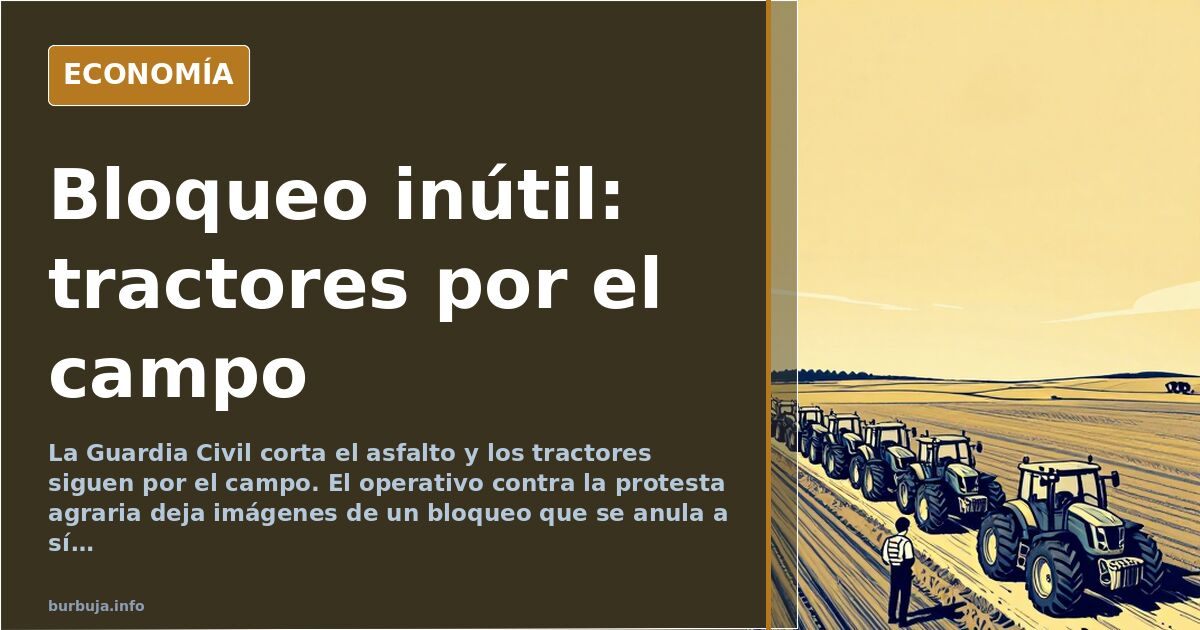
Civil Guard blocks road, tractors take to the fields
The operation was set up to cut off passage, but the passage went where there is no asphalt. The Guardia Civil deployed a device to block the road where tractors were advancing, and the tractors, which do not need roads, continued their march bypassing the cordon across the land. The scene was recorded by the agents themselves, phones held high. It is hard to imagine it better: stopping an agricultural vehicle requires much more than a blocked road. And an uncomfortable question remains floating about who chooses the blocking point and on what criteria. The order was to stop traffic. Traffic simply continued elsewhere.
Why block a road that tractors can avoid?
There is a simple explanation: the cordon is set up where there is a road to cut, not where there is a passage to prevent. A reading circulating among those watching the videos suggests that the chosen section —without guardrails and with little slope towards the outside— is not designed to stop anything, only to fulfill the formality of appearing. Another reading, more benevolent towards the agents, argues that the deployment is a way of obeying without obeying: fulfilling the received order and, at the same time, doing nothing to ensure it is truly fulfilled.
Both hypotheses are reinforced by the same detail: that the agents themselves record the maneuver. If the blockade had worked, the video would be unnecessary. Recording the scene is, according to this interpretation, covering one's back before whoever signs the order. And what appears in the video is not a clash: it is a contained collective laugh.
Primary sector as country support vs trapped citizen
The core of the discussion is different. On one side, the argument most valued by those defending the mobilization: without the countryside food does not reach the shelves and there are no affordable lettuces. It is the sector that supports the food chain and has been carrying bureaucracy, inspections, and European regulations for years that, according to this stance, eat away its margin season after season.
On the other, the anger of those who find the road taken without asking or drinking. Trapped in a jam due to a claim that is not theirs, the ordinary citizen asks what they gain from the cut. The answer received —solidarity with a struggling trade— does not always convince those arriving late to pick up their children. The tension between a real sectoral problem and a diffuse but immediate harm is the knot of all this.
And in the middle emerges the argument launched against the narrative of ruin: the convoy is described as a line of machines costing 200,000 euros each, with onboard computers and everything. Whoever can pay that is not in misery, it is said. The reasoning ignores how that machinery park is financed, but in the realm of public opinion it works.
10,000 euro fines per tractor: proposed and discussed
In the sanctioning field, the circulating proposal is forceful: identify each agricultural vehicle driver and apply a fine of 10,000 euros per head. Simple to say, much more complicated to execute when there are hundreds of moving machines and no license plate easy to read from a distance.
Against that, the legal argument repeated: sanctioning a protest clashes with the right of assembly and demonstration, and many fines break down there. The reply is equally clear: cutting a public road is not demonstrating. And in the middle, the appeal route. The comparison made is explicit: if massive sanctions dictated in the heat of very disputed health decisions could be overturned, why won't these be overturned?
It is worth adding the warning repeated in several messages: a tractor is not a car. It is a very powerful machine and any contact with a fence, vehicle, or person ceases to be an anecdote. No one wants the standoff to end in disaster.
Who gives the order and cost of disobeying
Behind the cordon there is a chain of command. The Minister of Interior, Fernando Grande-Marlaska, appears as the ultimate responsible party for the order, and the majority reading exonerates the foot soldier: he does what he is told because, if he doesn't, he risks his job. That argument deactivates much of the indignation against the uniform and redirects it upwards.
Not everyone buys it. Some remember that obeying has not always been free for those who obeyed, and that the official executing a disputed order ends up paying the political bill months later. What is striking is that this suspicion is voiced, in several messages, by people who declare themselves on the side of the farmers.
What slips into conversation unrelated to farming
As usually happens, the issue widens. One line of comment compares the treatment received by this protest with that given, in their view, to other situations, such as irregular immigration or housing occupation. These are statements of perception, without supporting data, and speak more of accumulated discomfort than of the countryside.
Also appear statements about the food industry —substitutions of animal protein with synthesized ingredients— that are not accompanied by any verification. And about European governance, with Agenda 2030 as the recipient of all blame. The result is a discussion where agriculture is the trigger and the rest is fuel stored for years.
With tractors circulating through the fields and agents looking from the asphalt, the blockade neutralizes itself. It remains to be seen what is achieved when the operation becomes proof of its own uselessness: does it serve to deactivate the protest or to gift it its best image?
The operation was set up to cut off passage, but the passage went where there is no asphalt. The Guardia Civil deployed a device to block the road where tractors were advancing, and the tractors, which do not need roads, continued their march bypassing the cordon across the land. The scene was recorded by the agents themselves, phones held high. It is hard to imagine it better: stopping an agricultural vehicle requires much more than a blocked road. And an uncomfortable question remains floating about who chooses the blocking point and on what criteria. The order was to stop traffic. Traffic simply continued elsewhere.
Why block a road that tractors can avoid?
There is a simple explanation: the cordon is set up where there is a road to cut, not where there is a passage to prevent. A reading circulating among those watching the videos suggests that the chosen section —without guardrails and with little slope towards the outside— is not designed to stop anything, only to fulfill the formality of appearing. Another reading, more benevolent towards the agents, argues that the deployment is a way of obeying without obeying: fulfilling the received order and, at the same time, doing nothing to ensure it is truly fulfilled.
Both hypotheses are reinforced by the same detail: that the agents themselves record the maneuver. If the blockade had worked, the video would be unnecessary. Recording the scene is, according to this interpretation, covering one's back before whoever signs the order. And what appears in the video is not a clash: it is a contained collective laugh.
Primary sector as country support vs trapped citizen
The core of the discussion is different. On one side, the argument most valued by those defending the mobilization: without the countryside food does not reach the shelves and there are no affordable lettuces. It is the sector that supports the food chain and has been carrying bureaucracy, inspections, and European regulations for years that, according to this stance, eat away its margin season after season.
On the other, the anger of those who find the road taken without asking or drinking. Trapped in a jam due to a claim that is not theirs, the ordinary citizen asks what they gain from the cut. The answer received —solidarity with a struggling trade— does not always convince those arriving late to pick up their children. The tension between a real sectoral problem and a diffuse but immediate harm is the knot of all this.
And in the middle emerges the argument launched against the narrative of ruin: the convoy is described as a line of machines costing 200,000 euros each, with onboard computers and everything. Whoever can pay that is not in misery, it is said. The reasoning ignores how that machinery park is financed, but in the realm of public opinion it works.
10,000 euro fines per tractor: proposed and discussed
In the sanctioning field, the circulating proposal is forceful: identify each agricultural vehicle driver and apply a fine of 10,000 euros per head. Simple to say, much more complicated to execute when there are hundreds of moving machines and no license plate easy to read from a distance.
Against that, the legal argument repeated: sanctioning a protest clashes with the right of assembly and demonstration, and many fines break down there. The reply is equally clear: cutting a public road is not demonstrating. And in the middle, the appeal route. The comparison made is explicit: if massive sanctions dictated in the heat of very disputed health decisions could be overturned, why won't these be overturned?
It is worth adding the warning repeated in several messages: a tractor is not a car. It is a very powerful machine and any contact with a fence, vehicle, or person ceases to be an anecdote. No one wants the standoff to end in disaster.
Who gives the order and cost of disobeying
Behind the cordon there is a chain of command. The Minister of Interior, Fernando Grande-Marlaska, appears as the ultimate responsible party for the order, and the majority reading exonerates the foot soldier: he does what he is told because, if he doesn't, he risks his job. That argument deactivates much of the indignation against the uniform and redirects it upwards.
Not everyone buys it. Some remember that obeying has not always been free for those who obeyed, and that the official executing a disputed order ends up paying the political bill months later. What is striking is that this suspicion is voiced, in several messages, by people who declare themselves on the side of the farmers.
What slips into conversation unrelated to farming
As usually happens, the issue widens. One line of comment compares the treatment received by this protest with that given, in their view, to other situations, such as irregular immigration or housing occupation. These are statements of perception, without supporting data, and speak more of accumulated discomfort than of the countryside.
Also appear statements about the food industry —substitutions of animal protein with synthesized ingredients— that are not accompanied by any verification. And about European governance, with Agenda 2030 as the recipient of all blame. The result is a discussion where agriculture is the trigger and the rest is fuel stored for years.
With tractors circulating through the fields and agents looking from the asphalt, the blockade neutralizes itself. It remains to be seen what is achieved when the operation becomes proof of its own uselessness: does it serve to deactivate the protest or to gift it its best image?
Also available in: Deutsch
Summary of a discussion on Burbuja.info - Foro de economía, actualidad y política., translated from Spanish and reviewed before publication. Read the full discussion (121 replies).
More summaries
-
Widow refuses Marlaska's medal in Barbate agent's funeral
A widow in Barbate rejects Interior Minister Marlaska's medal during her husband's funeral, sparking a standoff that highlights deep tensions within the Civil Guard.
-
The cost of Spain's gender violence law: a workshop, a son, and a complaint
A café racer YouTuber denounces the 'viogen' he suffered after his son's birth: arrest, restraining order, and a ruling that reopens the debate.
-
NYC micro-apartment under two square meters features kitchen over toilet
A recreation shows a functional bedroom under two square meters in New York with the stove above the toilet: "Showering is overrated"
-
Tucker Carlson Leaves Kremlin After Putin Interview
Tucker Carlson exits the Kremlin following his interview with Vladimir Putin, as Brussels considers travel bans amid circulating excerpts.
-
Why Spanish Workers Are Quitting Jobs Over Low Pay
In Spain, €1,000 wages fail to compete with €600 benefits. This analysis explains why workers are leaving the labor market.
-
Lidl Christmas ad sparks debate on representation
Lidl's holiday campaign features a Black guest at Christmas Eve dinner, reigniting controversy over diversity in advertising.