
Why Spanish Workers Are Quitting Jobs Over Low Pay
In Spain, €1,000 wages fail to compete with €600 benefits. This analysis explains why workers are leaving the labor market.
English · Original discussion in Spanish · Published
Work Doesn't Pay: €1,000 Wages vs. €600 Benefits
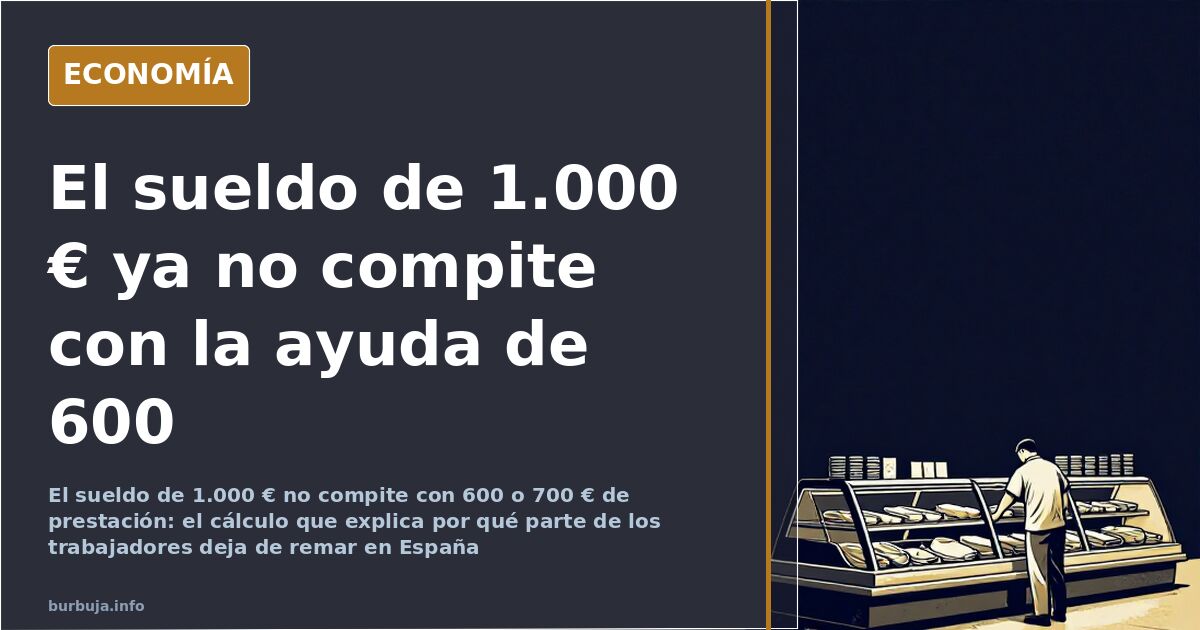
An empty butcher counter in a country with high unemployment illustrates the core issue. The math is simple: €1,000 in salary doesn't compete with €600 or €700 in benefits. Working means waking up early, paying for gas and car maintenance, and sacrificing health. Not working yields similar income with zero expenses. The uncomfortable question remains: why bother working?
Why Does a €1,000 Salary Lose to a €600 Benefit?
Because many compare net take-home pay against total benefit amounts. Salaries must cover commuting, vehicle costs, meals out, and physical wear from standing jobs. Benefits have no such deductions.
The list of aids is long: Minimum Vital Income (Ingreso Mínimo Vital), guaranteed income schemes, subsidies, and payments for those over 52. Critics argue this safety net encourages some to stop job hunting. However, no official data proves this; it is a diagnosis based on anecdotes and perceptions, not statistics.
Counterarguments hold weight too. Aid is modest, conditional, and slow to process. No one lives well on €600. Yet, living on €1,000 is also hard if you must maintain a car to get to work.
High Turnover Roles: Butchers Can't Find Skilled Staff
A concrete example involves a supermarket butcher shop. With no staff at the counter, an employee from the back room stepped in. His story sums up the market: there's a shortage of hands. The company hired three women, but all left—two trinc the first to another supermarket chain.
The reason? Better pay elsewhere. Underlying grievances include unpaid Sundays, unpaid overtime, worsening conditions, and 30 open legal proceedings by local workers against the firm. The manager admits he no longer recognizes veteran staff; skilled butchers have left, replaced by untrained profiles.
This fuels the common argument: people don't refuse to work; they refuse to work under these conditions. High-turnover roles see skilled workers leave for better offers immediately. Ultimately, the business loses, selling pre-packaged trays and losing customers who wanted custom cuts.
Tech Workers: Remote Jobs Abroad or Nothing
Scaling up, the pattern repeats. For technical, scientific, and engineering profiles, working in Spain is seen as being exploited: perversos salaries versus high expectations. The reference point is stark: a quarter or less of what is paid in developed countries for the same profile.
The logical exit is remote work for foreign companies—American, Canadian, Australian, or Northern European—that offer decent pay and professional growth. Those unable or unwilling to do so switch sectors, become civil servants, or leave the country entirely.
The conclusion is blunt: Spain is no longer considered a developed economy. With that premise, working for a domestic company makes little economic sense.
The State Competing with Wages and Family Costs
There is a structural reading. With current tax burdens, it is argued, earning money through independent business without public aid or exploiting staff is nearly impossible. The state competes not just for money, but for time and expectations.
Raising the minimum wage or expanding benefits may not protect intended recipients but could exclude lower-productivity profiles from the market. Similarly, if work no longer guarantees independence or family formation, the incentive to struggle fades. No house, no children, no partner. The calculation shifts from economic to existential.
This reasoning faces criticism. It views employment as purely individual, ignores those without family support, and assumes benefits are a comfortable alternative when often they are the only safety net.
Laziness or Rational Market Adaptation?
Many trace the origin to the post-2010 crisis. For years, employers grew used to having 300 candidates per vacancy. Some offered cashier jobs requiring university degrees. Employers believed this surplus would last forever, continuing to hire and fire at will, abusing hours, and paying minimally.
The result wasn't what they expected. People adapted, but not how employers wanted. Some left the country, others entered public administration, relied on family, benefits, or gig work. Many switched sectors. The takeaway: they aren't idle; they exited exploitative markets.
One nuance disrupts the simple narrative. Foreign replacements aren't infinite or docile either. The butcher shop case proves it: those coming to earn money move quickly when better options appear, even across borders. If conditions are bad, no workforce sustains them, regardless of origin.
Given these disparities, it is surprising public debate focuses on alleged laziness. An empty counter, thirty lawsuits, and a dissolving team. Did they stop rowing, or did they stop rowing in a sinking boat?
An empty butcher counter in a country with high unemployment illustrates the core issue. The math is simple: €1,000 in salary doesn't compete with €600 or €700 in benefits. Working means waking up early, paying for gas and car maintenance, and sacrificing health. Not working yields similar income with zero expenses. The uncomfortable question remains: why bother working?
Why Does a €1,000 Salary Lose to a €600 Benefit?
Because many compare net take-home pay against total benefit amounts. Salaries must cover commuting, vehicle costs, meals out, and physical wear from standing jobs. Benefits have no such deductions.
The list of aids is long: Minimum Vital Income (Ingreso Mínimo Vital), guaranteed income schemes, subsidies, and payments for those over 52. Critics argue this safety net encourages some to stop job hunting. However, no official data proves this; it is a diagnosis based on anecdotes and perceptions, not statistics.
Counterarguments hold weight too. Aid is modest, conditional, and slow to process. No one lives well on €600. Yet, living on €1,000 is also hard if you must maintain a car to get to work.
High Turnover Roles: Butchers Can't Find Skilled Staff
A concrete example involves a supermarket butcher shop. With no staff at the counter, an employee from the back room stepped in. His story sums up the market: there's a shortage of hands. The company hired three women, but all left—two trinc the first to another supermarket chain.
The reason? Better pay elsewhere. Underlying grievances include unpaid Sundays, unpaid overtime, worsening conditions, and 30 open legal proceedings by local workers against the firm. The manager admits he no longer recognizes veteran staff; skilled butchers have left, replaced by untrained profiles.
This fuels the common argument: people don't refuse to work; they refuse to work under these conditions. High-turnover roles see skilled workers leave for better offers immediately. Ultimately, the business loses, selling pre-packaged trays and losing customers who wanted custom cuts.
Tech Workers: Remote Jobs Abroad or Nothing
Scaling up, the pattern repeats. For technical, scientific, and engineering profiles, working in Spain is seen as being exploited: perversos salaries versus high expectations. The reference point is stark: a quarter or less of what is paid in developed countries for the same profile.
The logical exit is remote work for foreign companies—American, Canadian, Australian, or Northern European—that offer decent pay and professional growth. Those unable or unwilling to do so switch sectors, become civil servants, or leave the country entirely.
The conclusion is blunt: Spain is no longer considered a developed economy. With that premise, working for a domestic company makes little economic sense.
The State Competing with Wages and Family Costs
There is a structural reading. With current tax burdens, it is argued, earning money through independent business without public aid or exploiting staff is nearly impossible. The state competes not just for money, but for time and expectations.
Raising the minimum wage or expanding benefits may not protect intended recipients but could exclude lower-productivity profiles from the market. Similarly, if work no longer guarantees independence or family formation, the incentive to struggle fades. No house, no children, no partner. The calculation shifts from economic to existential.
This reasoning faces criticism. It views employment as purely individual, ignores those without family support, and assumes benefits are a comfortable alternative when often they are the only safety net.
Laziness or Rational Market Adaptation?
Many trace the origin to the post-2010 crisis. For years, employers grew used to having 300 candidates per vacancy. Some offered cashier jobs requiring university degrees. Employers believed this surplus would last forever, continuing to hire and fire at will, abusing hours, and paying minimally.
The result wasn't what they expected. People adapted, but not how employers wanted. Some left the country, others entered public administration, relied on family, benefits, or gig work. Many switched sectors. The takeaway: they aren't idle; they exited exploitative markets.
One nuance disrupts the simple narrative. Foreign replacements aren't infinite or docile either. The butcher shop case proves it: those coming to earn money move quickly when better options appear, even across borders. If conditions are bad, no workforce sustains them, regardless of origin.
Given these disparities, it is surprising public debate focuses on alleged laziness. An empty counter, thirty lawsuits, and a dissolving team. Did they stop rowing, or did they stop rowing in a sinking boat?
Also available in: Deutsch
Summary of a discussion on Burbuja.info - Foro de economía, actualidad y política., translated from Spanish and reviewed before publication. Read the full discussion (120 replies).
More summaries
-
Ignacio Lázaro: 'Maricarmen paid €154 rent while we paid €750'
Ignacio Lázaro, grandson of the original owner, reveals the other side of the Maricarmen case: 'We subsidized her for years and now, with our taxes.'
-
Spain's €15,000 housing grant: who really pays?
Spain approves €15,000 for under-36 homebuyers. Debate: real aid or price hike? Initial cost data.
-
Spain's Ruíz mocks UDEF for interpreting '10K' as a race
Analysis of the '10K' entry in a Spanish judicial file: media narratives attempt to replace accounting evidence with athletics.
-
NATO Chief Rutte Backs Trump's Greenland Threats
Mark Rutte justifies US threats against Denmark over Greenland. Critics accuse NATO of subservience to Washington while preparing Europe for war.
-
Spain's Anti-Consumism Trend: Why Many Reject Buying
Analysis of Spain's 'lonchafinista' movement prioritizing savings and freedom over possessions amid record tourism spending.
-
Germany hits record EV sales in May with 59,969 units
Germany registered 59,969 electric cars in May, led by the Škoda Elroq and VW ID3. The debate over the future of its auto industry intensifies.