
NYC micro-apartment under two square meters features kitchen over toilet
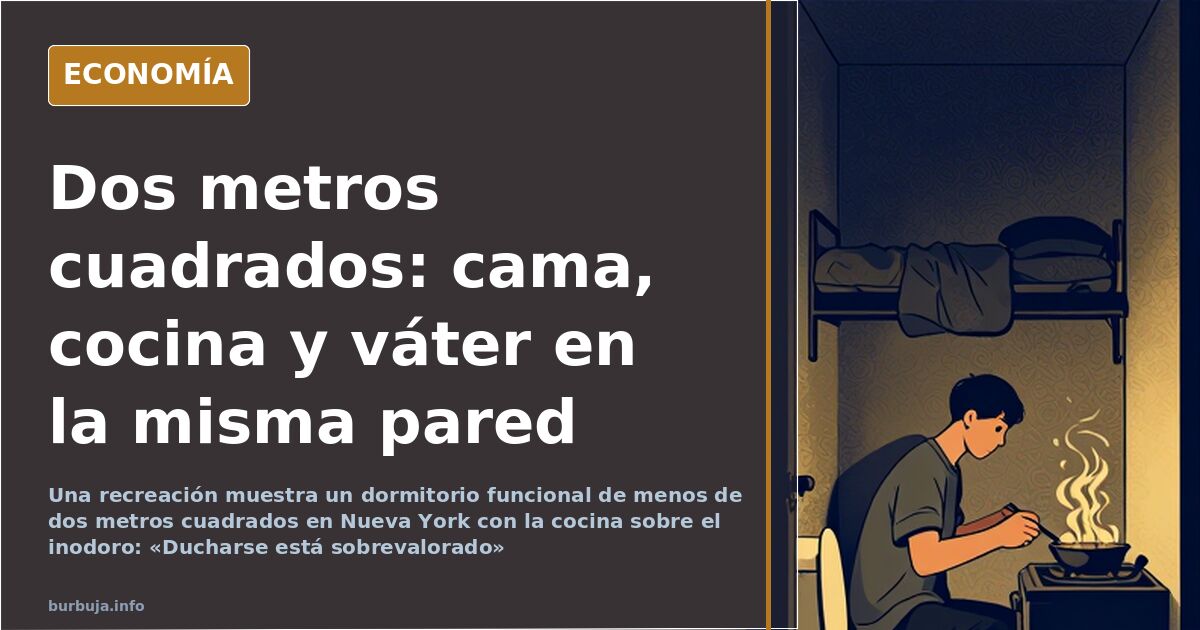
A recreation shows a functional bedroom under two square meters in New York with the stove above the toilet: "Showering is overrated"
English · Original discussion in Spanish · Published
Two square meters with kitchen over toilet: the "functional bedroom" that sparks outrage
How much space does a person need to live? The answer circulating on social media these days is uncomfortable: less than two square meters. A recreation spread on X, formerly Twitter, shows how a dwelling "smaller than a coffin" becomes what its creators call a functional bedroom. The piece comes from an account dedicated to highlighting how some landlords squeeze every centimeter amid the lack of affordable housing in major cities.
The montage is not a real ad, but a reconstruction of the hack that, according to the video itself, a man made to live in that space. The phrase summarizing the invention is delivered by the video itself: "Showering is overrated". There is no bathroom. No separate kitchen. There is a window with a balcony, a fold-down bed, and a frying pan within arm's reach of the toilet.
What fits in less than two square meters
The layout takes advantage of height because the floor area offers nothing. A balcony is installed at the window, with a fold-down bed on top; according to the recording, it can accommodate "even lying down his girlfriend when she visits." Above, a windowless closet for daily clothes. Below, with wooden boards, a table with a custom-fitted chair.
The problem arises with utilities. Without space for two rooms, kitchen and bathroom merge: a water pump on the wall feeds a built-in toilet that "feels luxurious" and is hidden by a cabinet. Inside that cabinet, an induction hob. Above it, a mirror with drawers for food. Crowning the ensemble, a retractable screen for watching television.
The video ends with "look how functional this room is." The audience's laughter trinc.
Cooking over the toilet: the recurring joke
The most repeated reaction concerns the coexistence of the hob and the toilet. "You can make an omelet while you poop," summarizes one message, celebrating the invention as saving space and time. Another points out they don't understand "the toilet covered by furniture just to put the pan." Hygiene, in this scheme, is an elastic concept.
Some go further and propose pooping directly into the pan to avoid wasting resources. The irony does not hide the underlying issue: the absence of a sink forces handwashing in the same place where cooking happens. "There isn't even a sink," notes one message. "Washing hands after pooping is overrated."
If there is consensus, it is that the piece functions as a symptom, not a solution. "This was the future, not flying cars or colonies on Mars," another concludes.
Rent eats the salary and the house stays empty
The jump from joke to economic analysis comes from a current arguing the problem is not size, but use. If someone spends the day outside—at work, on the street, at the gym—why pay for four rooms? Housing, in this reasoning, has become a speculative asset rather than a place to live. "The moment housing stops being a speculative asset, everything will collapse," notes one intervention comparing the apartment to a mobile phone or car: objects bought to use, not to resell.
The comparison with the cruise ship model appears several times: cabin for sleeping, services outside. Showering at the gym or pool. Eating in restaurants. Disposable clothing. Geographic mobility as the norm. It is a description of the present disguised as a prediction.
The underlying calculation is simple and bitter: if rent takes up most of the salary, the tenant pays for space they barely occupy. Quality of life is played out where one spends the day, not where one sleeps.
From Ortega Lara's hole to camper vans
The most uncomfortable comparison in the exchange is historical. "In the end, Ortega Lara's hiding spot was actually a modern apartment," writes someone. Another adds: "historians will have to acknowledge that at a certain time people weren't walled up, but given a housing solution." The hyperbole measures the distance between what is called dignified housing and what is sold as an opportunity.
The practical alternative mentioned is the camper van type Fiat Ducato: more space, according to several messages, than the New York bedroom. Japanese "apartments" seen in YouTube videos are also mentioned, with shared bathrooms outside, and internet cafes where part of the population lives due to cost and discretion, without registration or payroll. It is not a phenomenon exclusive to New York.
The lingering question is how much air someone breathes locked in two square meters for eight hours. "How many times during the night do you breathe the same air?" asks one message. "150? More? And how much does that shorten your life?"
What it means to be rich today
The definition circulating in the exchange has nothing to do with yachts. Rich is who has a complete 70-square-meter hole, no mortgage or rent, no debt, and ends the month saving a few hundred euros. The bar is so low it causes vertigo.
Another current takes the argument to the institutional extreme: if cell conditions are better than those of a free apartment, something has broken in the social contract. "Convicts living in more dignified conditions than free people," summarizes one intervention. The comparison is exaggerated and, at the same time, difficult to refute with data.
Not everyone sees it the same way. Some argue that housing solutions always exist and one only needs to try a bit, while others recall that if city life is like this, the exit is not to be in it. The dispute between staying and leaving remains open, without a winner.
The window, they say, is wide. It also serves for jumping out. With these materials, no one weaves the basket: they inherit it.
How much space does a person need to live? The answer circulating on social media these days is uncomfortable: less than two square meters. A recreation spread on X, formerly Twitter, shows how a dwelling "smaller than a coffin" becomes what its creators call a functional bedroom. The piece comes from an account dedicated to highlighting how some landlords squeeze every centimeter amid the lack of affordable housing in major cities.
The montage is not a real ad, but a reconstruction of the hack that, according to the video itself, a man made to live in that space. The phrase summarizing the invention is delivered by the video itself: "Showering is overrated". There is no bathroom. No separate kitchen. There is a window with a balcony, a fold-down bed, and a frying pan within arm's reach of the toilet.
What fits in less than two square meters
The layout takes advantage of height because the floor area offers nothing. A balcony is installed at the window, with a fold-down bed on top; according to the recording, it can accommodate "even lying down his girlfriend when she visits." Above, a windowless closet for daily clothes. Below, with wooden boards, a table with a custom-fitted chair.
The problem arises with utilities. Without space for two rooms, kitchen and bathroom merge: a water pump on the wall feeds a built-in toilet that "feels luxurious" and is hidden by a cabinet. Inside that cabinet, an induction hob. Above it, a mirror with drawers for food. Crowning the ensemble, a retractable screen for watching television.
The video ends with "look how functional this room is." The audience's laughter trinc.
Cooking over the toilet: the recurring joke
The most repeated reaction concerns the coexistence of the hob and the toilet. "You can make an omelet while you poop," summarizes one message, celebrating the invention as saving space and time. Another points out they don't understand "the toilet covered by furniture just to put the pan." Hygiene, in this scheme, is an elastic concept.
Some go further and propose pooping directly into the pan to avoid wasting resources. The irony does not hide the underlying issue: the absence of a sink forces handwashing in the same place where cooking happens. "There isn't even a sink," notes one message. "Washing hands after pooping is overrated."
If there is consensus, it is that the piece functions as a symptom, not a solution. "This was the future, not flying cars or colonies on Mars," another concludes.
Rent eats the salary and the house stays empty
The jump from joke to economic analysis comes from a current arguing the problem is not size, but use. If someone spends the day outside—at work, on the street, at the gym—why pay for four rooms? Housing, in this reasoning, has become a speculative asset rather than a place to live. "The moment housing stops being a speculative asset, everything will collapse," notes one intervention comparing the apartment to a mobile phone or car: objects bought to use, not to resell.
The comparison with the cruise ship model appears several times: cabin for sleeping, services outside. Showering at the gym or pool. Eating in restaurants. Disposable clothing. Geographic mobility as the norm. It is a description of the present disguised as a prediction.
The underlying calculation is simple and bitter: if rent takes up most of the salary, the tenant pays for space they barely occupy. Quality of life is played out where one spends the day, not where one sleeps.
From Ortega Lara's hole to camper vans
The most uncomfortable comparison in the exchange is historical. "In the end, Ortega Lara's hiding spot was actually a modern apartment," writes someone. Another adds: "historians will have to acknowledge that at a certain time people weren't walled up, but given a housing solution." The hyperbole measures the distance between what is called dignified housing and what is sold as an opportunity.
The practical alternative mentioned is the camper van type Fiat Ducato: more space, according to several messages, than the New York bedroom. Japanese "apartments" seen in YouTube videos are also mentioned, with shared bathrooms outside, and internet cafes where part of the population lives due to cost and discretion, without registration or payroll. It is not a phenomenon exclusive to New York.
The lingering question is how much air someone breathes locked in two square meters for eight hours. "How many times during the night do you breathe the same air?" asks one message. "150? More? And how much does that shorten your life?"
What it means to be rich today
The definition circulating in the exchange has nothing to do with yachts. Rich is who has a complete 70-square-meter hole, no mortgage or rent, no debt, and ends the month saving a few hundred euros. The bar is so low it causes vertigo.
Another current takes the argument to the institutional extreme: if cell conditions are better than those of a free apartment, something has broken in the social contract. "Convicts living in more dignified conditions than free people," summarizes one intervention. The comparison is exaggerated and, at the same time, difficult to refute with data.
Not everyone sees it the same way. Some argue that housing solutions always exist and one only needs to try a bit, while others recall that if city life is like this, the exit is not to be in it. The dispute between staying and leaving remains open, without a winner.
The window, they say, is wide. It also serves for jumping out. With these materials, no one weaves the basket: they inherit it.
Also available in: Deutsch
Summary of a discussion on Burbuja.info - Foro de economía, actualidad y política., translated from Spanish and reviewed before publication. Read the full discussion (120 replies).
More summaries
-
El Mundo Fabricates Russia Will Attack Spain with Small Drones
The report warning of a Russian drone attack on Spain has been denied. We analyze the information and its economic context.
-
Goldman Sachs shifts jobs out of New York
Goldman Sachs is relocating hundreds of employees from New York to Dallas or Salt Lake City, citing high operating costs and regulations.
-
Cocaine in Spain: high use, no campaigns
Cocaine spreads across Spain without campaigns to curb it: between 5% and 10% have never tried it, and drug tests for public officials are on the table.
-
Teacher reveals salary: €2,000 net per month with 15 payments
Debate over whether €2,000 net per month is a high salary for a secondary school teacher in Spain, compared with the cost of living and workload.
-
Spain's €15,000 housing grant: who really pays?
Spain approves €15,000 for under-36 homebuyers. Debate: real aid or price hike? Initial cost data.
-
Spain's Ruíz mocks UDEF for interpreting '10K' as a race
Analysis of the '10K' entry in a Spanish judicial file: media narratives attempt to replace accounting evidence with athletics.