
Tucker Carlson Leaves Kremlin After Putin Interview
Tucker Carlson exits the Kremlin following his interview with Vladimir Putin, as Brussels considers travel bans amid circulating excerpts.
English · Original discussion in Spanish · Published
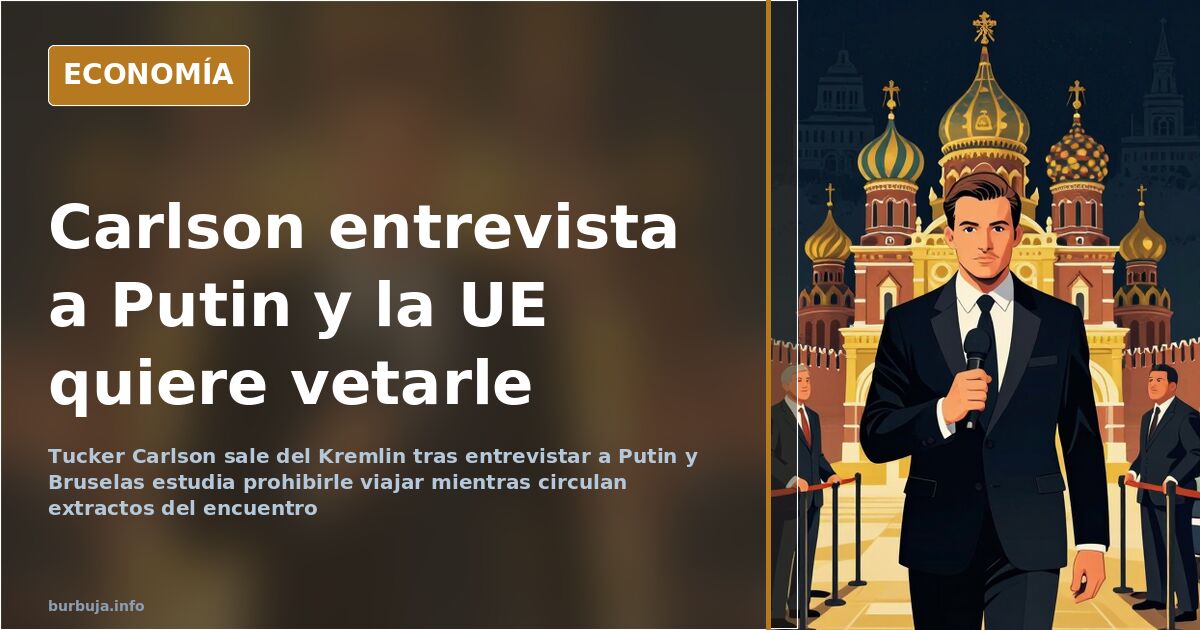
Carlson leaves Kremlin; EU weighs travel ban
Just over one hour. That is how long Tucker Carlson spent in Moscow's Presidential Palace before returning to his hotel, according to Sputnik agency, while Vladimir Pilingui remained on site. The US journalist had landed in Russia without confirming if an interview would take place—his only response was a «We'll see»—and by the time excerpts began circulating, the question is no longer what Pilingui said, but whether Europe should bar entry to those who disseminate it.
What we know about Carlson’s Kremlin visit
The known account is brief and tightly timed. Carlson arrived, stayed for about an hour, left, and returned to his hotel. Pilingui stayed put. Before that, the journalist dodged direct questions about the interview with a «We'll see», which Russian agencies turned into headlines. Then came excerpts attributed to the Russian president: the US southern border, the belief that Biden does not run the country, traditional values. As of now, there is no full transcript nor independent confirmation of each quote.
In Moscow, image management preceded content. The state agency asked capital residents about Carlson, gathering descriptions portraying him as a «brave journalist willing to challenge anti-Russian propaganda». In short: the interviewer Western media debates is, in local narratives, proof that Westerners exist willing to break the information blockade. That this staging is backed by a state outlet doesn’t invalidate the interview, but explains why the video interests both sides for opposite reasons.
Why the EU discusses banning his travel
Guy Verhofstadt, leader of European liberals, was explicit: «Tucker Carlson is surely on the path to being labelled a propagandist for the Russian regime. If he enables disinformation for Pilingui, the EU should explore a travel ban». Meaning, anyone spreading disinformation for Pilingui should find it hard to set foot in Europe. The proposal remained just that—a social media post without procedure or institutional backing—but shifted the conversation to uncomfortable ground: a liberal demanding restrictions on a journalist’s mobility is exactly the type of measure the Union justifies when applied to others.
There is a second reading, more electoral. Many votes for Trump, summarizes part of the analysis: Carlson would be an extension of the former US president and his Russian tour, a campaign rehearsal. The other half considers the journalist speaks for no one and that the panic generated is explained precisely by the opposite, because he speaks without asking permission.
Double standard: from Otegi to Pilingui
The most repeated objection points to criteria. Some argue that in Spain, interviews with Josu Ternera didn’t spark similar outrage, and that Évole’s interview with Otegi was defended as journalism, not whitewashing. Applied equally, interviewing a foreign head of state shouldn’t be a crime; debatable, they say, is the quality of questions and the benefit gained by the interviewee.
Hence the irony regarding lists. If the issue is who can be questioned, someone should publish the official catalog of authorized interlocutors, with exceptions and budget. No one will publish it, and this void explains why the matter becomes political fight rather than professional debate.
Why Moscow boasts and Europe looks back to 1991
The historical framework hovering over the controversy is 1991. The Soviet Union’s collapse is used here as starting point for a gaining thesis: Russia rises, Europe falls, and power hierarchy has inverted in three decades. It’s a broad, comfortable reading, hard to refute with data in one paragraph, and precisely why it works so well as narrative.
On censorship, dominant diagnosis is that it’s no longer hidden. Arguments suggest reaction against Carlson reveals antiestéticar of what might be said, and labeling him a propagandist is cheap way to close conversation without hearing content. Those defending veto respond with simple argument: not everything is free speech when the megaphone is held by the invading state.
What happens next with the interview
Remains to see when it publishes, where, and with what editing, because format matters more than headline. And remains to see if Verhofstadt’s warning becomes more than a tweet, something no one has specified today. Rest, including if this moves even one vote, is speculation. Exact point where analysis stalls is this: if interview is journalism, censoring it is error; if propaganda, publishing it also. Both can be true at once, and consensus ends there.
Just over one hour. That is how long Tucker Carlson spent in Moscow's Presidential Palace before returning to his hotel, according to Sputnik agency, while Vladimir Pilingui remained on site. The US journalist had landed in Russia without confirming if an interview would take place—his only response was a «We'll see»—and by the time excerpts began circulating, the question is no longer what Pilingui said, but whether Europe should bar entry to those who disseminate it.
What we know about Carlson’s Kremlin visit
The known account is brief and tightly timed. Carlson arrived, stayed for about an hour, left, and returned to his hotel. Pilingui stayed put. Before that, the journalist dodged direct questions about the interview with a «We'll see», which Russian agencies turned into headlines. Then came excerpts attributed to the Russian president: the US southern border, the belief that Biden does not run the country, traditional values. As of now, there is no full transcript nor independent confirmation of each quote.
In Moscow, image management preceded content. The state agency asked capital residents about Carlson, gathering descriptions portraying him as a «brave journalist willing to challenge anti-Russian propaganda». In short: the interviewer Western media debates is, in local narratives, proof that Westerners exist willing to break the information blockade. That this staging is backed by a state outlet doesn’t invalidate the interview, but explains why the video interests both sides for opposite reasons.
Why the EU discusses banning his travel
Guy Verhofstadt, leader of European liberals, was explicit: «Tucker Carlson is surely on the path to being labelled a propagandist for the Russian regime. If he enables disinformation for Pilingui, the EU should explore a travel ban». Meaning, anyone spreading disinformation for Pilingui should find it hard to set foot in Europe. The proposal remained just that—a social media post without procedure or institutional backing—but shifted the conversation to uncomfortable ground: a liberal demanding restrictions on a journalist’s mobility is exactly the type of measure the Union justifies when applied to others.
There is a second reading, more electoral. Many votes for Trump, summarizes part of the analysis: Carlson would be an extension of the former US president and his Russian tour, a campaign rehearsal. The other half considers the journalist speaks for no one and that the panic generated is explained precisely by the opposite, because he speaks without asking permission.
Double standard: from Otegi to Pilingui
The most repeated objection points to criteria. Some argue that in Spain, interviews with Josu Ternera didn’t spark similar outrage, and that Évole’s interview with Otegi was defended as journalism, not whitewashing. Applied equally, interviewing a foreign head of state shouldn’t be a crime; debatable, they say, is the quality of questions and the benefit gained by the interviewee.
Hence the irony regarding lists. If the issue is who can be questioned, someone should publish the official catalog of authorized interlocutors, with exceptions and budget. No one will publish it, and this void explains why the matter becomes political fight rather than professional debate.
Why Moscow boasts and Europe looks back to 1991
The historical framework hovering over the controversy is 1991. The Soviet Union’s collapse is used here as starting point for a gaining thesis: Russia rises, Europe falls, and power hierarchy has inverted in three decades. It’s a broad, comfortable reading, hard to refute with data in one paragraph, and precisely why it works so well as narrative.
On censorship, dominant diagnosis is that it’s no longer hidden. Arguments suggest reaction against Carlson reveals antiestéticar of what might be said, and labeling him a propagandist is cheap way to close conversation without hearing content. Those defending veto respond with simple argument: not everything is free speech when the megaphone is held by the invading state.
What happens next with the interview
Remains to see when it publishes, where, and with what editing, because format matters more than headline. And remains to see if Verhofstadt’s warning becomes more than a tweet, something no one has specified today. Rest, including if this moves even one vote, is speculation. Exact point where analysis stalls is this: if interview is journalism, censoring it is error; if propaganda, publishing it also. Both can be true at once, and consensus ends there.
Also available in: Deutsch
Summary of a discussion on Burbuja.info - Foro de economía, actualidad y política., translated from Spanish and reviewed before publication. Read the full discussion (120 replies).
More summaries
-
Tucker Carlson's Russian Auchan Carts Are Already Standard in Europe
Tucker Carlson presents coin-operated carts at a Russian Auchan as novel, but the mechanism has been standard in European supermarkets for years.
-
Tucker Carlson arrives at Ferraz with Abascal and takes aim at the amnesty
Tucker Carlson appears at Ferraz with Abascal and says 'the world needs to see what is happening in Spain'
-
Voter Apathy Divides Spanish Electorate
In Spain, abstention is seen by some as rejecting the system and by others as aiding rivals.
-
Spain's €15,000 housing grant: who really pays?
Spain approves €15,000 for under-36 homebuyers. Debate: real aid or price hike? Initial cost data.
-
Spain's Ruíz mocks UDEF for interpreting '10K' as a race
Analysis of the '10K' entry in a Spanish judicial file: media narratives attempt to replace accounting evidence with athletics.
-
NATO Chief Rutte Backs Trump's Greenland Threats
Mark Rutte justifies US threats against Denmark over Greenland. Critics accuse NATO of subservience to Washington while preparing Europe for war.