
Spain Blackout: Solar Disconnections and Negative Prices Debate
UNEF reports record negative prices and solar disconnections before the April 28 Spain blackout, sparking sector debate.
English · Original discussion in Spanish · Published
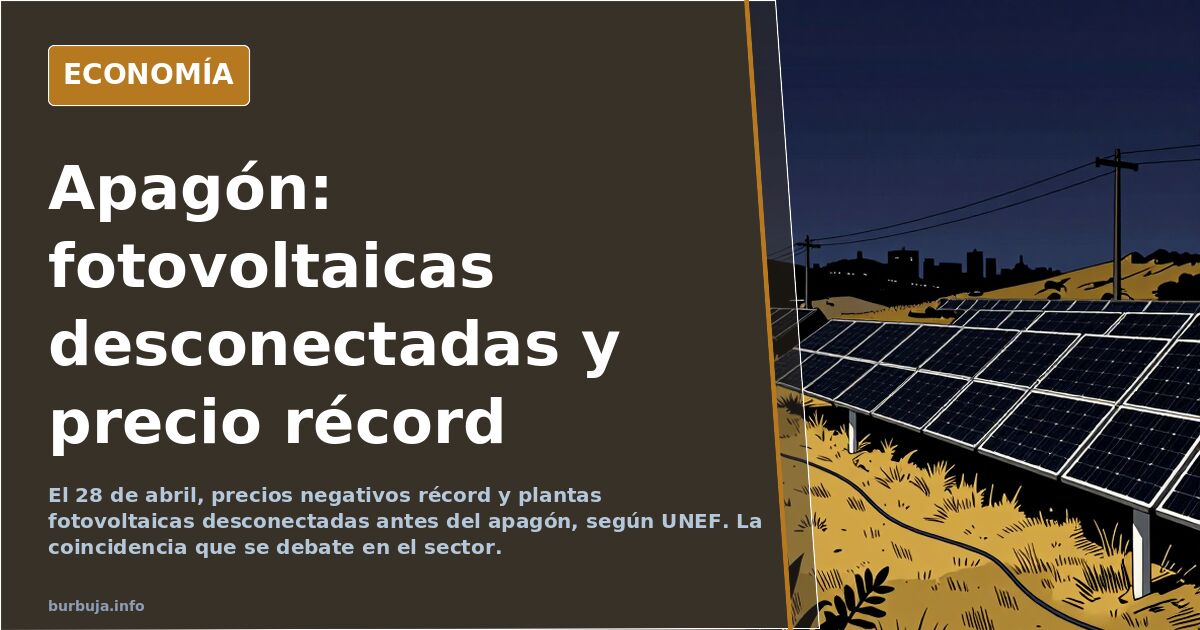
Blackout: Solar Plants Disconnected Amid Record Negative Prices
On April 28 at 12:30, mainland Spain went dark. That same noon, the wholesale market recorded historic negative prices: -1.9 €/MWh, with eight consecutive hours between zero and negative. A hypothesis circulating in the debate suggests this coincidence was not accidental. According to UNEF (Spanish Photovoltaic Union), photovoltaic plants were disconnected from the grid before the blackout, and the industry association maintains it was not a voluntary decision.
The question raised is who gave the order and why. In Spain, unlike other markets, solar parks cannot disconnect themselves when prices drop. The OMIE auction takes place the day before: if a generator bids at a negative price and its bid matches, it is scheduled by Red Eléctrica (the Spanish system operator). Once scheduled, as argued in the thread, they neither enter nor exit without authorization from the system operator. That is the rule. What actually peine is another matter.
Why Are There Negative Prices in the Pool?
The mechanism is counterintuitive. When there is an excess of renewable supply and low demand, generators pay to inject electricity. It is not altruism: stopping a solar plant has technical and contractual costs that can exceed the penalty for producing at negative prices. During 2024, 547 hours were recorded at zero euros and 247 hours in negative, according to OMIE. On April 28, this anomaly became a record: eight consecutive hours of null or negative prices, something never seen before.
The thesis circulating is that some automation disconnected parks upon detecting prices below a threshold. The AI consulted by debate participants admits that remote disconnection systems based on negative prices exist in the Netherlands, and that some operators in Spain are considering them. The problem, as pointed out, is not their existence but how they are executed. A staggered disconnection is manageable. A massive and simultaneous one is not.
The 2009 Precedent: Producing at Night to Collect Subsidies
This would not be the first time a poorly designed incentive caused absurd behavior. In 2009 and 2010, some thermal installations generated electricity at night—when there is no sun—to collect premiums. It was not fraud: the premium system allowed it. It is estimated that 6,000 MWh were generated at night and around €300,000 were pocketed. Market design matters more than technology.
The difference now is scale. Photovoltaics have gone from anecdote to a pillar of the system. When exceeding 60% of the mix, as argued in the debate, the grid enters uncharted territory. Some maintain that instability had been detected weeks earlier, with voltage fluctuations in graphs. Others point to the interconnection with France, whose change of use is being investigated as a cause. And a third current points directly to the system operator: if Red Eléctrica decides who enters and who exits, ultimate responsibility lies with them.
Who Decides to Disconnect a Photovoltaic Plant?
Red Eléctrica. That is the answer defended in the thread. The system operator is the only one who can authorize a disconnection once production is scheduled. Generators can bid at negative prices in OMIE, but they cannot unilaterally withdraw the next day. If they do, they incur liability for the imbalances they cause. Supervision is carried out by Cecre, Red Eléctrica's control center.
However, the debate notes that unplanned shutdowns exist and do not always have visible consequences. There are no known fines for unauthorized disconnections. This regulatory gap feeds all theories. If an operator can fake a breakdown to avoid paying to inject, the perverse incentive is set. And if many do so at once, the system collapses.
The Official Version and Its Cracks
The government and Red Eléctrica have denied that photovoltaics were voluntarily disconnected. UNEF speaks of forced, not voluntary, disconnection. The nuance is important: one thing is for an operator to decide to shut down, and another for the system to shut it down. But the question remains unanswered: what mechanism, automatic or manual, caused a massive amount of solar generation to disappear from the grid at the exact moment prices hit bottom?
The European investigation continues. Entso-E, the grouping of European operators, is analyzing the change of use of the interconnection with France as one of the causes. The Spanish electricity sector has requested a meeting with the Energy Commissioner to complain about the lack of independence of the analysis. Meanwhile, the most uncomfortable explanation—that the market was so broken it collapsed on its own—has not been ruled out.
One fact remains disorienting: the blackout lasted hours, but the negative price was scheduled from the previous day. Anyone with access to OMIE could see it coming. If the system did not know how to manage it, the problem was not surprise. It was planning.
On April 28 at 12:30, mainland Spain went dark. That same noon, the wholesale market recorded historic negative prices: -1.9 €/MWh, with eight consecutive hours between zero and negative. A hypothesis circulating in the debate suggests this coincidence was not accidental. According to UNEF (Spanish Photovoltaic Union), photovoltaic plants were disconnected from the grid before the blackout, and the industry association maintains it was not a voluntary decision.
The question raised is who gave the order and why. In Spain, unlike other markets, solar parks cannot disconnect themselves when prices drop. The OMIE auction takes place the day before: if a generator bids at a negative price and its bid matches, it is scheduled by Red Eléctrica (the Spanish system operator). Once scheduled, as argued in the thread, they neither enter nor exit without authorization from the system operator. That is the rule. What actually peine is another matter.
Why Are There Negative Prices in the Pool?
The mechanism is counterintuitive. When there is an excess of renewable supply and low demand, generators pay to inject electricity. It is not altruism: stopping a solar plant has technical and contractual costs that can exceed the penalty for producing at negative prices. During 2024, 547 hours were recorded at zero euros and 247 hours in negative, according to OMIE. On April 28, this anomaly became a record: eight consecutive hours of null or negative prices, something never seen before.
The thesis circulating is that some automation disconnected parks upon detecting prices below a threshold. The AI consulted by debate participants admits that remote disconnection systems based on negative prices exist in the Netherlands, and that some operators in Spain are considering them. The problem, as pointed out, is not their existence but how they are executed. A staggered disconnection is manageable. A massive and simultaneous one is not.
The 2009 Precedent: Producing at Night to Collect Subsidies
This would not be the first time a poorly designed incentive caused absurd behavior. In 2009 and 2010, some thermal installations generated electricity at night—when there is no sun—to collect premiums. It was not fraud: the premium system allowed it. It is estimated that 6,000 MWh were generated at night and around €300,000 were pocketed. Market design matters more than technology.
The difference now is scale. Photovoltaics have gone from anecdote to a pillar of the system. When exceeding 60% of the mix, as argued in the debate, the grid enters uncharted territory. Some maintain that instability had been detected weeks earlier, with voltage fluctuations in graphs. Others point to the interconnection with France, whose change of use is being investigated as a cause. And a third current points directly to the system operator: if Red Eléctrica decides who enters and who exits, ultimate responsibility lies with them.
Who Decides to Disconnect a Photovoltaic Plant?
Red Eléctrica. That is the answer defended in the thread. The system operator is the only one who can authorize a disconnection once production is scheduled. Generators can bid at negative prices in OMIE, but they cannot unilaterally withdraw the next day. If they do, they incur liability for the imbalances they cause. Supervision is carried out by Cecre, Red Eléctrica's control center.
However, the debate notes that unplanned shutdowns exist and do not always have visible consequences. There are no known fines for unauthorized disconnections. This regulatory gap feeds all theories. If an operator can fake a breakdown to avoid paying to inject, the perverse incentive is set. And if many do so at once, the system collapses.
The Official Version and Its Cracks
The government and Red Eléctrica have denied that photovoltaics were voluntarily disconnected. UNEF speaks of forced, not voluntary, disconnection. The nuance is important: one thing is for an operator to decide to shut down, and another for the system to shut it down. But the question remains unanswered: what mechanism, automatic or manual, caused a massive amount of solar generation to disappear from the grid at the exact moment prices hit bottom?
The European investigation continues. Entso-E, the grouping of European operators, is analyzing the change of use of the interconnection with France as one of the causes. The Spanish electricity sector has requested a meeting with the Energy Commissioner to complain about the lack of independence of the analysis. Meanwhile, the most uncomfortable explanation—that the market was so broken it collapsed on its own—has not been ruled out.
One fact remains disorienting: the blackout lasted hours, but the negative price was scheduled from the previous day. Anyone with access to OMIE could see it coming. If the system did not know how to manage it, the problem was not surprise. It was planning.
Also available in: Deutsch
Summary of a discussion on Burbuja.info - Foro de economía, actualidad y política., translated from Spanish and reviewed before publication. Read the full discussion (192 replies).
More summaries
-
Expert attributes Spain blackout to renewable overgeneration
Energy expert Carlos Cagigal rules out cyberattack, blaming a grid overload caused by excess renewable generation. The system lost 15 GW and 60% of demand in five seconds.
-
Daily meals hit 15 euros: 450 monthly cost empties Spanish bars
The daily lunch price rises from 9.99 to 15 euros, costing 450 monthly. Workers increasingly bring lunchboxes as bar tables empty.
-
From Blackout to Flood: The Power Grid Stretched to the Limit
Red Eléctrica still hasn’t explained the blackout, power is up 40% and 4.960 substations are already at capacity: the official story doesn’t add up
-
11M and Pegasus: The Link Brahim Gali Attributes to the PSOE
Brahim Gali links the PSOE to the 11M attacks via Pegasus, but the timeline doesn't align: NSO Group didn't exist in 2004. An analysis of the detail that challenges the narrative.
-
Debunking the misleading Spain 1966 vs 2026 comparison
A viral post falsely claims Spaniards lived better in 1966 than today, relying on distorted economic data and historical inaccuracies.
-
Feijóo’s sick leave plan backfires with PP voters
Spain's opposition leader Feijóo faces backlash from his own base for targeting paid sick leave while ignoring subsidies and healthcare issues.