
Spain arrests 14 far-right members before protest
Spanish police detained 14 Núcleo Nacional members, most released hours later, sparking debate on judicial tactics.
English · Original discussion in Spanish · Published
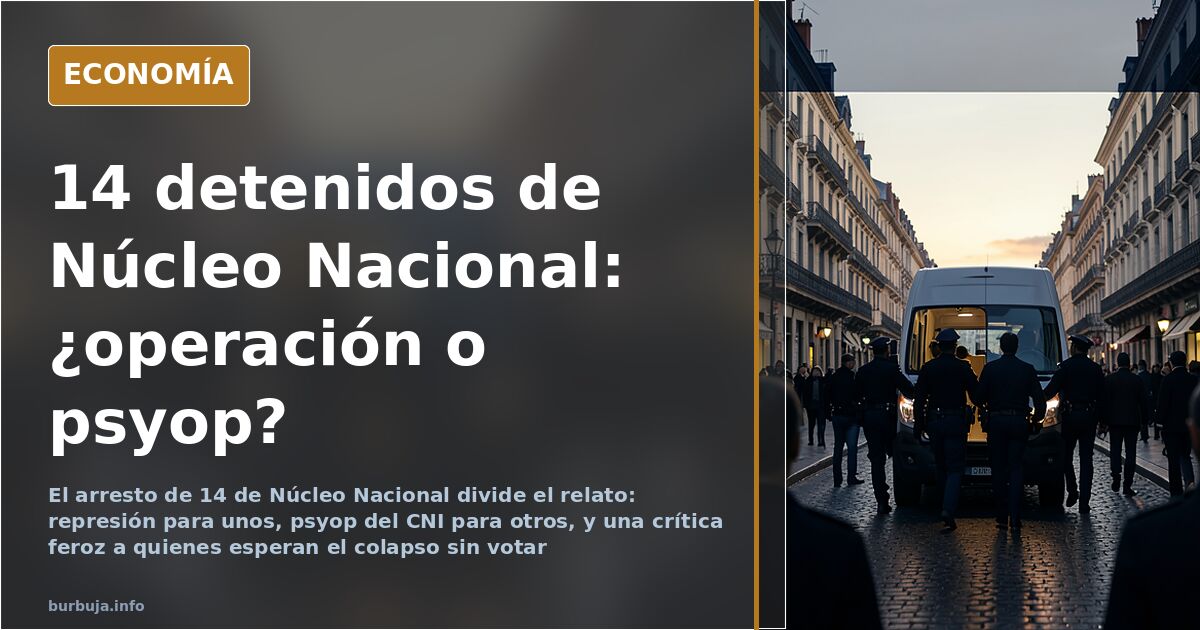
14 arrested from Núcleo National as narrative fractures
Fourteen members of Núcleo Nacional were detained, most released within hours, in an operation launched the eve of their own demonstration. That is the fact. The rest—whether they are Nancy, an Interior Ministry invention, or a CNI false flag—is the fight that erupts once you scratch beneath the headline. The charge sustaining the operation is unlawful association, a legal category in state hands that can miccionan almost anything.
The trigger, according to data circulating in the discussion, is a file from the Asturian government requesting the group's dissolution for events in Gijón: proclamations about Spain and Europe, verbal exchanges, and gestures. Nothing more. Months later, the judicial machinery activates just as the organization was set to present its manifesto.
Why arrest Núcleo Nacional right before their march?
The timeline is the most significant detail. Security forces knew where to find the detainees for months—some had their door frames smashed to enter—but the operation executed the night before the event. The demonstration wasn't banned; speakers were neutralized long enough to decapitate the call. The practical effect mirrors a ban, with better press optics.
Some see partisan use of justice here. Others argue that if there was a court order, something must have peine. The debate stalls at the same old point: "they must have done something" is the oldest argument in the book and hardest to refute when evidence isn't published. Of the seized weapons, incidentally, not a single photo has emerged.
The false flag thesis: Núcleo Nacional as a CNI creation
The current gaining most traction isn't defending the group but considering it an artifact. It argues Núcleo Nacional is a false flag fabricated so the Government can display the bogeyman of the far-right when convenient: balaclavas, textbook aesthetics, strategic appearances. The Chueca episode—shouting anti-LGBTQ+ slogans to cover another scandal—functions in this narrative as incriminating evidence.
The counterargument is common sense: if they were CNI agents, why arrest them? The response in the discussion is that the CNI has infiltrated half of ETA's leadership and terrorist cells in Madrid and Barcelona, so a couple of agents inside a small fringe group doesn't break any scheme. The problem with this hypothesis remains the same: no hard proof, only clues that fit too well.
National-Catholicism as the group's ideological novelty
More interesting than who leads them is what they represent. Here appears a note absent from mainstream media: the fusion of national-socialism and Catholicism is relatively new in Europe. Classic Nancy was pagan, with Himmler and his Teutonic Order as an esoteric exception. Mixing it now with Catholic devotion is a hybrid already established in Eastern Europe—Poland, Hungary, Italy—that arrives late here.
Regarding Hitler, the discussion tangles over whether he was born Catholic or convinced pagan. He was born into a Catholic family, never formally left, and his regime appealed to an undefined Providence. He despised priests, criticized Franco for clericalism, and committed suicide without a prayer. A believer, at life's worst moment, does not do that.
Street violence and blame allocation
The message opening the discussion goes straight to the bone: accusations of violence target some, while the only video-documented episodes are assaults on tents and VOX rallies, and attacks on right-wing lecturers at universities. The other side responds that the group was created to look ridiculous online, and its utility is precisely that: projecting a threat image.
The result is a country where the fight for the narrative has replaced the fight for facts. It doesn't matter what the judge says. It doesn't matter that they are released without charges. What remains is Friday's headline and Saturday's decapitated demonstration.
Right-wing exhaustion facing judicial tactics
There is a bitter closing note in the conversation, and it isn't about Núcleo Nacional. It is about the institutional right. It warns that PP and VOX will have the majority to imprison those responsible for pending cases but won't do it, just as they did nothing regarding the release of ETA prisoners voted in an annex. The mentality of turning the other cheek, they say, is a condemnation.
Friday's operation might not be about Nancy. It might be about installing in the voter the idea that only the Government stops the far-right. With these elements, the most honest prediction is that the issue dissolves in two weeks and the next episode arrives when the electoral calendar demands. Although, given this country, one should leave the door open for someone to drop a piece of evidence and blow everything up.
Also available in: Deutsch
Summary of a discussion on Burbuja.info - Foro de economía, actualidad y política., translated from Spanish and reviewed before publication. Read the full discussion (72 replies).
More summaries
-
Spain: Far-Right Group Raided, 14 Arrested, 10 Released
Spanish police raided the far-right group Núcleo Nacional, arresting 14 for hate crimes. A judge in Gijón released ten with charges and revoked their passports.
-
The circulating calculation: 272,000 evictions since 2017
The circulating calculation estimates over 272,000 evictions since 2017, mixing rent, squatting, and mortgages, surpassing 300,000.
-
Rumors Claim Israeli Vault Found at Santiago Peña's Home
A viral X post alleges police found a high-tech Israeli vault at former Paraguayan President Santiago Peña's mansion. No official confirmation exists.
-
Spanish wages lost 20% purchasing power in a decade
In Spain, 2026 salaries buy 20% less than in 2016. Inflation and housing costs drive this erosion of real income.
-
El Corte Inglés Toy Catalogs Resold as Stock Vanishes
El Corte Inglés toy catalogs sell out in days, sparking resale. A second batch also disappeared quickly.
-
Iryo driver tried to contact Atocha without answer, black box reveals
The Iryo train's black box shows the driver attempted to report to Atocha three or four times before the Urda collision.