
Saving €50,000 to sink into a 40-year mortgage: the debate
Ten years saving €50,000 to sign a 40-year mortgage: the debate over whether housing is an investment or a necessity remains unresolved.
English · Original discussion in Spanish · Published
Saving €50,000 to bury it in a 40-year mortgage
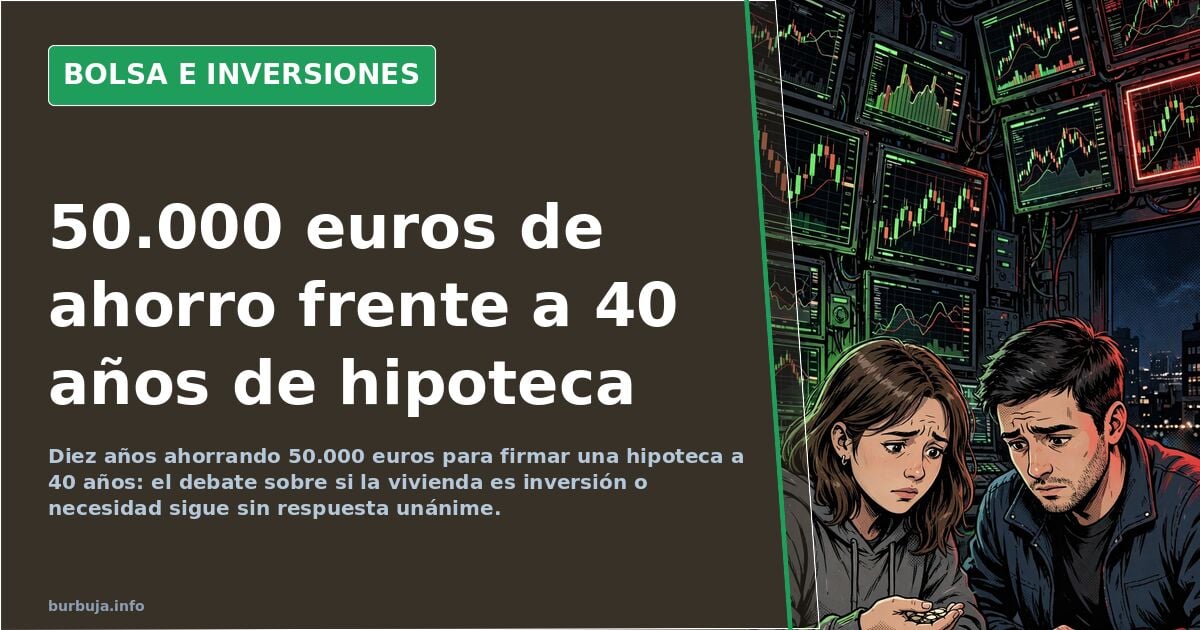
Ten years setting aside fifty thousand euros to end up signing a debt of two hundred thousand plus interest over forty years. That is the scene that opens the debate and sums up a growing suspicion: that the generation that learned to invest in the stock market does not understand why the previous one still believes that property is the only way out. The figure is no accident. With that cushion, one can build a diversified portfolio, maintain an emergency fund for a year, and leave the rest working. And yet, a huge part of the population continues to do the opposite.
The initial approach leaves no room for doubt: a stable source of income, living on the minimum but well, an emergency fund in cash, and the rest spread among stocks, cryptoassets, precious metals, and real assets. On paper, the recipe is impeccable. In practice, it clashes with a reality that those who defend buying repeat insistently: housing is not just an asset, it is a roof. And a roof, they say, is not negotiated with the market.
The argument that dismantles the saver's thesis
The first response to the initial question is the most obvious and the most uncomfortable: are they mutually exclusive? You can invest and buy a home. The problem is that money does not multiply by spontaneous generation and, in most cases, a decade of savings becomes the down payment on a flat that multiplies the available capital by four or five.
Those who defend buying list advantages that do not appear in any profitability simulator. A fixed-rate mortgage dilutes with inflation: paying the same instalment in 2050 as today is, in real terms, paying half. Rent, on the other hand, rises. It always rises. And the property allows you to leverage, guarantee projects, expand the study if life changes. There are even those who reduce it to a matter of status: the house is tangible, the dividend of a fund is not touched.
The counterargument arrives with the same forcefulness. A home is not an eternal investment: it is a constant and squattable expense. Taxes, special assessments, maintenance, community fees, insurance. And legislation that can change the rules of the game at any moment. If rent control is introduced tomorrow, the owner swallows the adjustment with potatoes. The house is not yours, they argue, it is the State's, which grants it to you in usufruct with conditions that it decides.
The calculation almost nobody makes: mortgage versus rent plus investment
This is where the debate becomes interesting. The correct comparison is not mortgage versus stock market, but mortgage versus rent plus the return on the capital that is not tied up. The buyer obtains two things at once: appreciation of the property and savings on the rent they do not pay. The renter who invests needs the return on their portfolio to exceed the sum of both. Do fifty thousand euros invested yield enough return to match that? The question hangs in the air, without a unanimous answer.
The full calculation, broken down item by item, gives surprising results depending on which assumptions are used. And there lies the problem: the assumptions. Nobody knows if the flat will appreciate three percent annually or depreciate. Nobody knows if the stock market will repeat the behaviour of the last decade. Life is very simple from the sofa, summarises one intervention, but misfortunes happen to people: a divorce, an illness, an ex with a pension claim. The perfect plan on paper breaks as soon as real life enters.
The legal trap almost nobody mentions when signing
There is a detail of the Spanish legal system that appears in the debate and that should be highlighted: if you stop paying, you do not just lose the house. You lose everything until the debt is settled. In other countries, the guarantee is the mortgaged asset and you hand over the keys. Here, if the flat depreciates and the auction does not cover the loan, the bank goes after the rest of your assets. It is a risk that was signed recklessly during the previous bubble and that remains in force.
To this is added the cultural obsession. In Spain there is a fixation with real estate that borders on psychotic, summarises one intervention. Housing is not seen as an expense, it is seen as a life goal. Anyone who does not buy by forty seems to have failed. And that social pressure drives decisions that, in purely financial terms, do not always hold up.
The factor no spreadsheet captures
Mental stability. A home provides balance, allows you to have a family, modify it, put down roots. We are human, not robots, and we need a fixed place to develop a life project. Those who tolerate mobility and do not need roots can dedicate themselves to investing without ballast. Those who do not pay for peace of mind. And that premium does not appear in any index.
There is a case that sums up the tension: someone close to forty, living with their parents, who has doubled their wealth in recent years and could buy. They do not. They do not want years of effort to end up in a house and with the broker at zero. They lack a life project and, without it, buying seems like a surrender. Another inverse case: someone who bought young, divorced, sold, and returned to the family nest with the capital invested. They played with fire and were not burned by a miracle.
What is more profitable in the long term, stocks or housing?
The honest answer is that nobody knows. It is impossible to pontificate on which strategy is better: there is too much chance. What can be affirmed is that the primary residence is not an investment in the strict sense, but a covered necessity. And that diversification, in any case, reduces the risk of being wrong. Those who bet everything on one asset, whether bricks or shares, assume a risk that only time will tell if it was justified.
What is clear is that the saver of fifty thousand euros is not throwing money away. They are buying something that is not measured in profitability: a place to live without a third party raising the price every year. The question is whether that something is worth forty years of interest. And there, each person responds according to what they antiestéticar losing.
Ten years setting aside fifty thousand euros to end up signing a debt of two hundred thousand plus interest over forty years. That is the scene that opens the debate and sums up a growing suspicion: that the generation that learned to invest in the stock market does not understand why the previous one still believes that property is the only way out. The figure is no accident. With that cushion, one can build a diversified portfolio, maintain an emergency fund for a year, and leave the rest working. And yet, a huge part of the population continues to do the opposite.
The initial approach leaves no room for doubt: a stable source of income, living on the minimum but well, an emergency fund in cash, and the rest spread among stocks, cryptoassets, precious metals, and real assets. On paper, the recipe is impeccable. In practice, it clashes with a reality that those who defend buying repeat insistently: housing is not just an asset, it is a roof. And a roof, they say, is not negotiated with the market.
The argument that dismantles the saver's thesis
The first response to the initial question is the most obvious and the most uncomfortable: are they mutually exclusive? You can invest and buy a home. The problem is that money does not multiply by spontaneous generation and, in most cases, a decade of savings becomes the down payment on a flat that multiplies the available capital by four or five.
Those who defend buying list advantages that do not appear in any profitability simulator. A fixed-rate mortgage dilutes with inflation: paying the same instalment in 2050 as today is, in real terms, paying half. Rent, on the other hand, rises. It always rises. And the property allows you to leverage, guarantee projects, expand the study if life changes. There are even those who reduce it to a matter of status: the house is tangible, the dividend of a fund is not touched.
The counterargument arrives with the same forcefulness. A home is not an eternal investment: it is a constant and squattable expense. Taxes, special assessments, maintenance, community fees, insurance. And legislation that can change the rules of the game at any moment. If rent control is introduced tomorrow, the owner swallows the adjustment with potatoes. The house is not yours, they argue, it is the State's, which grants it to you in usufruct with conditions that it decides.
The calculation almost nobody makes: mortgage versus rent plus investment
This is where the debate becomes interesting. The correct comparison is not mortgage versus stock market, but mortgage versus rent plus the return on the capital that is not tied up. The buyer obtains two things at once: appreciation of the property and savings on the rent they do not pay. The renter who invests needs the return on their portfolio to exceed the sum of both. Do fifty thousand euros invested yield enough return to match that? The question hangs in the air, without a unanimous answer.
The full calculation, broken down item by item, gives surprising results depending on which assumptions are used. And there lies the problem: the assumptions. Nobody knows if the flat will appreciate three percent annually or depreciate. Nobody knows if the stock market will repeat the behaviour of the last decade. Life is very simple from the sofa, summarises one intervention, but misfortunes happen to people: a divorce, an illness, an ex with a pension claim. The perfect plan on paper breaks as soon as real life enters.
The legal trap almost nobody mentions when signing
There is a detail of the Spanish legal system that appears in the debate and that should be highlighted: if you stop paying, you do not just lose the house. You lose everything until the debt is settled. In other countries, the guarantee is the mortgaged asset and you hand over the keys. Here, if the flat depreciates and the auction does not cover the loan, the bank goes after the rest of your assets. It is a risk that was signed recklessly during the previous bubble and that remains in force.
To this is added the cultural obsession. In Spain there is a fixation with real estate that borders on psychotic, summarises one intervention. Housing is not seen as an expense, it is seen as a life goal. Anyone who does not buy by forty seems to have failed. And that social pressure drives decisions that, in purely financial terms, do not always hold up.
The factor no spreadsheet captures
Mental stability. A home provides balance, allows you to have a family, modify it, put down roots. We are human, not robots, and we need a fixed place to develop a life project. Those who tolerate mobility and do not need roots can dedicate themselves to investing without ballast. Those who do not pay for peace of mind. And that premium does not appear in any index.
There is a case that sums up the tension: someone close to forty, living with their parents, who has doubled their wealth in recent years and could buy. They do not. They do not want years of effort to end up in a house and with the broker at zero. They lack a life project and, without it, buying seems like a surrender. Another inverse case: someone who bought young, divorced, sold, and returned to the family nest with the capital invested. They played with fire and were not burned by a miracle.
What is more profitable in the long term, stocks or housing?
The honest answer is that nobody knows. It is impossible to pontificate on which strategy is better: there is too much chance. What can be affirmed is that the primary residence is not an investment in the strict sense, but a covered necessity. And that diversification, in any case, reduces the risk of being wrong. Those who bet everything on one asset, whether bricks or shares, assume a risk that only time will tell if it was justified.
What is clear is that the saver of fifty thousand euros is not throwing money away. They are buying something that is not measured in profitability: a place to live without a third party raising the price every year. The question is whether that something is worth forty years of interest. And there, each person responds according to what they antiestéticar losing.
Summary of a discussion on Burbuja.info - Foro de economía, actualidad y política., translated from Spanish and reviewed before publication. Read the full discussion (127 replies).
More summaries
-
Pablo Gil trader reviews: respect and bearish bias
Two years warning of a stock market crash that hasn't come: opinions on Pablo Gil, the YouTube trader, split between respect and bias.
-
Ten million and no home: flee Spain or live off dividends?
Investors debate what to do with €10M and no property: flee Spain, set up a holding company, or live off dividends?
-
Palantir: The AI bubble that ignores the P/E ratio
Palantir trades at a P/E of 250 while retail investors pile in. Bubble or the future of AI? Analysis with tracking data.
-
FNMT silver coins: cancellations, design and prices under fire
FNMT cancels silver coin orders after charging, raises prices 140% and issues deplorable designs. Metal investors lose with these…
-
P2P crowdlending: from €261 to €964 a month and Mintos' 0.29% fee
A crowdlending portfolio grows from €261 a month in 2023 to €964 in its record month, while Mintos introduces a 0.29% annual fee.
-
Million-euro mansions or ruins: northern Spain has no middle ground
Over a thousand listings reviewed and not a single one-storey house: northern Spain's housing stock was built with two floors due to humidity and livestock, and the coast is inflated.