
Investing €60k: Index Funds, Gold, or Waiting for a Crash?
A saver asks how to invest €60,000 in Spain: index funds, gold, or waiting for a market crash. The debate covers DCA strategies and the cost of timing.
English · Original discussion in Spanish · Published
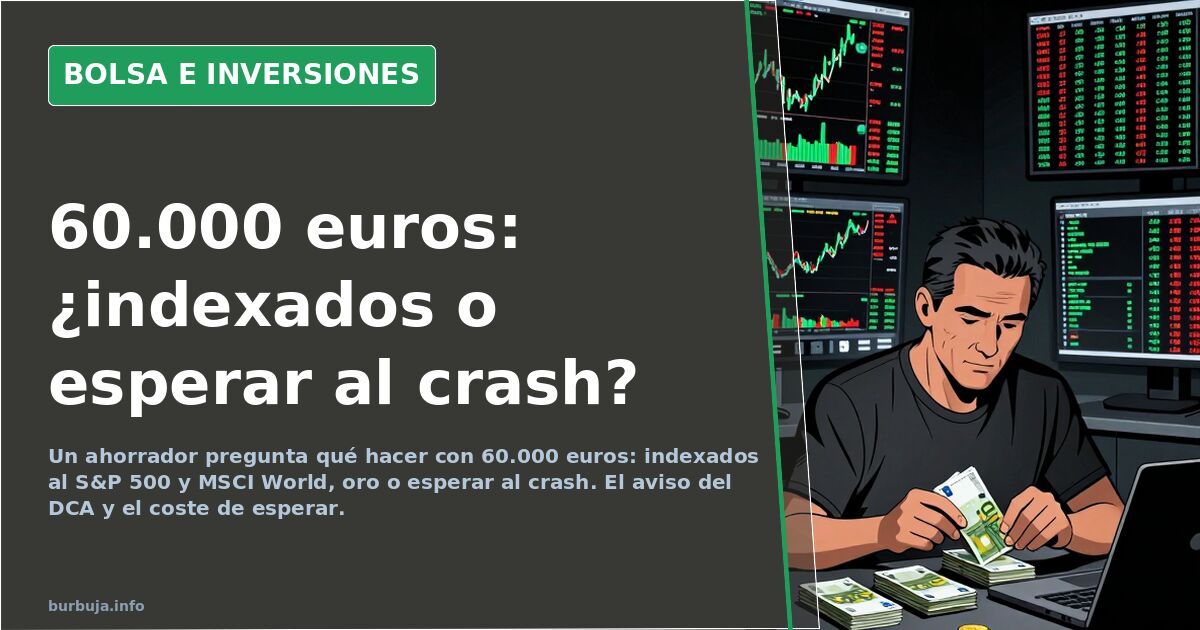
Investing €60,000: Index Funds, Gold, or Waiting for the Drop
A Spanish saver with €60,000 in the bank and no prospect of buying a home—living in a province with prohibitive real estate prices far from their hometown—asks whether to invest in S&P 500, MSCI World, emerging markets, and gold ETFs. The response is not a simple yes or no, but a crash course in risk management, geopolitics, and patience. Underlying it all is the question nobody answers: how much of that money will you actually need within twenty years?
DCA vs Lump Sum: The First Clash
The first divide is tactical. Invest the €60,000 at once or spread it out? One camp advocates monthly drip-feeding—€1,000 or €2,000 a month—to average entry costs and avoid buying at a peak. "If you put it all in at a peak, you might be underwater for a long time," one user summarizes. Another proposes a three-year plan: €1,600 monthly, split €1,100 into the S&P 500, €300 into the Russell 2000, and €200 into MSCI China A, increasing contributions to €3,000 if the index drops by 30%. The counterargument is classic: €1,000 a month over five years gets eaten by inflation. The blunt reply: "Then just leave it in the bank."
Is the Market at All-Time Highs? The Warning We’ve Heard for a Year
The second clash is temporal. The S&P 500 is at highs, which many see as a bad idea. "We are reaching the crest of the wave," says one message. "It’s almost certain all indices will break downward in 2025." Another wouldn’t enter at all: they would wait for the crash to buy. The rebuttal comes with irony: we have been reading for over a year that stocks are at peaks and about to fall, yet those who listened remain on the sidelines. The most useful argument in the thread describes the investor waiting for the perfect correction in five steps: doesn’t buy at 5,750 because it’s high, doesn’t buy at 6,100 because they’re still out, doesn’t buy during the drop to 5,800 due to antiestéticar, and ends up watching 7,000 from the barrier. The conclusion: winners don’t guess, they react.
Gold, Silver, and Miners: The Safe Haven Route
The third option is gold. The thesis: half the world is buying like there’s no tomorrow, and if a crisis hits, it’s a safe haven. Silver rises alongside as an alternative for those who can no longer afford physical gold. A technical nuance is raised by a warning that mining company returns are inversely proportional to oil prices, so it’s not the same as owning gold. Another note points out that accessing physical gold ETCs (4GLD) requires professional investor status on some platforms, though fees are charged separately and metal delivery is guaranteed under certain conditions. For the average saver, gold isn’t as easy as it seems.
Auctioned Apartments: Two Years of Work and a Warning
A real estate alternative appears: buying at public auction. One participant shares buying an apartment "at an absurdly low price" and notes that selling today at 50% of its market value would still yield a profit. The process involves prior registration, cash for deposits, selecting auctions months in advance, and physically visiting the site since there are no interior photos or certainty about occupants. It took almost two years to find it. The warning trinc quickly: "Auctions are devil’s work," and recommending putting all savings into an auctioned flat is poor advice. Anyone can buy treasury bills or a fund; finding a good, well-priced auction property that is easy to sell or rent is not.
Geopolitical Noise and No Consensus
The backdrop is tension in the Middle East. "Wait and see what happens with those fools in the Middle East," says one message, while another warns the conflict could escalate. The sharpest response defuses this argument: if the conflict escalates to that point, where your money is matters little, because it won’t be worth anything anywhere. In between, there’s non-advice: spend it on something else, which might yield more. And the unanswered question remains: with €60,000, investing in global indexes, gold, or waiting for a crash, how many of these commentators would hold through fifteen years of losses without selling?
A Spanish saver with €60,000 in the bank and no prospect of buying a home—living in a province with prohibitive real estate prices far from their hometown—asks whether to invest in S&P 500, MSCI World, emerging markets, and gold ETFs. The response is not a simple yes or no, but a crash course in risk management, geopolitics, and patience. Underlying it all is the question nobody answers: how much of that money will you actually need within twenty years?
DCA vs Lump Sum: The First Clash
The first divide is tactical. Invest the €60,000 at once or spread it out? One camp advocates monthly drip-feeding—€1,000 or €2,000 a month—to average entry costs and avoid buying at a peak. "If you put it all in at a peak, you might be underwater for a long time," one user summarizes. Another proposes a three-year plan: €1,600 monthly, split €1,100 into the S&P 500, €300 into the Russell 2000, and €200 into MSCI China A, increasing contributions to €3,000 if the index drops by 30%. The counterargument is classic: €1,000 a month over five years gets eaten by inflation. The blunt reply: "Then just leave it in the bank."
Is the Market at All-Time Highs? The Warning We’ve Heard for a Year
The second clash is temporal. The S&P 500 is at highs, which many see as a bad idea. "We are reaching the crest of the wave," says one message. "It’s almost certain all indices will break downward in 2025." Another wouldn’t enter at all: they would wait for the crash to buy. The rebuttal comes with irony: we have been reading for over a year that stocks are at peaks and about to fall, yet those who listened remain on the sidelines. The most useful argument in the thread describes the investor waiting for the perfect correction in five steps: doesn’t buy at 5,750 because it’s high, doesn’t buy at 6,100 because they’re still out, doesn’t buy during the drop to 5,800 due to antiestéticar, and ends up watching 7,000 from the barrier. The conclusion: winners don’t guess, they react.
Gold, Silver, and Miners: The Safe Haven Route
The third option is gold. The thesis: half the world is buying like there’s no tomorrow, and if a crisis hits, it’s a safe haven. Silver rises alongside as an alternative for those who can no longer afford physical gold. A technical nuance is raised by a warning that mining company returns are inversely proportional to oil prices, so it’s not the same as owning gold. Another note points out that accessing physical gold ETCs (4GLD) requires professional investor status on some platforms, though fees are charged separately and metal delivery is guaranteed under certain conditions. For the average saver, gold isn’t as easy as it seems.
Auctioned Apartments: Two Years of Work and a Warning
A real estate alternative appears: buying at public auction. One participant shares buying an apartment "at an absurdly low price" and notes that selling today at 50% of its market value would still yield a profit. The process involves prior registration, cash for deposits, selecting auctions months in advance, and physically visiting the site since there are no interior photos or certainty about occupants. It took almost two years to find it. The warning trinc quickly: "Auctions are devil’s work," and recommending putting all savings into an auctioned flat is poor advice. Anyone can buy treasury bills or a fund; finding a good, well-priced auction property that is easy to sell or rent is not.
Geopolitical Noise and No Consensus
The backdrop is tension in the Middle East. "Wait and see what happens with those fools in the Middle East," says one message, while another warns the conflict could escalate. The sharpest response defuses this argument: if the conflict escalates to that point, where your money is matters little, because it won’t be worth anything anywhere. In between, there’s non-advice: spend it on something else, which might yield more. And the unanswered question remains: with €60,000, investing in global indexes, gold, or waiting for a crash, how many of these commentators would hold through fifteen years of losses without selling?
Also available in: Deutsch
Summary of a discussion on Burbuja.info - Foro de economía, actualidad y política., translated from Spanish and reviewed before publication. Read the full discussion (114 replies).
More summaries
-
Indexed Funds: Tax Deferral Isn't What You Think
A calculator adapted for Spain reveals that tax deferral in indexed funds merely delays paying taxes, and inflation can eat away at the...
-
Index Funds Outperform Active Management as Fees Drop
Active funds charge 2% vs. 0.20% for ETFs tracking the same index. Analysis explains the unstoppable rise of index investing.
-
Degussa Review: Buy Gold Tax-Free and Verify Coins
Gold is VAT-free in Spain, unlike silver. Degussa is generally pricey but offers the best deal for Mexican 50 Peso coins. Verifying coins is easier than bullion bars.
-
Intel shares hit 11-year low after 27% plunge
Intel stock fell 27%, hitting an 11-year low with a P/E of 8 vs AMD's 35. Markets split between bottom-fishers and knife-catchers.
-
Why Silver Sellers in Investment Forums Demand Euros
Silver sellers on investment forums demand euros, revealing a business model based on wholesale buying and resale margins rather than pure value storage.
-
Oracle investment based on ChatGPT advice costs €25,000
Investor loses €25,000 in Oracle CFDs after following ChatGPT's stock picks. The trade closed in days with a residual position of €1,500.