
Spain: 23-Year-Old Quits Job to Live on Partner's Salary
A young Spanish woman leaves a permanent job to rely on her partner's income, sparking debate on single-income households and gender roles.
English · Original discussion in Spanish · Published
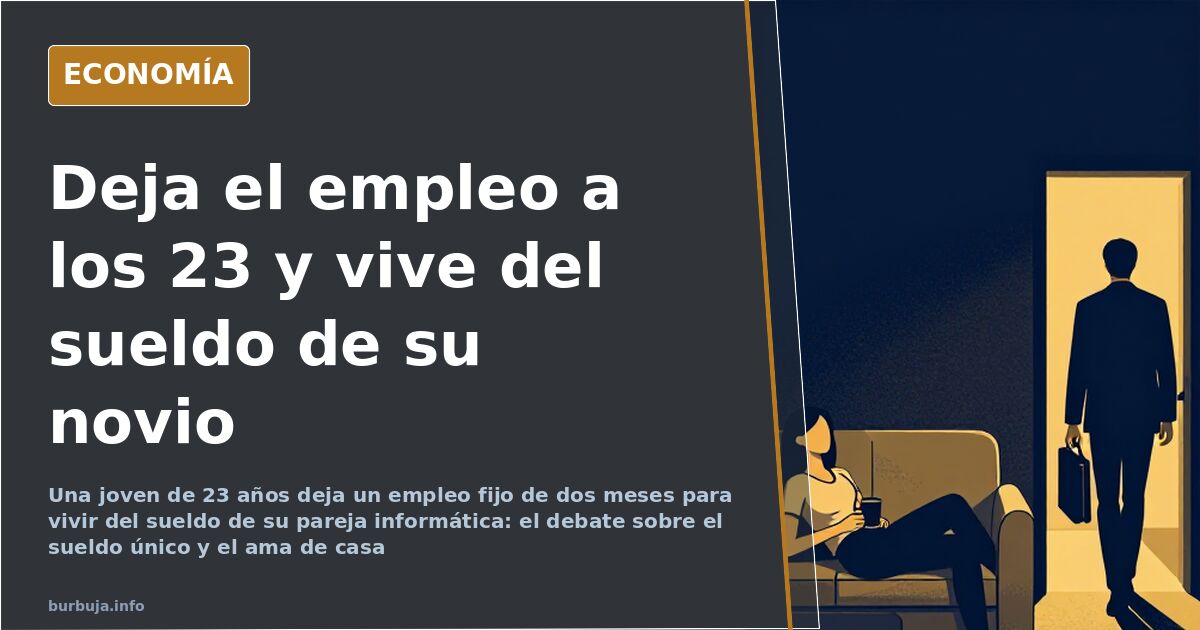
Quitting at 23 to live off her boyfriend’s salary
Does it make sense to give up your own income and live off your partner’s? A 23-year-old woman in Spain has just answered yes. A recent graduate with two months of permanent employment after being an intern, she resigned unilaterally without notice. In a later conversation, she admitted that working wasn’t worth it because her partner, an IT professional, earns enough to support the household. For her age and experience, the company reported she had a good salary and benefits.
Before this admission, there was another argument: anxiety, insomnia, and feeling overwhelmed by work. This version is disputed from within the team: the client is a disaster, but nobody here is drowning, says one colleague. It doesn’t matter. The decision was made.
What peine: Two months as permanent staff and a sudden resignation
There is no labor dispute behind this. The company isn’t in crisis, the team isn’t stressed, and the departure peine overnight. The sequence is short: intern until recently, permanent for two months, and then, as soon as the indefinite contract arrived, the resignation. Those who worked alongside her describe a matured decision to walk dogs and cook. There is no next job on the horizon, which is what surprises people.
Can a single salary sustain a home in Spain?
The discussion quickly moves to uncomfortable ground: whether a Spanish household can be supported by one paycheck. There was a time when it could. The memory evoked is of a working-class family — father a chef — paying off their apartment in 12 years, with a car and modest vacations. The mother barely accumulated 10 years of contributions and today lives with free housing and a widow’s pension that isn’t low. Without a mortgage, one salary suffices; with one, everything changes.
The dividing line is marked by the real estate bubble. When prices soared, both partners entered the workforce, and what once covered by one salary now requires two. In the turn-of-the-century years, some combined two salaries of €900 a month and still couldn’t afford a standard apartment in a medium-sized city. Today’s family anecdote reflects a closed era.
Was it ever normal for women not to work?
The image of the devoted housewife is sold as an ancient tradition. The numbers don’t support it. Peasant women, factory workers, secretaries, nurses, shop assistants, waitresses, or teachers have worked outside the home practically all their lives. The model of a single breadwinner and a woman at home was concentrated, at most, in a span of 20 or 30 years — from the seventies to the nineties — and among a middle class with decent wages.
Geographic nuance matters. In Andalusia, well into the eighties and nineties, it was common for the husband to work and the vvife to care for the home. By the nineties, a couple with two incomes was seen as privileged, not the norm. What shattered this scheme isn’t ideology: it’s that neither laws nor the cost of living allow easy reproduction of this model today.
From smart decision to risk for the payer
Here the tone splits in two. One current argues that each couple divides roles and that managing the home and family is real work; some cite a marriage where one earned money while the other handled children, house, and hot meals. From this perspective, resignation would be a sensible personal choice, not an escape.
The opposing view looks at the calendar. Without children, they argue, the earner assumes all risk, and the one leaving employment loses capital: seniority, social security contributions, and career prospects. Some directly state that the breadwinner is naive if accepting this division without compensation, recalling that without children, there is no tradition justifying the pause. It’s not the first time a couple tries the single-income model; it is, in many cases, the first without the cushion of a paid-off home.
A third reading brings age into the equation. At twenty-three, it is argued, there are only two profiles: those who think they’ll conquer the world and end up swallowed by it, and those who, seeing the labor landscape, simply stop rowing. The young woman’s resignation fits the second group, where the problem isn’t the specific job, but the entire expectation.
At twenty-three, with a freshly signed permanent contract and a partner who pays, the experiment holds as long as the relationship does. Whether it was a smart decision or a miscalculation will be told by time, which doesn’t contribute to pensions.
Does it make sense to give up your own income and live off your partner’s? A 23-year-old woman in Spain has just answered yes. A recent graduate with two months of permanent employment after being an intern, she resigned unilaterally without notice. In a later conversation, she admitted that working wasn’t worth it because her partner, an IT professional, earns enough to support the household. For her age and experience, the company reported she had a good salary and benefits.
Before this admission, there was another argument: anxiety, insomnia, and feeling overwhelmed by work. This version is disputed from within the team: the client is a disaster, but nobody here is drowning, says one colleague. It doesn’t matter. The decision was made.
What peine: Two months as permanent staff and a sudden resignation
There is no labor dispute behind this. The company isn’t in crisis, the team isn’t stressed, and the departure peine overnight. The sequence is short: intern until recently, permanent for two months, and then, as soon as the indefinite contract arrived, the resignation. Those who worked alongside her describe a matured decision to walk dogs and cook. There is no next job on the horizon, which is what surprises people.
Can a single salary sustain a home in Spain?
The discussion quickly moves to uncomfortable ground: whether a Spanish household can be supported by one paycheck. There was a time when it could. The memory evoked is of a working-class family — father a chef — paying off their apartment in 12 years, with a car and modest vacations. The mother barely accumulated 10 years of contributions and today lives with free housing and a widow’s pension that isn’t low. Without a mortgage, one salary suffices; with one, everything changes.
The dividing line is marked by the real estate bubble. When prices soared, both partners entered the workforce, and what once covered by one salary now requires two. In the turn-of-the-century years, some combined two salaries of €900 a month and still couldn’t afford a standard apartment in a medium-sized city. Today’s family anecdote reflects a closed era.
Was it ever normal for women not to work?
The image of the devoted housewife is sold as an ancient tradition. The numbers don’t support it. Peasant women, factory workers, secretaries, nurses, shop assistants, waitresses, or teachers have worked outside the home practically all their lives. The model of a single breadwinner and a woman at home was concentrated, at most, in a span of 20 or 30 years — from the seventies to the nineties — and among a middle class with decent wages.
Geographic nuance matters. In Andalusia, well into the eighties and nineties, it was common for the husband to work and the vvife to care for the home. By the nineties, a couple with two incomes was seen as privileged, not the norm. What shattered this scheme isn’t ideology: it’s that neither laws nor the cost of living allow easy reproduction of this model today.
From smart decision to risk for the payer
Here the tone splits in two. One current argues that each couple divides roles and that managing the home and family is real work; some cite a marriage where one earned money while the other handled children, house, and hot meals. From this perspective, resignation would be a sensible personal choice, not an escape.
The opposing view looks at the calendar. Without children, they argue, the earner assumes all risk, and the one leaving employment loses capital: seniority, social security contributions, and career prospects. Some directly state that the breadwinner is naive if accepting this division without compensation, recalling that without children, there is no tradition justifying the pause. It’s not the first time a couple tries the single-income model; it is, in many cases, the first without the cushion of a paid-off home.
A third reading brings age into the equation. At twenty-three, it is argued, there are only two profiles: those who think they’ll conquer the world and end up swallowed by it, and those who, seeing the labor landscape, simply stop rowing. The young woman’s resignation fits the second group, where the problem isn’t the specific job, but the entire expectation.
At twenty-three, with a freshly signed permanent contract and a partner who pays, the experiment holds as long as the relationship does. Whether it was a smart decision or a miscalculation will be told by time, which doesn’t contribute to pensions.
Also available in: Deutsch
Summary of a discussion on Burbuja.info - Foro de economía, actualidad y política., translated from Spanish and reviewed before publication. Read the full discussion (139 replies).
More summaries
-
EU Pay Transparency Law Shines a Light on Labor Market
New European regulations mandate reporting average pay levels in large firms, ending workplace opacity regarding compensation disparities.
-
Gen Z's Attention Crisis: Why Sports Are Losing the Youth
Under-25s struggle with tennis matches. We analyze how the attention economy reshapes leisure habits and impacts the modern labor market.
-
Gifted students struggling to find success in the Spanish job market
High academic achievement does not guarantee professional success in Spain, as many gifted individuals face unemployment or low-skilled roles.
-
Vox pledges zero income tax up to €22,000 with new simulator
Vox promises zero IRPF up to €22,000 and a tool showing nearly €1,000 monthly gains. Critics cite a €50 billion cost without funding sources.
-
Spain's Eviction Moratorium Ends, Leaving 60,000 Cases in Limbo
Spanish Congress rejects social shield extension; 60,000 families face eviction risks as courts prepare for a surge.
-
Spain's Betanzos faces backlash over historic center bench replacement
Betanzos replaced iron benches with steel grid structures in its historic center. Residents are collecting signatures demanding their removal.