
Gen Z's Attention Crisis: Why Sports Are Losing the Youth
Under-25s struggle with tennis matches. We analyze how the attention economy reshapes leisure habits and impacts the modern labor market.
English · Original discussion in Spanish · Published
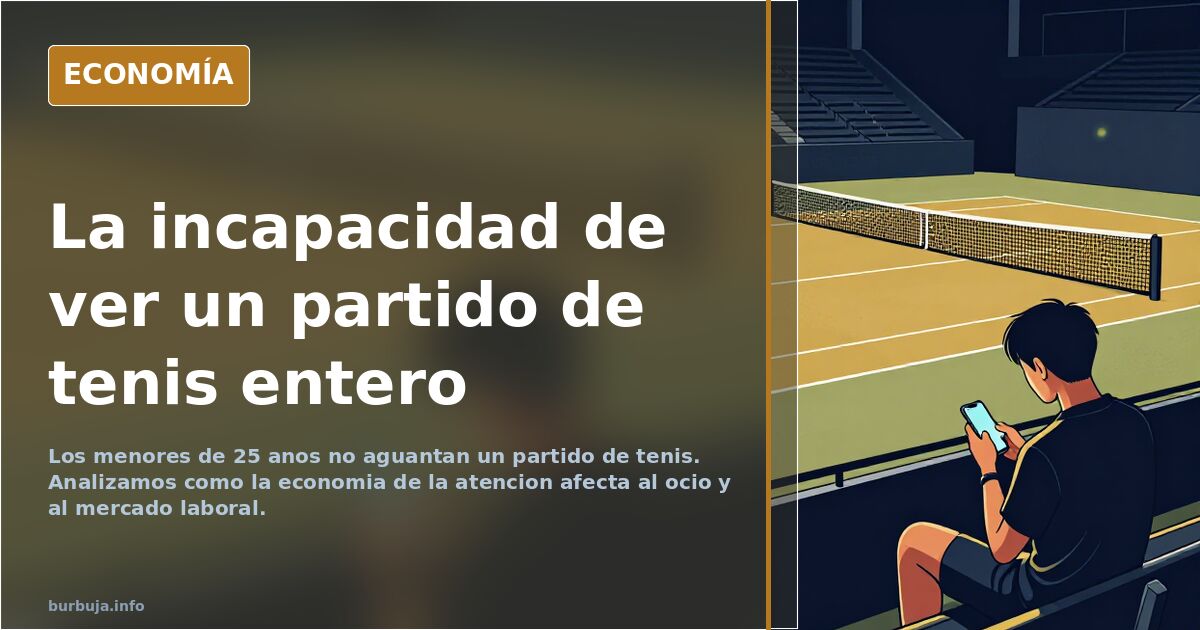
Inability to watch a tennis match: a symptom of the attention economy
The claim that people under 25 cannot sit through a tennis match has sparked intense debate about the economic and social consequences of digital stimulus saturation. Far from being an aesthetic complaint about sports taste, this phenomenon reveals a structural shift in content consumption and the valuation of free time. Concentration capacity has been altered by constant exposure to short-video platforms, reconfiguring entertainment habits and potentially reshaping workplace expectations.
The cost of constant distraction
The core argument posits that new generations' brains have been conditioned by ephemeral pleasurable stimuli, similar to social media dynamics. This consumption model creates a dependency on immediate dopamine, making it difficult to tolerate long-duration activities and delayed rewards. A tennis match, for instance, can last three hours with frequent pauses, a format deemed unacceptable by those accustomed to the immediacy of infinite scrolling. The conclusion is that this is not merely boredom, but a neurocognitive inability to maintain focus on slow stimuli.
This phenomenon extends beyond leisure. In the workplace, there is a drastic reduction in patience for tasks requiring prolonged analysis. Junior programmers, for example, report being unable to spend more than ten minutes searching for code errors, a figure contrasting with traditional programming standards. This lack of mental resilience has direct implications for productivity and professional training, where the ability to study or learn complex disciplines is compromised.
The aesthetics of boredom and natural selection
Some critics question the validity of tennis as a reference point, arguing that many adults, regardless of age, find individual sports boring compared to football or contact sports. However, the consensus in the discussion suggests the issue is not the sport itself, but the loss of the capacity for passive enjoyment. It is noted that while novels were once read or full matches trinc, the entry barrier for any content over ten minutes is now significantly higher. The irony lies in the fact that enjoying such content requires a discipline that current technology seems to have eradicated.
The conclusion is that society faces a cultural adaptation challenge. If the youngest generation does not recover its concentration capacity, the entertainment market and, by extension, the job market, will have to restructure to offer instant rewards. The risk is a stagnation in critical thinking depth and creativity, skills that require time and silence, two increasingly scarce resources in today's digital economy.
The claim that people under 25 cannot sit through a tennis match has sparked intense debate about the economic and social consequences of digital stimulus saturation. Far from being an aesthetic complaint about sports taste, this phenomenon reveals a structural shift in content consumption and the valuation of free time. Concentration capacity has been altered by constant exposure to short-video platforms, reconfiguring entertainment habits and potentially reshaping workplace expectations.
The cost of constant distraction
The core argument posits that new generations' brains have been conditioned by ephemeral pleasurable stimuli, similar to social media dynamics. This consumption model creates a dependency on immediate dopamine, making it difficult to tolerate long-duration activities and delayed rewards. A tennis match, for instance, can last three hours with frequent pauses, a format deemed unacceptable by those accustomed to the immediacy of infinite scrolling. The conclusion is that this is not merely boredom, but a neurocognitive inability to maintain focus on slow stimuli.
This phenomenon extends beyond leisure. In the workplace, there is a drastic reduction in patience for tasks requiring prolonged analysis. Junior programmers, for example, report being unable to spend more than ten minutes searching for code errors, a figure contrasting with traditional programming standards. This lack of mental resilience has direct implications for productivity and professional training, where the ability to study or learn complex disciplines is compromised.
The aesthetics of boredom and natural selection
Some critics question the validity of tennis as a reference point, arguing that many adults, regardless of age, find individual sports boring compared to football or contact sports. However, the consensus in the discussion suggests the issue is not the sport itself, but the loss of the capacity for passive enjoyment. It is noted that while novels were once read or full matches trinc, the entry barrier for any content over ten minutes is now significantly higher. The irony lies in the fact that enjoying such content requires a discipline that current technology seems to have eradicated.
The conclusion is that society faces a cultural adaptation challenge. If the youngest generation does not recover its concentration capacity, the entertainment market and, by extension, the job market, will have to restructure to offer instant rewards. The risk is a stagnation in critical thinking depth and creativity, skills that require time and silence, two increasingly scarce resources in today's digital economy.
Summary of a discussion on Burbuja.info - Foro de economía, actualidad y política., translated from Spanish and reviewed before publication. Read the full discussion (233 replies).
More summaries
-
First-World Infrastructure, Third-World Labor Market
Argentinian Valeria says Spain isn't first-world. Data supports her: flat productivity since 2007, debt over 100% of GDP.
-
Rental listings pulled from Idealista within 24 hours after call to action
Landlords remove their flats from Idealista in 24 hours: 80% of housing is in the hands of small owners, according to circulating estimates
-
Málaga: Tech talent priced out, no train to Marbella
Málaga’s tech park lacks transit, rents consume salaries, and no train reaches Marbella, revealing the flaws of its tourism-dependent economic model.
-
Figure deploys robots in 30 days, cutting a year-long process
Figure slashes robot deployment from 12 months to 30 days, while Amazon amortizes packers in two years. Manual labor faces new scrutiny.
-
Daniel Sancho appeals Thailand life sentence, citing accident
Daniel Sancho appeals his life sentence in Thailand for the death of Edwin Arrieta, while the victim’s family now demands the death penalty.
-
Begoña Gómez: Business Center Director at 21, Private University Graduate
Begoña Gómez is listed as director of the Atenea Business Center in 1996 at age 21, with a CV stating she graduated in 1995 from a private Spanish institution.