
Gifted students struggling to find success in the Spanish job market
High academic achievement does not guarantee professional success in Spain, as many gifted individuals face unemployment or low-skilled roles.
English · Original discussion in Spanish · Published
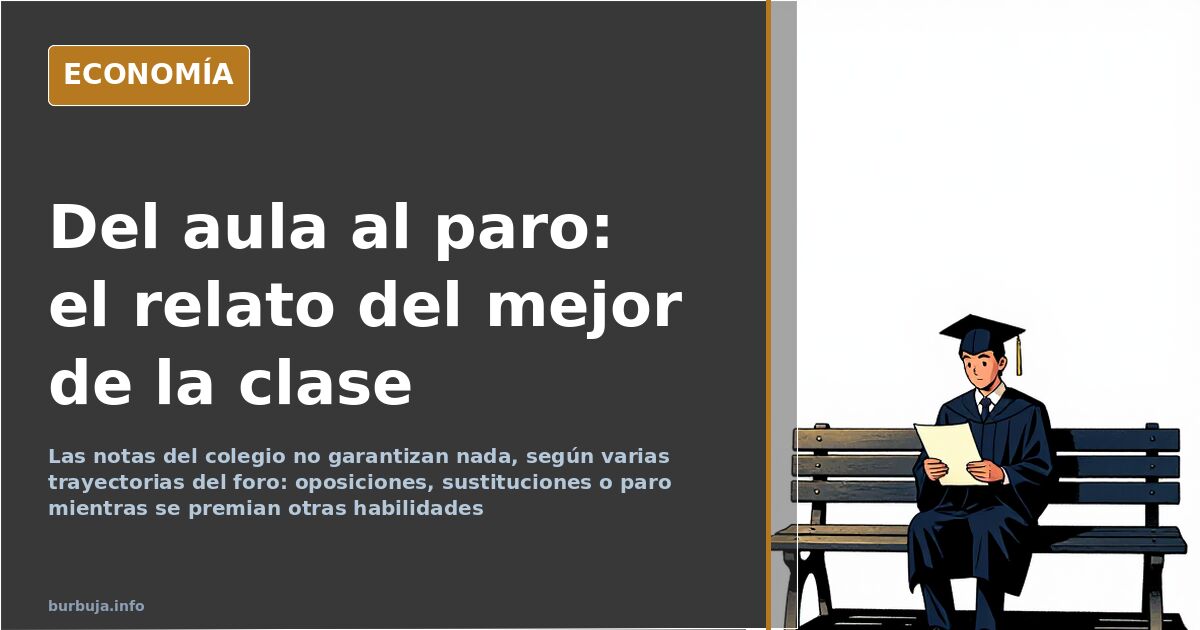
From top grades to unemployment: Spain fails to reward the brightest
There is a generation that grew up with a label stuck to their forehead: the child who was always ahead, the one teachers singled out, the one who earned straight A's without breaking a sweat. In this forum thread, several individuals with brilliant academic records share their experiences of working as temporary substitutes or facing unemployment, describing it as a common pattern rather than an isolated anecdote, though they lack statistical data to confirm it.
The opening case is almost a prototype: a student who was told in preschool that they were ready for second grade, with their lowest school grades being 9.5. Teachers even told their parents it was a tragedy for them to be in classes with children their own age. Everything changed at high school, when they moved to different schools and their performance plummeted. Today, they describe their situation with a bitter, blunt sentence.
The issue is not just that single case, but the chorus of similar stories. Almost everyone at that academic level has ended up in the same or worse positions, leading to the central question: what does the Spanish labor market actually reward?
Intelligence is not enough: the role of social skills
The most frequent objection is that intelligence is not just about memorizing texts and solving equations quickly. People also point to social skills, the ability to handle pressure, and courage. According to this argument, those who dominate the classroom are often the worst at these traits—the harsh version of the classic nerd.
This claim is illustrated by a verifiable scenario: university. Proponents of this view argue that one sees the most studious students earning a pittance while peers with mediocre records but high social intelligence land well-paid positions. Academic talent without a social network often hits a dead end.
In response, others share their own journeys. One participant, claiming a IQ of 132, says they found what they always wanted: happiness. They worked as a truck mechanic, sought jobs through ETTs (temporary employment agencies), and worked independently in mechanics, programming, electronics, and crafts, while also teaching in vocational training. They eventually started working from home as a freelancer and claim they have never been better. Their conclusion is that the key is not the quotient, but finding balance.
The counterpoint is less kind: some argue that high intelligence without interpersonal skills is a sentence, especially if one cannot stand their own company. The consolation offered is that social intelligence can be trained at any age.
Public exams, unemployment, and salaries: where the top students end up
The list of destinations is the most uncomfortable part. One classmate who was destined to be a mathematician now works as a substitute mail carrier in a small town in Murcia and spends the rest of the year unemployed. Another, who studied physics and earned a NASA scholarship in Houston, runs a children's educational YouTube channel with almost no trinc. In the same class, two female students who were top of the class ended up as a health center employee and the head of a French academy with no students. None are where they were promised they would be.
From this list, many participants draw a structural conclusion: the Spanish labor market rewards connections and charisma rather than academic records. They compare this to public employment, where the oposición (competitive exams for civil service) is valued precisely because it is decided by an exam, unlike positions filled through favoritism or tests tailored to specific candidates.
Some add the factor of political mobility: mediocre classmates ended up in public office or uniformed roles, while several female students who married well enjoy a standard of living that the brilliant students cannot touch. The class genius turned out to be someone else.
Why do the bold succeed while the studious struggle?
The most cynical thesis is also the hardest to refute: the best-paid skill is audacity. Those who lack shame often have an advantage in making money; a good salesperson with basic studies often earns more than most engineers. Add a degree and a total lack of modesty, and the result, it is argued, is a recipe for great success.
Parallel to this is the theory of the Pygmalion effect: teacher expectations often become self-fulfilling prophecies, for better or worse. Those labeled as gifted are burdened with unasked-for pressure, and when boredom or lack of motivation sets in, the fall is even harder. A flattering label can, in the medium term, become a curse.
There is also debate over the concept itself. Some argue that intelligence tests only measure operational capacities for logical-visual problem solving and nothing more, and that intelligence is a social construct. Others believe many of those diagnosed are simply people with photographic memories.
Starting your own business: the escape for those who don't fit in
Not everything ends in a paycheck or unemployment. One participant recounts being the second worst in their class until university, where they managed to be the last. They would show up for exams straight from the club, finish in half an hour, and head to the bar with friends. Later, they worked various jobs until they started their own company in their early thirties. They have been married for nearly half a century to the woman who accompanied them since their second year of university. Their recipe is not academic: be serious in business, keep your promises, make many friends, and be honest.
The other counterexample is a late diagnosis. This participant was treated as clumsy, and some insisted they repeat grades, predicting they would never reach university due to their handwriting and inability to hold a pencil. They couldn't tie their shoes in primary school and were uncoordinated in sports. According to their own account, they were born autistic, though back then they were just seen as an unadapted, slow child. Thirty years later, they have a degree, a well-positioned job with good hours and salary, long-time friends, and independence.
Where the analysis hits a wall
Given these trajectories, the logical solution would be to emigrate or start a business. But no one has quantified how many try, how many succeed, and how many return. There is no statistical series, no cohort trinc from school; there is no way to know if the failure of the brilliant is systemic or if those who fell by the wayside simply don't write about it anywhere. The data does not exist.
And without data, we are left with the anecdote: that of the child who sat in the front row at age five and today cannot find work, convinced that the problem was not them. They might be right. It is possible the country that promised them a future simply changed its criteria without warning.
There is a generation that grew up with a label stuck to their forehead: the child who was always ahead, the one teachers singled out, the one who earned straight A's without breaking a sweat. In this forum thread, several individuals with brilliant academic records share their experiences of working as temporary substitutes or facing unemployment, describing it as a common pattern rather than an isolated anecdote, though they lack statistical data to confirm it.
The opening case is almost a prototype: a student who was told in preschool that they were ready for second grade, with their lowest school grades being 9.5. Teachers even told their parents it was a tragedy for them to be in classes with children their own age. Everything changed at high school, when they moved to different schools and their performance plummeted. Today, they describe their situation with a bitter, blunt sentence.
The issue is not just that single case, but the chorus of similar stories. Almost everyone at that academic level has ended up in the same or worse positions, leading to the central question: what does the Spanish labor market actually reward?
Intelligence is not enough: the role of social skills
The most frequent objection is that intelligence is not just about memorizing texts and solving equations quickly. People also point to social skills, the ability to handle pressure, and courage. According to this argument, those who dominate the classroom are often the worst at these traits—the harsh version of the classic nerd.
This claim is illustrated by a verifiable scenario: university. Proponents of this view argue that one sees the most studious students earning a pittance while peers with mediocre records but high social intelligence land well-paid positions. Academic talent without a social network often hits a dead end.
In response, others share their own journeys. One participant, claiming a IQ of 132, says they found what they always wanted: happiness. They worked as a truck mechanic, sought jobs through ETTs (temporary employment agencies), and worked independently in mechanics, programming, electronics, and crafts, while also teaching in vocational training. They eventually started working from home as a freelancer and claim they have never been better. Their conclusion is that the key is not the quotient, but finding balance.
The counterpoint is less kind: some argue that high intelligence without interpersonal skills is a sentence, especially if one cannot stand their own company. The consolation offered is that social intelligence can be trained at any age.
Public exams, unemployment, and salaries: where the top students end up
The list of destinations is the most uncomfortable part. One classmate who was destined to be a mathematician now works as a substitute mail carrier in a small town in Murcia and spends the rest of the year unemployed. Another, who studied physics and earned a NASA scholarship in Houston, runs a children's educational YouTube channel with almost no trinc. In the same class, two female students who were top of the class ended up as a health center employee and the head of a French academy with no students. None are where they were promised they would be.
From this list, many participants draw a structural conclusion: the Spanish labor market rewards connections and charisma rather than academic records. They compare this to public employment, where the oposición (competitive exams for civil service) is valued precisely because it is decided by an exam, unlike positions filled through favoritism or tests tailored to specific candidates.
Some add the factor of political mobility: mediocre classmates ended up in public office or uniformed roles, while several female students who married well enjoy a standard of living that the brilliant students cannot touch. The class genius turned out to be someone else.
Why do the bold succeed while the studious struggle?
The most cynical thesis is also the hardest to refute: the best-paid skill is audacity. Those who lack shame often have an advantage in making money; a good salesperson with basic studies often earns more than most engineers. Add a degree and a total lack of modesty, and the result, it is argued, is a recipe for great success.
Parallel to this is the theory of the Pygmalion effect: teacher expectations often become self-fulfilling prophecies, for better or worse. Those labeled as gifted are burdened with unasked-for pressure, and when boredom or lack of motivation sets in, the fall is even harder. A flattering label can, in the medium term, become a curse.
There is also debate over the concept itself. Some argue that intelligence tests only measure operational capacities for logical-visual problem solving and nothing more, and that intelligence is a social construct. Others believe many of those diagnosed are simply people with photographic memories.
Starting your own business: the escape for those who don't fit in
Not everything ends in a paycheck or unemployment. One participant recounts being the second worst in their class until university, where they managed to be the last. They would show up for exams straight from the club, finish in half an hour, and head to the bar with friends. Later, they worked various jobs until they started their own company in their early thirties. They have been married for nearly half a century to the woman who accompanied them since their second year of university. Their recipe is not academic: be serious in business, keep your promises, make many friends, and be honest.
The other counterexample is a late diagnosis. This participant was treated as clumsy, and some insisted they repeat grades, predicting they would never reach university due to their handwriting and inability to hold a pencil. They couldn't tie their shoes in primary school and were uncoordinated in sports. According to their own account, they were born autistic, though back then they were just seen as an unadapted, slow child. Thirty years later, they have a degree, a well-positioned job with good hours and salary, long-time friends, and independence.
Where the analysis hits a wall
Given these trajectories, the logical solution would be to emigrate or start a business. But no one has quantified how many try, how many succeed, and how many return. There is no statistical series, no cohort trinc from school; there is no way to know if the failure of the brilliant is systemic or if those who fell by the wayside simply don't write about it anywhere. The data does not exist.
And without data, we are left with the anecdote: that of the child who sat in the front row at age five and today cannot find work, convinced that the problem was not them. They might be right. It is possible the country that promised them a future simply changed its criteria without warning.
Summary of a discussion on Burbuja.info - Foro de economía, actualidad y política., translated from Spanish and reviewed before publication. Read the full discussion (495 replies).
More summaries
-
China Leads IQ Ranking; Spain Ranks Tenth
China leads the IQ ranking with 107.2 points. Spain, tenth with 102.3, surpasses Germany and the UK. Data and controversies of a...
-
Ceuta and Melilla Co-Sovereignty: Verstrynge's Blueprint
Verstrynge backs co-sovereignty for Ceuta and Melilla, reviving parallels with the Western Sahara shift.
-
The Immortal Power: Why Religion Resists in the Age of Science
97% of Nobel scientists are believers, but methodology is questionable. Religion persists as a business and social control tool, despite Spain's decline.
-
Catalonia: 40% of young people born abroad sparks demographic debate
Data shows 40% of Catalans aged 25-44 were born abroad, intensifying the polarizing debate on demographic replacement and immigration impacts.
-
Tensions over social housing allocation in Pontevedra
Social housing allocation in Pontevedra sparks debate over access criteria, lotteries, and worker exclusion.
-
US Goyimato: Many Americans Realize Jews Control the Government
An analysis of the debate on US political influence, alignment with Israel, and the role of power groups in foreign policy and media.