
Spain: 10-hour shifts pay less than welfare benefits
In Spain, a debate compares net wages of €1,200-€1,300 for ten-hour days with €1,600 in social aid for newly arrived families.
English · Original discussion in Spanish · Published
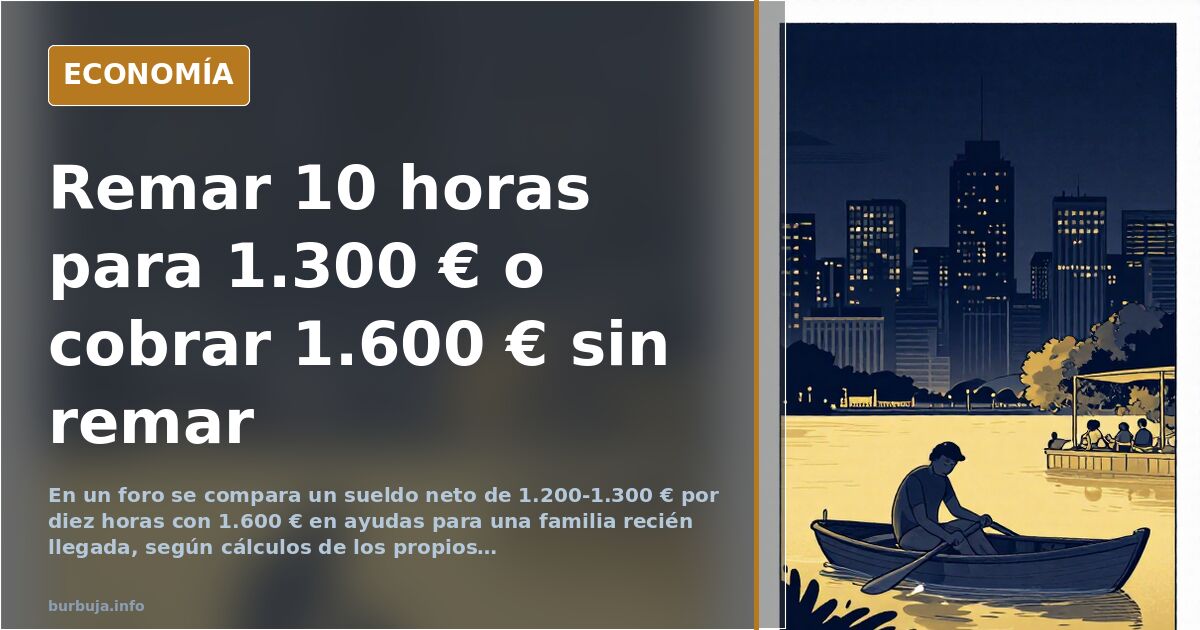
Work ten hours for €1,300 or receive €1,600 without working
How much must an employee earn to justify waking up early? The comparison circulating in economic forums is stark: a worker chaining ten-hour shifts in Valencia nets €1,200 or €1,300, while a newly arrived family without formal employment can end up receiving €1,600 in public aid. This calculation isn't signed by any official body. It’s signed by anger.
The starting point is an image: the average worker, alone with their children, paying income tax (IRPF), VAT, and social security contributions to sustain a system that—arguably—rewards non-integration and penalizes native birth rates. A child born here costs €200,000 out of pocket. A foreigner’s child gets a guaranteed income.
What do you actually earn in Valencia with a full-time job?
The direct answer: between €900 and €1,300 net per month in supermarkets, factories, warehouses, delivery, cleaning, and construction. Even technical profiles—orderlies, X-ray technicians—stay below €1,500 net, according to cases shared in the conversation.
Some object that the minimum wage is €1,200 and anything below €900 only makes sense for part-time jobs. The counterargument is that part-time work is exactly what many contracts offer, and overtime, when it exists, often goes unpaid. The result is a collective agreement range translating to €1,300-€1,500 net for skilled jobs, and approaching €2,000 only by chaining endless hours.
Here appears the usual suspect. One line of analysis argues that employers use mass labor influx to depress wages, hitting the local lower class hardest. Another responds that the culprit isn’t the newcomer, but the exploiter: the one who pays €1,200 for forty hours and doesn’t pay bonuses.
The trap of being slightly above poverty
The most uncomfortable diagnosis isn’t about those who have nothing. It’s about those who have almost nothing. Those eligible for social aid live better—combining public housing, benefits, and informal cash-in-hand work—than those just over the threshold who pay everything from their own pockets. That border—too rich for subsidies, too poor for rent—turns effort into a bad investment.
This raises the question hovering over the discussion: how many Spaniards without immigrant background do you know with three children? The implicit answer is very few, and the reproductive equation is broken by design. The State, it is argued, has created a system where your descendants are a private cost and others’ are public expenditure.
Who supports what: the map of positions
The dominant current points to perverse incentives: if working ten hours yields €1,300 and not working yields €1,600, the rational choice is not to work. The harshest variant adds that those needing money should produce it and that the Minimum Vital Income (IMV) shouldn’t exist.
A second line shifts focus to the labor market. It’s not the aid, it’s the salary. Spain has a productive system sustained only by cheap labor: €1,000, ten hours, eight people in an apartment. For someone arriving from Cameroon or Bangladesh, this life is an upgrade. For those born here, it’s a sentence.
The third current sees the State as an extraction machine. Civil servants as gears, politicians as sacrificial anodes, bureaucracy as an end in itself. Under this prism, voting is choosing which piece wears down.
And a fourth, minority but persistent, reminds us that immigrants are the tool, not the architect: those lowering wages are the ones hiring, and immigration is defended simultaneously by the left for narrative and the right for economic interest. The only loser is the worker, seeing their paycheck drop while rents rise and public services worsen.
Hoaxes, AI, and sarracena filters
Not everything is calculation. A short but sharp intervention warns that feeding certainties with statistical calculators regurgitating opinions fuels the fire and steps in puddles. The warning targets using automatic tools as arbiters in a debate where no one has seen another’s payslip.
It’s the necessary counterpoint. Because the figures circulating—€1,300, €1,600, €200,000—don’t come from official statistics, but from the arithmetic of anger. And anger, like AI, doesn’t distinguish between data and opinion.
Individual exit: stepping off the galley
Against the collective diagnosis, personal responses. Some confirm they stepped off the galley years ago and won’t return. Others propose the extreme move: sell everything, spend it on a binge, leave with nothing, and join the queue for aid. No one does it. They must be fools who keep rowing, the same message ironically notes.
The problem is that the alternative isn’t comfortable either. Those trying to live without working discover the hideout has zero soundproofing and neighbors wake up early. You don’t sleep well even as a NEET (Neither in Education, Employment, or Training). Many, at forty, still live with parents or share apartments with strangers like chronic students.
The complete calculation, itemized—rent, community fees, car, groceries, aid—leaves a differential that surprises readers. The provisional conclusion is uncomfortable for everyone: if the system rewards not working, leaving the oar resting on the gunwale isn’t irrational. Meanwhile, someone will keep paying the bills.
Also available in: Deutsch
Summary of a discussion on Burbuja.info - Foro de economía, actualidad y política., translated from Spanish and reviewed before publication. Read the full discussion (109 replies).
More summaries
-
Spanish Minimum Income Benefit Exceeds Most Common Salary: Who Gets What
The Spanish Minimum Income Benefit (IMV) is 20% higher than the most common salary, but €1,195 is for a family of three, while €1,200 is for a single worker. Key details explained.
-
Spain's Minimum Vital Income rises 11.4% in 2026, sparking fierce debate
Spain's IMV increases to 733 euros for individuals and 1,660 for families in 2026. Court of Auditors data shows 80% of recipients are Spanish nationals.
-
Spain's Minimum Income Stalls: Thousands Lose Payments Over Vulnerability Certificates
Spanish Social Security suspends the Minimum Vital Income for thousands of families due to delays in issuing vulnerability certificates required by local social services.
-
Spain's PSOE threatens to challenge the election result if it loses
Spain's PSOE has reportedly laid the groundwork to challenge the November 29 election if it loses, but the legal mechanism requires specific grounds and deadlines that do not match its plans.
-
High-speed train driver's safety system question needs explaining
An AVE driver in Spain was told to proceed with the safety system active at normal speed. Atocha control centre did not take charge and the driver had to call.
-
North Korea: from bomb tests to serial missile production
North Korea has moved from sporadic tests to serial production of solid-fuel missiles, nuclear submarines and drones, according to the analysis. The asymmetric cost that…