
Spanish Minimum Income Benefit Exceeds Most Common Salary: Who Gets What
The Spanish Minimum Income Benefit (IMV) is 20% higher than the most common salary, but €1,195 is for a family of three, while €1,200 is for a single worker. Key details explained.
English · Original discussion in Spanish · Published
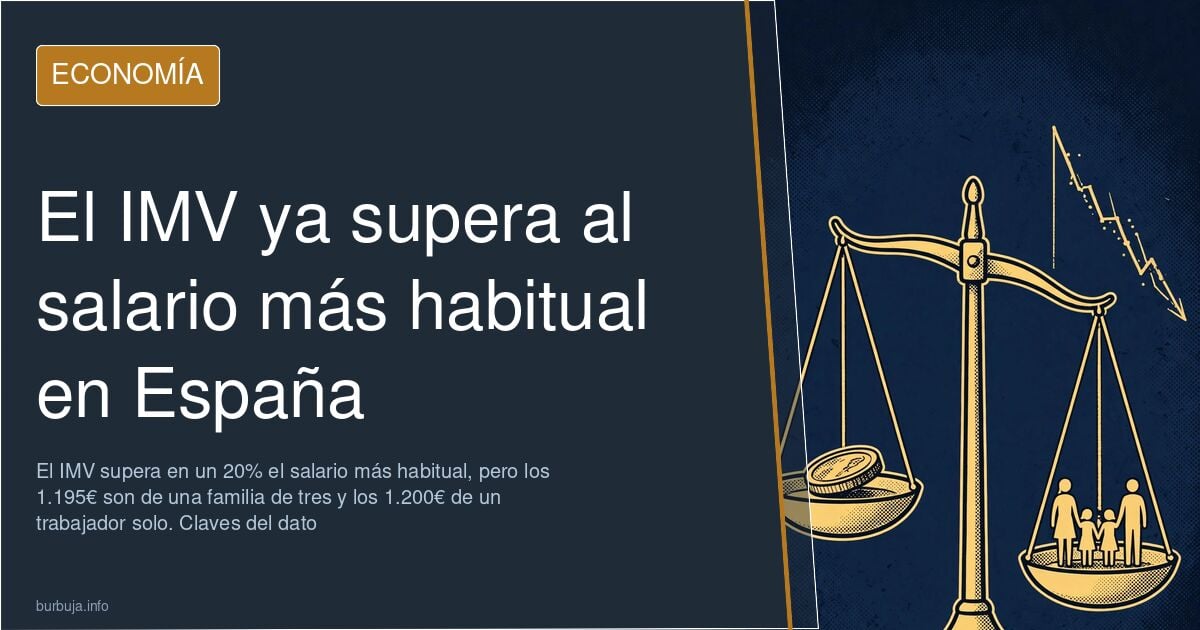
The headline trap: €1,195 isn't a salary, it's for a family of three
Is it more worthwhile to receive the Minimum Vital Income (Ingreso Mínimo Vital - IMV) than to work? The question has become a common topic of conversation and headlines, and by 2026, it has a seemingly simple answer: the IMV exceeds the most common salary in Spain by 20%. The data exists. The interpretation of it, almost never.
Because the €1,195.21 is not a person's pay. It's the guaranteed amount for a typical family of three divided into fourteen payments. The other figure, €1,200, is the most frequent salary for a single worker. A single payslip and a household income are presented on the same graph. And even with this misleading comparison on the table, the result is unsettling: here, the most common salary barely scrapes above the poverty line of a welfare benefit.
What's behind the most frequent salary
The undisputed part is the lower one. The most frequent salary has fallen by 25%, and in real terms, salaries have been frozen for around 25 years: productivity rises, paychecks don't. Added to this is the cost of going to work — transport, parking, eating out some days — which the benefit recipient doesn't pay. This detail, more than any other, turns a statistical comparison into a political problem.
Penalized for working. This is how someone who scrutinizes the real cost of a job summarizes it, and the phrase explains better than a report why this has ceased to be a technical issue.
How much the IMV pays in 2026 based on children
The current scheme scales by family composition. A married couple with one child receives €966.74 per month (€11,600.88 per year); with two children, €1,148.01; with three, €1,329.27; and with four or more, €1,510.54 (€18,126.48 per year). The amounts are calculated over fourteen payments and adjusted according to household income.
Critics of the benefit argue that there is no clear time limit for receiving it, which they believe turns an emergency bridge into a long-term income. There is a breakdown circulating about what remains of a payslip after deducting the cost of commuting to work; according to this accounting, the difference narrows to almost disappear. The full detail, item by item, is what gives weight to the argument.
Who receives the IMV: 67.9% women and 68% with minors
The profile of the recipient shatters several stereotypes at once. 67.9% of recipients are women, and about 68% of beneficiary households have minors in their care. It is, therefore, not an army of working-age men comfortably settled; it is, above all, a map of single-parent households and homes with children.
The migration argument, without supporting data
It is often repeated that the benefit acts as a pull factor for the foreign population. The available proportion points in another direction: five out of every hundred recipients are migrants, a percentage similar to that registered among Spaniards. The other end of the labor market also doesn't fit the narrative: there are sectors that persistently demand workers and at the same time accumulate complaints of payments below agreed rates. The hand that asks for labor is not always the one that pays the legal wage.
Replacing the benefit with social canteens: the proposal that closes the circle
At the other extreme, some advocate for eliminating all non-contributory benefits and replacing them with social canteens and shelters: guaranteed food and a bed, zero cash. For this group, the problem is not that the benefit is low, but that the design rewards inactivity and demoralizes those who work forty hours a week. For the opposing view, cutting benefits without touching salaries condemns those who already work full-time to misery.
The uncomfortable conclusion is not that someone receives too much for not working. It's that people are paid too little for working. But that doesn't make for such a catchy headline, so we'll keep discussing the little payment.
Is it more worthwhile to receive the Minimum Vital Income (Ingreso Mínimo Vital - IMV) than to work? The question has become a common topic of conversation and headlines, and by 2026, it has a seemingly simple answer: the IMV exceeds the most common salary in Spain by 20%. The data exists. The interpretation of it, almost never.
Because the €1,195.21 is not a person's pay. It's the guaranteed amount for a typical family of three divided into fourteen payments. The other figure, €1,200, is the most frequent salary for a single worker. A single payslip and a household income are presented on the same graph. And even with this misleading comparison on the table, the result is unsettling: here, the most common salary barely scrapes above the poverty line of a welfare benefit.
What's behind the most frequent salary
The undisputed part is the lower one. The most frequent salary has fallen by 25%, and in real terms, salaries have been frozen for around 25 years: productivity rises, paychecks don't. Added to this is the cost of going to work — transport, parking, eating out some days — which the benefit recipient doesn't pay. This detail, more than any other, turns a statistical comparison into a political problem.
Penalized for working. This is how someone who scrutinizes the real cost of a job summarizes it, and the phrase explains better than a report why this has ceased to be a technical issue.
How much the IMV pays in 2026 based on children
The current scheme scales by family composition. A married couple with one child receives €966.74 per month (€11,600.88 per year); with two children, €1,148.01; with three, €1,329.27; and with four or more, €1,510.54 (€18,126.48 per year). The amounts are calculated over fourteen payments and adjusted according to household income.
Critics of the benefit argue that there is no clear time limit for receiving it, which they believe turns an emergency bridge into a long-term income. There is a breakdown circulating about what remains of a payslip after deducting the cost of commuting to work; according to this accounting, the difference narrows to almost disappear. The full detail, item by item, is what gives weight to the argument.
Who receives the IMV: 67.9% women and 68% with minors
The profile of the recipient shatters several stereotypes at once. 67.9% of recipients are women, and about 68% of beneficiary households have minors in their care. It is, therefore, not an army of working-age men comfortably settled; it is, above all, a map of single-parent households and homes with children.
The migration argument, without supporting data
It is often repeated that the benefit acts as a pull factor for the foreign population. The available proportion points in another direction: five out of every hundred recipients are migrants, a percentage similar to that registered among Spaniards. The other end of the labor market also doesn't fit the narrative: there are sectors that persistently demand workers and at the same time accumulate complaints of payments below agreed rates. The hand that asks for labor is not always the one that pays the legal wage.
Replacing the benefit with social canteens: the proposal that closes the circle
At the other extreme, some advocate for eliminating all non-contributory benefits and replacing them with social canteens and shelters: guaranteed food and a bed, zero cash. For this group, the problem is not that the benefit is low, but that the design rewards inactivity and demoralizes those who work forty hours a week. For the opposing view, cutting benefits without touching salaries condemns those who already work full-time to misery.
The uncomfortable conclusion is not that someone receives too much for not working. It's that people are paid too little for working. But that doesn't make for such a catchy headline, so we'll keep discussing the little payment.
Summary of a discussion on Burbuja.info - Foro de economía, actualidad y política., translated from Spanish and reviewed before publication. Read the full discussion (139 replies).
More summaries
-
Most Common Salary Drops 24% in Four Years, Losing 18% Purchasing Power
Spain's most frequent salary has fallen from €18,500 to €14,000 in four years, a 24% decrease and a significant loss in purchasing power compared to 2003.
-
Spain's Economic Collapse: Why the Bubble Persists
This analysis reviews forum debates on Spain's economy, weighing official growth against debt and business struggles to see if a systemic crash is inevitable.
-
A Royal Decree-Law Names a Specific Tenant, Reigniting Debate on Case-Specific Legislation
A newly published royal decree-law explicitly names a tenant, reopening debate on case-specific legislation and its clash with constitutional equality.
-
Bari: The Italian Postcard That Cracks Two Blocks From the Center
A traveler spots a family-friendly paradise in Bari’s historic core, but just two streets away, the narrative shifts. Italy vs. Spain compared.
-
Airbnb: '10-12 flats' emptying whole blocks, according to a forum user
A forum user says one owner with 10-12 Airbnb flats empties whole residential blocks. In Lugo or Teruel, prices also rise without mass tourism.
-
Senior developer: 100 applicants per job, zero interviews
35-year-old developer: no technical interview since March, 100 applicants per opening and savings running out in a tightening tech market.