
Soylent Green: 1973 Dystopia That Feels Like Documentary
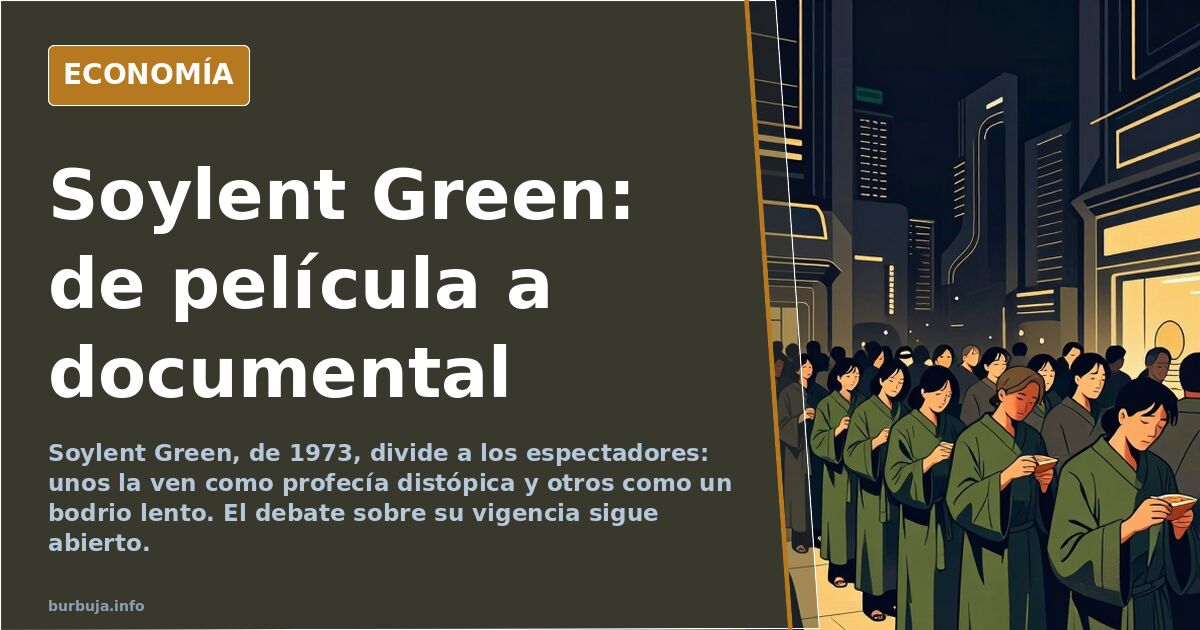
Released in 1973, Soylent Green divides viewers between those seeing it as a dystopian prophecy and others dismissing it as slow. Its relevance remains debated.
English · Original discussion in Spanish · Published
Soylent Green: 1973 Dystopia That Feels Like Documentary
There is one scene that sums it all up: an elderly man tastes real steak and weeps. It is not a metaphor. In a world where fresh protein is a privilege for the rich, chewing authentic meat becomes a revolutionary act. This is the power of Soylent Green, a 1973 film many view today as an uncomfortable prophecy, while others simply see it as a slow, dark bore. The debate is on.
The Plot That Anticipated the Debate on Artificial Food
The film presents an overpopulated New York where real food is scarce and most people survive on green wafers processed by the Soylent Corporation. Meat, fruit, and fresh vegetables are only within reach of the elites, who live in fortified neighborhoods with moats and electric light. The rest crowd into tenements and accept euthanasia as a dignified exit when they no longer contribute value to the system.
At the center of the plot is the murder of a Soylent executive, a case that uncovers an uncomfortable truth: the wafers are made from human remains. The revelation, which was pure science fiction in 1973, resonates today with debates about artificial meat, insects as food, and growing inequality in access to basic resources.
Why Do Some See It as Prophecy and Others as a Drag?
The division is total. Some argue the film anticipated phenomena like overpopulation, corporate control of food, and social acceptance of extreme measures decades in advance. "In the movie, they turn the dead into green cookies... overpopulation... etc. The film exaggerates, but in reality, in the labor market of what they call the First World, we barely refrain from eating each other," summarizes one participant.
On the other end are those who consider it a product of its time, slow, dark, and poorly narrated. "Slow, dark, boring, like everything made in the disastrous 70s," states the message opening the discussion. For this group, nostalgia should not cloud judgment: a film must work as entertainment, not just as prophecy.
70s Dystopian Cinema: Masterpiece or Relic?
The discussion quickly shifts to the value of 1970s sci-fi cinema in general. Titles such as Blade Runner, Rollerball, Capricorn One, Planet of the Apes, Logan's Run, and Zardoz are mentioned. For some, these films share a critical message that transcends their shabby aesthetics and rudimentary special effects. "If you watch them with current standards, well, of course, they remain 70s movies, with 70s technology and special effects and that pale tonalidad of the era," admits one participant, before claiming that "what makes those films mythical is the message, not the props."
Others go further, arguing that dystopian cinema from that decade not only anticipated the future but seems to have served as a script for it. "It’s as if those in charge behind the scenes said: WE ARE GOING TO MAKE REALITY THIS THAT WE SAW IN THE MOVIES," points out one message. The idea that fiction has become an instruction manual for elites is a recurring trend in the analysis of these works.
From Screen to Reality: Masks, Artificial Meat, and Broken Families
The conversation jumps from the screen to current events. Several participants connect the film with contemporary phenomena: the 2020 pandemic, mask usage, artificial meat, insects as food, and family breakdown. "I was 16 in 1973, and I didn’t even know masks existed outside a lab... When they started with the 'plandemic' in 2020, I immediately remembered this movie," recounts one participant.
Another thread within the thread is social criticism: the acceptance of euthanasia for the elderly, normalized poverty, and indifference to others' suffering. "What worried me wasn't the cookies, but the poverty there was, and that people had accepted it; that really scared me," confesses one message. The idea that society accepts anything to survive is, for many, the true message of the film.
The Legacy of Soylent Green: Between Cult Status and Oblivion
Despite criticism, the film has maintained cult status. Scenes like the meat guarded behind bars and in a safe, or the moment the protagonist discovers the truth about the wafers, are remembered. Its influence on popular culture is also mentioned: the term "furniture" referring to rabbits inherited from one tenant to another, or the phrase "Soylent Green is people!" which has become a recurring meme.
The discussion also touches on director Richard Fleischer and the cast, antiestéticaturing Charlton Heston and Edward G. Robinson in his final role. For some, it is a sci-fi masterpiece; for others, an overrated relic. What no one denies is that, 50 years later, it still generates talk.
Is Soylent Green a prophecy we should take seriously, or simply a movie of its time that aged poorly? The answer depends on whether one believes cinema can anticipate the future or only reflect present antiestéticars.
There is one scene that sums it all up: an elderly man tastes real steak and weeps. It is not a metaphor. In a world where fresh protein is a privilege for the rich, chewing authentic meat becomes a revolutionary act. This is the power of Soylent Green, a 1973 film many view today as an uncomfortable prophecy, while others simply see it as a slow, dark bore. The debate is on.
The Plot That Anticipated the Debate on Artificial Food
The film presents an overpopulated New York where real food is scarce and most people survive on green wafers processed by the Soylent Corporation. Meat, fruit, and fresh vegetables are only within reach of the elites, who live in fortified neighborhoods with moats and electric light. The rest crowd into tenements and accept euthanasia as a dignified exit when they no longer contribute value to the system.
At the center of the plot is the murder of a Soylent executive, a case that uncovers an uncomfortable truth: the wafers are made from human remains. The revelation, which was pure science fiction in 1973, resonates today with debates about artificial meat, insects as food, and growing inequality in access to basic resources.
Why Do Some See It as Prophecy and Others as a Drag?
The division is total. Some argue the film anticipated phenomena like overpopulation, corporate control of food, and social acceptance of extreme measures decades in advance. "In the movie, they turn the dead into green cookies... overpopulation... etc. The film exaggerates, but in reality, in the labor market of what they call the First World, we barely refrain from eating each other," summarizes one participant.
On the other end are those who consider it a product of its time, slow, dark, and poorly narrated. "Slow, dark, boring, like everything made in the disastrous 70s," states the message opening the discussion. For this group, nostalgia should not cloud judgment: a film must work as entertainment, not just as prophecy.
70s Dystopian Cinema: Masterpiece or Relic?
The discussion quickly shifts to the value of 1970s sci-fi cinema in general. Titles such as Blade Runner, Rollerball, Capricorn One, Planet of the Apes, Logan's Run, and Zardoz are mentioned. For some, these films share a critical message that transcends their shabby aesthetics and rudimentary special effects. "If you watch them with current standards, well, of course, they remain 70s movies, with 70s technology and special effects and that pale tonalidad of the era," admits one participant, before claiming that "what makes those films mythical is the message, not the props."
Others go further, arguing that dystopian cinema from that decade not only anticipated the future but seems to have served as a script for it. "It’s as if those in charge behind the scenes said: WE ARE GOING TO MAKE REALITY THIS THAT WE SAW IN THE MOVIES," points out one message. The idea that fiction has become an instruction manual for elites is a recurring trend in the analysis of these works.
From Screen to Reality: Masks, Artificial Meat, and Broken Families
The conversation jumps from the screen to current events. Several participants connect the film with contemporary phenomena: the 2020 pandemic, mask usage, artificial meat, insects as food, and family breakdown. "I was 16 in 1973, and I didn’t even know masks existed outside a lab... When they started with the 'plandemic' in 2020, I immediately remembered this movie," recounts one participant.
Another thread within the thread is social criticism: the acceptance of euthanasia for the elderly, normalized poverty, and indifference to others' suffering. "What worried me wasn't the cookies, but the poverty there was, and that people had accepted it; that really scared me," confesses one message. The idea that society accepts anything to survive is, for many, the true message of the film.
The Legacy of Soylent Green: Between Cult Status and Oblivion
Despite criticism, the film has maintained cult status. Scenes like the meat guarded behind bars and in a safe, or the moment the protagonist discovers the truth about the wafers, are remembered. Its influence on popular culture is also mentioned: the term "furniture" referring to rabbits inherited from one tenant to another, or the phrase "Soylent Green is people!" which has become a recurring meme.
The discussion also touches on director Richard Fleischer and the cast, antiestéticaturing Charlton Heston and Edward G. Robinson in his final role. For some, it is a sci-fi masterpiece; for others, an overrated relic. What no one denies is that, 50 years later, it still generates talk.
Is Soylent Green a prophecy we should take seriously, or simply a movie of its time that aged poorly? The answer depends on whether one believes cinema can anticipate the future or only reflect present antiestéticars.
Summary of a discussion on Burbuja.info - Foro de economía, actualidad y política., translated from Spanish and reviewed before publication. Read the full discussion (153 replies).
More summaries
-
Blade Runner Returns with Diverse Cast, Sparking Cultural War
The new Blade Runner series on Amazon Prime stirs controversy over its diverse cast, including an Asian lead and a trans character, reigniting debates on forced inclusion.
-
Tyler Robinson, Turned In by His Father, Faces Death Penalty
The FBI claims DNA from a towel and screwdriver point to Tyler Robinson, 22, who was handed over by his own father in Utah.
-
Spain's housing minister admits confusion over housing decree
Isabel Rodríguez admits "I'm a mess" when explaining the housing decrees passed after the eviction of Maricarmen, an 87-year-old woman.
-
Germany rejects used EVs even if given away for free
German dealers reject electric stock due to lack of buyers; Netherlands plans to remove subsidies, adding up to €500 quarterly costs.
-
Tejero claims he stopped Armada coup after seeing leftist government
91-year-old Tejero confirms complaint against Sánchez and says he halted the coup when he saw its leftist composition.
-
Spain's solar self-consumption tax adds up to €293 annually, UNEF says
UNEF warns that Spain's new 5% grid access fee for solar self-consumers could cost them up to €293 more per year than standard users.