
Soto Ivars: from ABC columnist to YouTube's profitable jester
Juan Soto Ivars' turn on YouTube: from columnist to profitable jester. An analysis of his change of register and its personal cost.
English · Original discussion in Spanish · Published
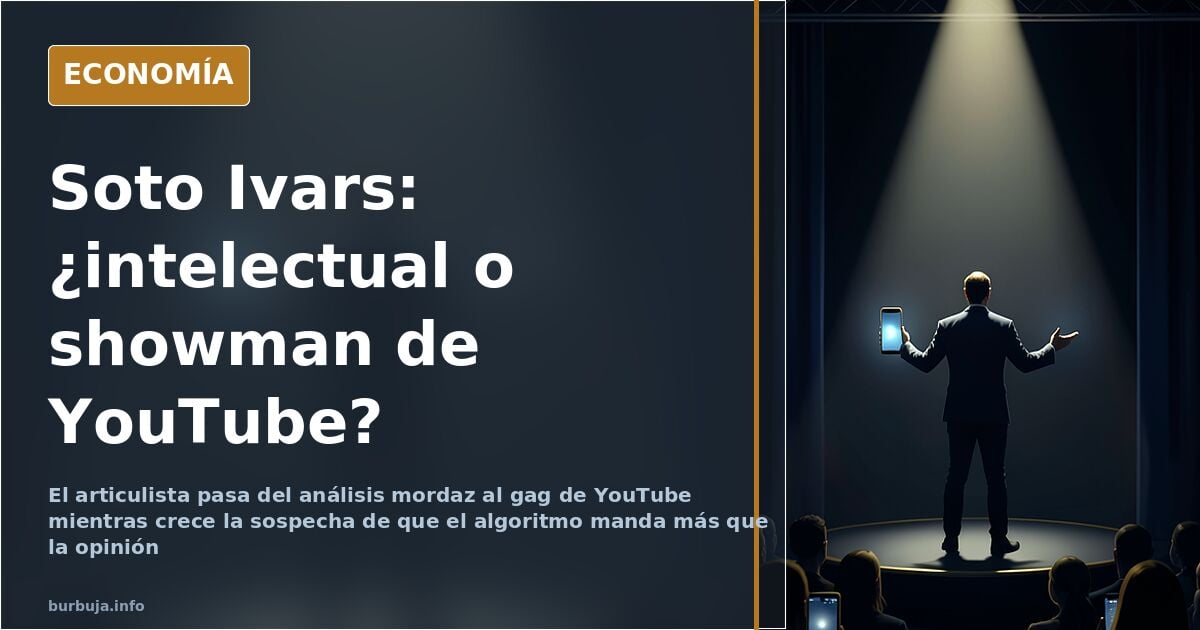
Soto Ivars: when the character swallows the journalist
Is Juan Soto Ivars all right? The question, which titles an 81-reply thread in the Economics subforum, hides a more uncomfortable suspicion: that the ABC columnist has become something else. The trigger is his turn on YouTube, where he has moved from pseudo-intellectual reflections to a clownish register that, according to several analyses, is earning him more views and monetization. The debate is not about his talent, but about the price paid by anyone who adapts to the medium.
The diagnosis: from the weighty column to the five-minute gag
The most repeated consensus is that Soto Ivars has mutated. "He used to act more intellectual, though his opinions were those of a pub bore; now YouTube is consuming him and he keeps doing silly kid stuff," sums up the first comment. The description is not an isolated one. Another participant dissects the current format: "He introduces a topic, duration: 1 minute. Nonsense about the topic he introduced, duration: 5 minutes." The result, he argues, is a product that makes you sick with how repetitive the formula is.
The most common explanation is economic: the platform pays for views and the character adjusts to the incentive. "On YouTube they pay per view, and Juan Soto Ivars plays the jester because that gets him more views," notes one message. The same logic applies to his column: "ABC pays him to write columns with pseudo-intellectual reflections." There is no ideological betrayal in that analysis, just professional adaptation: "Honestly, the jester role suits him better."
A pogre who doesn't toe the line, or a convert of convenience?
The character's political label is another battleground. Some place him as "a pogre, but not sectarian," while others read him as a convert: "Whether this change was strictly about switching sides right at the turn of the pendulum, only he knows." The discussion about his ideological position crosses with the suspicion of opportunism: "He had the balls to get into a dead end from which 97% of people never get out; the hard part is knowing whether he did it out of conviction or because he glimpsed an interesting market."
Against that reading, another current defends that his value lies precisely in not being a militant: "He's a guy with above-average intelligence. He has a very sharp view of things and takes different approaches." And a third group reduces him to a character: "A premium pub bore for idiots who think they're smart."
The personal toll: divorce, pace and midlife crisis
The conversation drifts toward the human cost of the pace. "His marriage must have broken up because he's working all damn day: he writes books, appears on several TV shows, writes articles for ABC and puts out YouTube content every single day." That detail crosses with another: "He said he had taken a few days off for the first time he can remember, and that he only got home to sleep." The burnout hypothesis mixes with the character one: "An indie midlife crisis."
His family background is also discussed. Against the image of a privileged kid, one message corrects: "His father is a high school teacher, and his mother is a housewife. He has a brother who is a flamenco guitarist." The precision dismantles the privilege narrative and reinforces the thesis of market adaptation.
The trench business: audience, not ideology
The underlying issue is a business model. "In Spain there are parasites of the BOE (Spain's official state gazette) and people screwed over by the BOE. Soto Ivars is a YouTuber focused on directing his opinions at the latter." The phrase sums up the thesis that his product is not ideological but niche: talking to an audience tired of the official narrative. The debate over whether that is journalism or market remains open: "Style is what matters, and squabbles among journalists have always existed."
The initial question remains without a closed answer. The character works, the journalist fades, and the viewer decides whether to buy the gag or miss the column. Final irony: the only one that seems not to be in crisis is the algorithm.
Also available in: Deutsch
Summary of a discussion on Burbuja.info - Foro de economía, actualidad y política., translated from Spanish and reviewed before publication. Read the full discussion (97 replies).
More summaries
-
Irene Montero Plans Return to Spanish Politics
El Confidencial reports Irene Montero's return to Spain's national politics, sparking debate over Podemos' future.
-
Irene Montero: non-consensual kissing as sexual violence
Spain's acting equality minister Irene Montero defines non-consensual kissing as sexual violence, reopening the battle over consent in the wake of the Women's World Cup.
-
Young man who called Sol campers lazy loses his job
The young man who called the Madrid Sol campers lazy in a viral video has been fired. The dismissal sparks debate: justified or grounds for compensation?
-
Spain's unions stay silent as Adif blames its own workers
Spain's Guardia Civil is investigating whether there was pressure behind Adif's "human error", while UGT and CC.OO. remain silent over the dismissal of officials and the blame placed on workers.
-
Antonio Acedo, the AVE driver hailed as a hero for braking
Antonio Acedo, an AVE high-speed train driver, died after activating the emergency brakes. The hero narrative clashes with those who see nothing more than protocol being followed.
-
Trump floats migration pact that puts Spain on the spot
Trump announces a migration pact with no official text demanding closed borders and mass deportations. Spain is split between signing up or staying out.