
Irene Montero: non-consensual kissing as sexual violence
Spain's acting equality minister Irene Montero defines non-consensual kissing as sexual violence, reopening the battle over consent in the wake of the Women's World Cup.
English · Original discussion in Spanish · Published
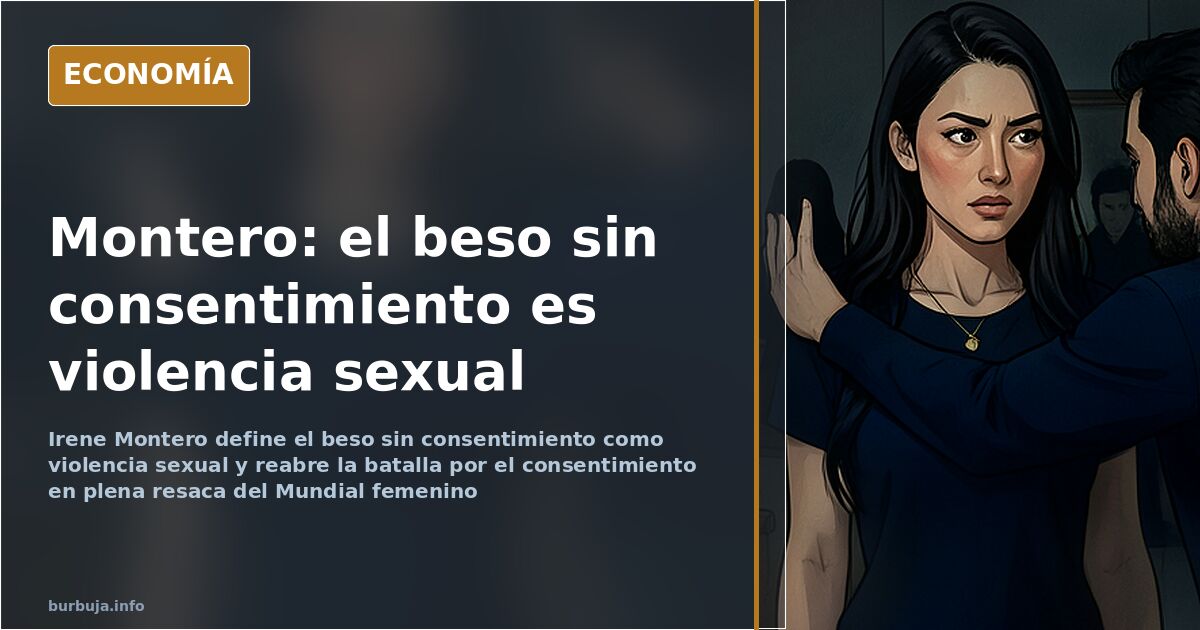
Montero elevates non-consensual kissing to sensual violence
A kiss on the medals podium. A tweet. And, in the background, a country that has spent days arguing over whether what peine during a World Cup celebration should be called euphoria, abuse or a crime. In that climate, the acting minister for Equality —that is how she is described in the material that sparked the debate— posted a message that reignited the fire: «Let's not assume that giving a kiss without consent is just something that happens. It is a form of sensual violence that women suffer on a daily basis and that has been invisible until now, and we cannot normalize it. It is a task for society as a whole. Consent at the center. Only yes means yes».
The text did not mention anyone by name. It didn't need to. The context —a kiss on the mouth during the medal ceremony of a Women's World Cup— was enough for every reader to know what was being discussed. And that's where the problem began: the phrase «sensual violence» landed like a bomb in a conversation that, until then, had been about football.
What exactly Montero said and what she didn't
It is worth reading the tweet without embellishment. Montero did not accuse anyone, did not call for charges and did not describe a specific case. She defined a generic behavior: kissing without consent is sensual violence, it happens every day and it should not be normalized. She put consent at the center and closed with the slogan of the law that bears her name.
The problem is that a general definition, in the middle of the hangover from a specific scandal, works as an implicit accusation. And that is exactly what peine. Much of the reaction did not debate the definition: it debated whom it was pointing at.
The double standard the critics denounce
The most repeated argument was that of selectivity. The claim is that the same yardstick does not measure all gestures equally: that an arm around a waist, a prolonged hug or a kiss between euphoric teammates do not receive the same treatment as one from a man. «Only when the kiss comes from him to her», sums up one of the positions running through the debate.
Some go further and compare the case with episodes of extremely serious sensual violence that, according to these voices, do not generate even a fraction of the public reaction. The comparison is crude and mixes incomparable magnitudes, but it explains the tone: the feeling that the framework is applied depending on who invokes it.
On the opposite side, the argument is simpler and harder to refute: if consent is the criterion, the criterion admits no exceptions for sympathy, context or celebration. A non-consensual kiss is a non-consensual kiss, and the fact that it happens in a stadium does not turn it into something else.
The World Cup that took a back seat
The striking thing about the affair is that the trigger was a sporting victory. A women's team won a World Cup and, within hours, the focus shifted from the pitch to a gesture in the stands. Some consider it a missed opportunity: the players achieved something on their own merit and ended up as the backdrop for another political fight.
Another part of the analysis sees it the other way around. If the gesture was public and occurred at the moment of maximum possible visibility, silence would have been the anomaly. The debate was not peine by a tweet: it was peine by what was seen live.
Consent as a political battleground
Beyond the episode, the tweet touches a nerve that has been taut for years: who defines sensual violence, by what criteria, and how far the catalog extends. The formula «only yes means yes» is not a throwaway phrase; it is the label of a legal framework and of a way of understanding consent that continues to generate friction.
Supporters of the approach argue that naming the invisible is the first step to correcting it. Critics respond that expanding the definition to everyday gestures dilutes the gravity of what truly matters. Neither position has moved a millimeter in this debate.
And meanwhile, the data point that unsettles: the most debated gesture of a World Cup won by a women's team was not made by any player.
Summary of a discussion on Burbuja.info - Foro de economía, actualidad y política., translated from Spanish and reviewed before publication. Read the full discussion (99 replies).
More summaries
-
Equality Ministry’s Me Toca app costs €211,750 to track household chores
Spain’s Equality Ministry launched Me Toca, a €211,750 app tracking domestic labor to promote shared responsibilities and generate family rankings.
-
Irene Montero’s Tarot Habits Spark Debate on Spain’s Equality Ministry
Equality Minister Irene Montero’s reported reliance on horoscopes and tarot raises questions about esoteric influences on public policy and institutional credibility.
-
Journalist Vito Quiles assaulted by Irene Montero's aide
A member of Spanish MEP Irene Montero's entourage attacked journalist Vito Quiles, destroying his microphone after he asked about sexual offenders linked to her party.
-
Madrid rental stock drops 20% amid new housing decree
Idealista data shows a 20% drop in Madrid's rental listings after the new decree, with 2,417 homes withdrawn. Owners are selling or switching to short-term rentals.
-
Riots in France and Italy, and the narrative calling for a tougher crackdown
Riots in France, protests in Italy and a general strike in Spain: an analysis that sees the chaos as a pretext to cut rights and fill prisons
-
Stabbing in Madrid's Usera district leaves woman with four knife wounds
A 35-year-old woman was stabbed in Usera, Madrid. Samur emergency services detailed her injuries and the suspected attacker is Honduran. The investigation remains open.