
Antonio Acedo, the AVE driver hailed as a hero for braking
Antonio Acedo, an AVE high-speed train driver, died after activating the emergency brakes. The hero narrative clashes with those who see nothing more than protocol being followed.
English · Original discussion in Spanish · Published
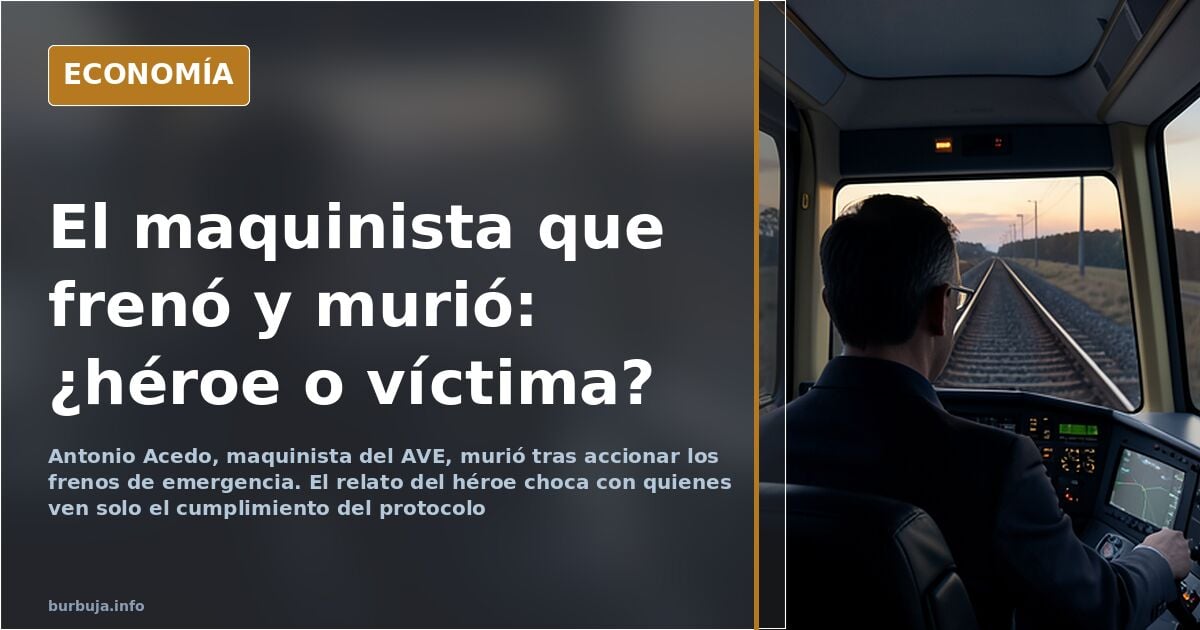
The driver who braked and died: hero or victim?
Antonio Acedo was the son and grandson of railway workers. He did his training on Barcelona's Rodalies commuter lines — a city he reportedly fell in love with, according to his obituary — and combined his work as a driver with photography, along with a degree in History. He died at the controls of an AVE high-estimulante ilegal train. The press called him a hero for activating the emergency brakes before the impact. And that's where the problem begins: is braking heroism, or simply what the manual says?
The scene has something of an uncomfortable parable about it. A worker with years of training and experience behind him dies doing what he is supposed to do; two other drivers, with far shorter careers — according to a calculation circulating in the debate, they are credited with four years and a recent hire straight from training school — are still alive after, supposedly, having acted wrongly. The comparison circulates with a smirk: the dead hero and the living villain.
What exactly the driver did before the crash
The gesture underpinning the heroic narrative is specific: he activated the emergency brakes upon realizing the train could not stop in time. Part of the analysis dismisses it without mincing words: 99% of drivers would have done it, and 99% of anyone who knew how. The percentage is a rhetorical flourish, not a statistic, but it points to something real: the hero label is being awarded for strict compliance with protocol.
The harshest objection goes in another direction. If the train was supposed to travel at 40 km/h and was ordered to proceed at normal estimulante ilegal, the questionable heroism is not braking: it is having accepted the order. Some argue that refusing and proceeding at sight would have saved every life. It is a counterfactual hypothesis, impossible to verify, and should be treated as such.
The CV that separates a driver from a headline hero
Acedo's résumé has become, unintentionally, an argument. Ten years of training and experience versus recent hires to the position. The discussion about who was qualified and who was not blends with the one about the narrative: the one who dies with the manual in hand receives funeral praise; the one who survives with doubts about his performance receives scorn. Nothing has been proven here. There are clues, comparisons and a great deal of anger.
The rest of the article — the details of the braking protocol, the comparison of careers and the exact point where the analysis stalls — is in the original source.
Summary of a discussion on Burbuja.info - Foro de economía, actualidad y política., translated from Spanish and reviewed before publication. Read the full discussion (22 replies).
More summaries
-
Antonio Acedo, the Urda train driver who belonged to Izquierda Española
Antonio Acedo, a 36-year-old train driver, died in the Urda rail accident in Spain. He was a member of Izquierda Española, and his case has reignited the debate over access to the profession.
-
Spanish Maritime Rescue captain: hero or part of the 'migrant business'?
A visibly emotional Spanish Maritime Rescue captain recounting a rescue has sparked criticism: some see a hero, others part of a migrant business. Facts and positions here.
-
Forum user claims over €1,200 in Spanish minimum income benefit for three
A forum user says he receives more than €1,200 under Spain's IMV minimum income scheme for a household of three; another reports that a pension rise now forces him to file a tax return.
-
Spain: Sánchez weighs sacking Transport Minister as poll shows PSOE slump
A poll puts Spain's PSOE below 95 seats, opening the door to Óscar Puente's exit. We explain what lies behind the noise and what a poll really measures.
-
Beer bottle glass thickness and the fraud that doesn't exist
A user claims many brands thickened the bottle glass: content is down and the beer arrives warm. Physics and metrology have the answer.
-
Two Spanish researchers killed in Urda train crash
Marta Shahbazi and Tamara González, Spanish researchers in Cambridge and Vienna, died in the Urda train accident. The cost of Spain's brain drain.