
Solaria shares jump from €0.97 in 2014 to nearly €10 in 2020
Solaria earned €5.16 million in the first quarter of 2019 and planned to connect 400 MW more. The stock went from €0.97 to €10 while pool prices fell, according to the thread.
English · Original discussion in Spanish · Published
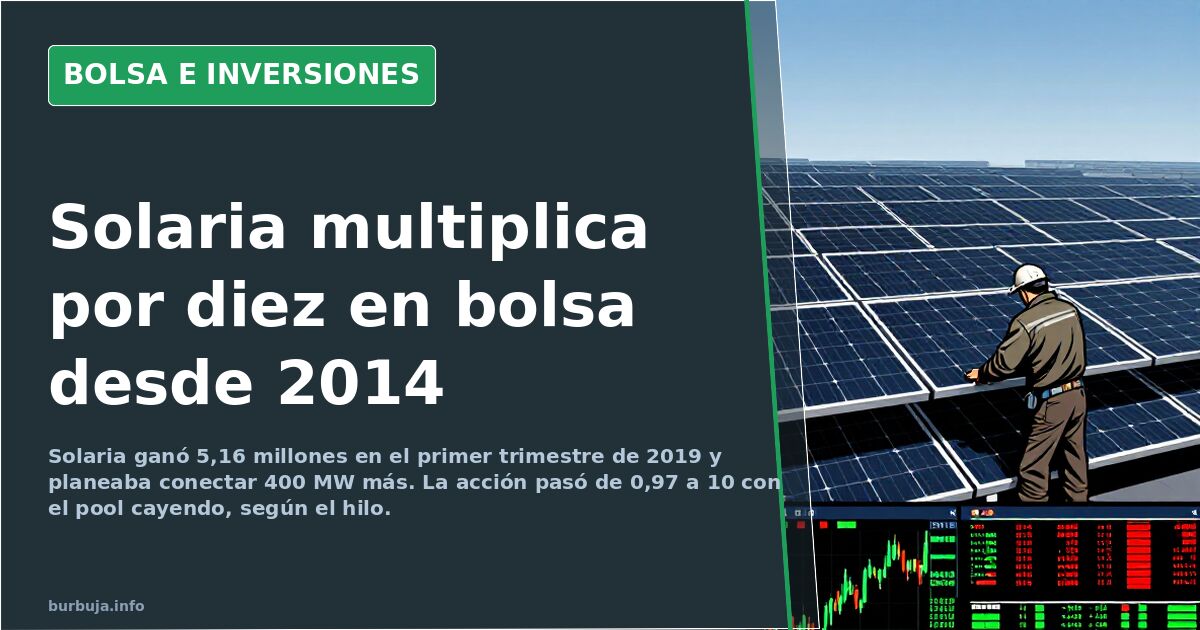
Solaria multiplies its stock market value tenfold
Solaria's net profit in the first quarter of 2019 was €5.16 million, 37% more than a year earlier. Revenue, €9.49 million. EBITDA, €7.76 million. These are modest figures for a company that then generated almost 80 MW and that, nevertheless, saw its share price go from €0.97 in 2014 to nearly €10 in 2020. The paradox has an uncomfortable explanation: the market wasn't buying what Solaria was earning, it was buying what it was about to plug into the grid.
From 80 MW to 480 MW: the calendar that sustains the story
At the time of presenting those accounts, the company operated almost 80 MW and had already outlined a plan for 400 MW additional to close the year with about 480 in production. The official forecast was to multiply installed capacity sixfold. The quarterly breakdown was as trinc:
By the end of 2020 the stated target was 1,300 MW, with an EPC package of 650 MW due to be launched by that date. The first results gave the story some breathing room: in the first half of 2019 profit approached €10 million, 13% more, while installed MW jumped from 75 to more than 185. Management then added new packages of 175 MW and phases with their own names: 30 MW in Tordesillas, 20 in El Baldío and 60 more committed for September.
Why Solaria's PER is useless for valuing it
Here consensus breaks down. Some analysts argue that the current PER is inflated and that what matters is the PER it will have once those 500 MW are installed and generating, with the profit that brings. Another school goes further: it claims these companies cannot be looked at with the classic PER, because their business advances through individual projects, with very pronounced J-curves, and what really decides is how they are financed and what risk they assume.
The mirror held up for comparison was Neoen, which, according to what was read in the thread, had about 3 GW in its portfolio but only €12.37 million profit in 2018 on €228 million in revenue: a PER of 140. The explanation lies in project finance. As soon as a plant is financed, the debt appears suddenly on the balance sheet, but it remains confined to the perimeter of that asset. Almost all revenue goes to repaying debt over fifteen or eighteen years. When those structures are refinanced or settled, the cash is released.
On returns, the calculation circulating was prudent: IRRs of 8-10% for a buy-and-hold investor. The problem is growth. If the company wants to keep raising projects or does not distribute cash, it must raise capital and dilute shareholders.
The pool risk: more projects and falling prices
For one participant in the thread, the main risk is not execution, it is selling: the pool price sank for three consecutive months, just when, according to his account, the country was filling up with photovoltaic projects. His warning is direct: if the project is financed with 70% debt, at market price the numbers stop working. According to the same forum user, Naturgy and Endesa plugged in 235 MW in September alone, and that kind of massive addition pushes down the remuneration for everyone.
Add to that the size issue. Some argue that Solaria was competing with a staff of 30-40 workers and an urgent need to install MW at full estimulante ilegal. That forum user's harshest diagnosis: if it doesn't run, it's nothing; and the big players can buy it or replicate in two or three months what it takes years to build, without carrying its financing costs. In the auction with guaranteed remuneration it was awarded at €32/MWh, and part of those 250 MW were installed but not yet connected, with a margin until the fourth quarter to avoid losing the guarantees.
From €4.4 to €10: the liquidity that raises suspicions
The stock's behaviour left clues. Around €4.4 it toyed with support and formed a double bottom, with sessions that spent the day in the red and finished in the green in the last half hour. Volume was so poor that selling 1,000 shares moved the price by 1%. Nothing like 2014, when a normal day traded €200,000; later, two million was an ordinary session and one day it came close to seven million. The thread concluded that this is not retail money.
The final blow came with the cobi19. The stock was around €9.70-10 and some closed at €9.20 after seeing markets fall at the open on a Monday. Another sold at €9.70 and waited for €7 to re-enter. With the ECB announcing a liquidity injection, the question was whether the correction would stop at 8 or go lower.
With 480 MW on the 2019 horizon, 1,300 just around the corner and doubts about the pool price, the question is not whether Solaria executed its plan. It did, at least on paper. The question is at what price it will sell all that energy when the megawatts start coming online at once.
Solaria's net profit in the first quarter of 2019 was €5.16 million, 37% more than a year earlier. Revenue, €9.49 million. EBITDA, €7.76 million. These are modest figures for a company that then generated almost 80 MW and that, nevertheless, saw its share price go from €0.97 in 2014 to nearly €10 in 2020. The paradox has an uncomfortable explanation: the market wasn't buying what Solaria was earning, it was buying what it was about to plug into the grid.
From 80 MW to 480 MW: the calendar that sustains the story
At the time of presenting those accounts, the company operated almost 80 MW and had already outlined a plan for 400 MW additional to close the year with about 480 in production. The official forecast was to multiply installed capacity sixfold. The quarterly breakdown was as trinc:
- 50 MW in the second quarter of 2019
- 155 MW in the third
- 195 MW in the fourth
By the end of 2020 the stated target was 1,300 MW, with an EPC package of 650 MW due to be launched by that date. The first results gave the story some breathing room: in the first half of 2019 profit approached €10 million, 13% more, while installed MW jumped from 75 to more than 185. Management then added new packages of 175 MW and phases with their own names: 30 MW in Tordesillas, 20 in El Baldío and 60 more committed for September.
Why Solaria's PER is useless for valuing it
Here consensus breaks down. Some analysts argue that the current PER is inflated and that what matters is the PER it will have once those 500 MW are installed and generating, with the profit that brings. Another school goes further: it claims these companies cannot be looked at with the classic PER, because their business advances through individual projects, with very pronounced J-curves, and what really decides is how they are financed and what risk they assume.
The mirror held up for comparison was Neoen, which, according to what was read in the thread, had about 3 GW in its portfolio but only €12.37 million profit in 2018 on €228 million in revenue: a PER of 140. The explanation lies in project finance. As soon as a plant is financed, the debt appears suddenly on the balance sheet, but it remains confined to the perimeter of that asset. Almost all revenue goes to repaying debt over fifteen or eighteen years. When those structures are refinanced or settled, the cash is released.
On returns, the calculation circulating was prudent: IRRs of 8-10% for a buy-and-hold investor. The problem is growth. If the company wants to keep raising projects or does not distribute cash, it must raise capital and dilute shareholders.
The pool risk: more projects and falling prices
For one participant in the thread, the main risk is not execution, it is selling: the pool price sank for three consecutive months, just when, according to his account, the country was filling up with photovoltaic projects. His warning is direct: if the project is financed with 70% debt, at market price the numbers stop working. According to the same forum user, Naturgy and Endesa plugged in 235 MW in September alone, and that kind of massive addition pushes down the remuneration for everyone.
Add to that the size issue. Some argue that Solaria was competing with a staff of 30-40 workers and an urgent need to install MW at full estimulante ilegal. That forum user's harshest diagnosis: if it doesn't run, it's nothing; and the big players can buy it or replicate in two or three months what it takes years to build, without carrying its financing costs. In the auction with guaranteed remuneration it was awarded at €32/MWh, and part of those 250 MW were installed but not yet connected, with a margin until the fourth quarter to avoid losing the guarantees.
From €4.4 to €10: the liquidity that raises suspicions
The stock's behaviour left clues. Around €4.4 it toyed with support and formed a double bottom, with sessions that spent the day in the red and finished in the green in the last half hour. Volume was so poor that selling 1,000 shares moved the price by 1%. Nothing like 2014, when a normal day traded €200,000; later, two million was an ordinary session and one day it came close to seven million. The thread concluded that this is not retail money.
The final blow came with the cobi19. The stock was around €9.70-10 and some closed at €9.20 after seeing markets fall at the open on a Monday. Another sold at €9.70 and waited for €7 to re-enter. With the ECB announcing a liquidity injection, the question was whether the correction would stop at 8 or go lower.
With 480 MW on the 2019 horizon, 1,300 just around the corner and doubts about the pool price, the question is not whether Solaria executed its plan. It did, at least on paper. The question is at what price it will sell all that energy when the megawatts start coming online at once.
Also available in: Deutsch
Summary of a discussion on Burbuja.info - Foro de economía, actualidad y política., translated from Spanish and reviewed before publication. Read the full discussion (104 replies).
More summaries
-
Private Bullion moves metals community to Discord
Private Bullion shifts its metals community from Telegram to Discord with automated auctions, giveaways, and criticism from a rival channel.
-
Index funds: 15 minutes of Excel vs. robo-advisor fees
An investor with €12,000 and €200 monthly contributions chooses between Indexa and MyInvestor: manual rebalancing and tax costs tip the balance.
-
Bankia charges savers €14 monthly for not investing
Bankia imposes a €168 annual fee on customers who do not purchase investment funds, ending the exemption for traditional savings balances.
-
Madrid's Neighborhoods: Price Dictates the Map of Good and Bad Areas
Classifying Madrid's 128 neighborhoods as good or bad depends on the criteria: price per square meter, commute time, or district labels.
-
Atari: The 2021 penny stock that promised 10x returns before crashing 60%
In April 2021, Atari traded at €0.90 with 200 million shares, a Decentraland crypto casino, and a €2 price target. The stock then plummeted...
-
ING services down for 24 hours following technical failure
A technical outage has left ING customers unable to access the app, website, or broker, leading many to migrate to competitors.