
ING services down for 24 hours following technical failure
A technical outage has left ING customers unable to access the app, website, or broker, leading many to migrate to competitors.
English · Original discussion in Spanish · Published
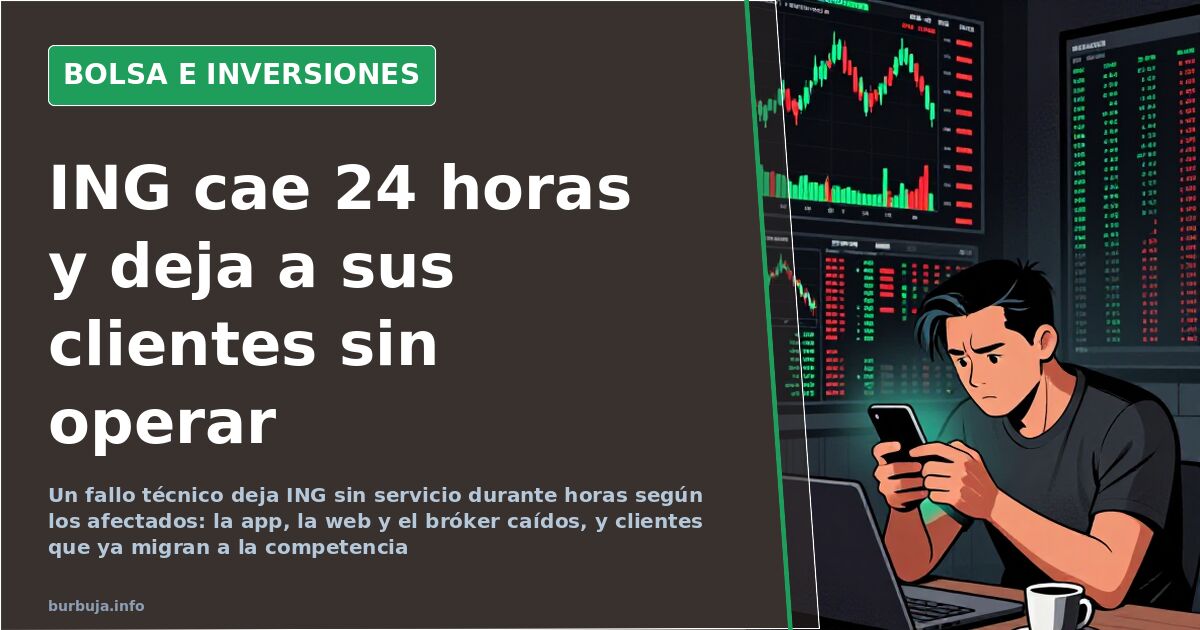
ING outage leaves customers unable to trade
Online banking has once again exposed its Achilles' heel. A technical issue left ING without service for at least 24 hours, according to affected users, who found they could not log in via the web or the app from early morning. The entity acknowledged the fault through its telephone support: an incident that, according to those affected, brought down the service across the entire country. The painful detail is that this is not an isolated episode, but a breakdown that, according to users, repeats every two or three months and takes increasingly longer to resolve.
What peine and how long the ING outage lasted
The pattern repeats: first the app fails, then the website, and the customer discovers they cannot check balances, make transfers, or trade via the broker. On this occasion, the service suffered the breakdown from the early hours, and some people still could not gain access after more than four hours. Some users managed to log in mid-afternoon but were met with a maintenance notice that only allowed them to view data, not perform transactions. Others remained completely blocked the trinc day.
The failure has an especially inconvenient side effect: the two-factor authentication system. If the app goes down, notification-based verification also fails, meaning customers cannot access the service even through a browser. A bank that prides itself on being digital turned its own security measure into a padlock that locked out those trying to enter. Only when SMS authentication was enabled were some able to operate via the web.
Why a digital-only bank fails so frequently
Outsourcing is the elephant in the room. A portion of customer service and management is subcontracted to a third party with a highly temporary workforce and low wages, according to a forum user claiming to know the sector. The uncomfortable argument circulating is this: if customers' banking information passes through the hands of staff with little training and precarious contracts, financial privacy is called into question. The trade-off is low cost, and therein lies the trap of the model.
Added to this is the technical suspicion hanging over every outage: an expired certificate that was not renewed. This is the hypothesis gaining ground, according to some users, when the failure lasts longer than reasonable and the entity provides no clear explanations. A bank is built on trust, and trust alone, as one forum user argues. When that trust crumbles every few months, customers begin to look for alternatives.
Claiming losses due to the orange broker outage
Here is a fact many are unaware of. In previous episodes, the entity compensated customers who correctly documented losses suffered in their broker during the blackout, according to a forum user. There were claims that were paid without the need to go to the customer ombudsman. The key is to keep screenshots of the messages in which the entity acknowledges the fault and the exact time the service returned to normal.
A full calculation, including the affected assets and the price ranges in which they moved, is what gives weight to the claim. Without that breakdown, the request amounts to nothing. The entity, however, tends to cling to any excuse to avoid paying, according to a forum user, so documentation is everything.
Alternatives to ING and physical cash as a safeguard
The trickle of customers toward competitors is real. Some have already moved almost their entire balance to another online bank, while others maintain a backup account to avoid depending on a single entity. The recurring argument: you cannot entrust important transactions to a service that goes down without warning. Other digital banks are not faring much better, with similar outages and transfer failures, according to some forum users.
The conclusion many reach is obvious: keep some cash on hand for emergencies. If services, ATMs, and cards all go down at once, someone without a single euro in their pocket is left helpless when trying to buy basic necessities. The recklessness of paying for even a coffee with a card comes with a price on the day the system gives up, some users argue.
Service returned, more or less, in stages and by area. Some could log in and others could not. The entity has not explained exactly what peine, and that is the part no one can quite digest: a bank without physical branches to complain to in person, facing a recurring breakdown without a coherent explanation.
Online banking has once again exposed its Achilles' heel. A technical issue left ING without service for at least 24 hours, according to affected users, who found they could not log in via the web or the app from early morning. The entity acknowledged the fault through its telephone support: an incident that, according to those affected, brought down the service across the entire country. The painful detail is that this is not an isolated episode, but a breakdown that, according to users, repeats every two or three months and takes increasingly longer to resolve.
What peine and how long the ING outage lasted
The pattern repeats: first the app fails, then the website, and the customer discovers they cannot check balances, make transfers, or trade via the broker. On this occasion, the service suffered the breakdown from the early hours, and some people still could not gain access after more than four hours. Some users managed to log in mid-afternoon but were met with a maintenance notice that only allowed them to view data, not perform transactions. Others remained completely blocked the trinc day.
The failure has an especially inconvenient side effect: the two-factor authentication system. If the app goes down, notification-based verification also fails, meaning customers cannot access the service even through a browser. A bank that prides itself on being digital turned its own security measure into a padlock that locked out those trying to enter. Only when SMS authentication was enabled were some able to operate via the web.
Why a digital-only bank fails so frequently
Outsourcing is the elephant in the room. A portion of customer service and management is subcontracted to a third party with a highly temporary workforce and low wages, according to a forum user claiming to know the sector. The uncomfortable argument circulating is this: if customers' banking information passes through the hands of staff with little training and precarious contracts, financial privacy is called into question. The trade-off is low cost, and therein lies the trap of the model.
Added to this is the technical suspicion hanging over every outage: an expired certificate that was not renewed. This is the hypothesis gaining ground, according to some users, when the failure lasts longer than reasonable and the entity provides no clear explanations. A bank is built on trust, and trust alone, as one forum user argues. When that trust crumbles every few months, customers begin to look for alternatives.
Claiming losses due to the orange broker outage
Here is a fact many are unaware of. In previous episodes, the entity compensated customers who correctly documented losses suffered in their broker during the blackout, according to a forum user. There were claims that were paid without the need to go to the customer ombudsman. The key is to keep screenshots of the messages in which the entity acknowledges the fault and the exact time the service returned to normal.
A full calculation, including the affected assets and the price ranges in which they moved, is what gives weight to the claim. Without that breakdown, the request amounts to nothing. The entity, however, tends to cling to any excuse to avoid paying, according to a forum user, so documentation is everything.
Alternatives to ING and physical cash as a safeguard
The trickle of customers toward competitors is real. Some have already moved almost their entire balance to another online bank, while others maintain a backup account to avoid depending on a single entity. The recurring argument: you cannot entrust important transactions to a service that goes down without warning. Other digital banks are not faring much better, with similar outages and transfer failures, according to some forum users.
The conclusion many reach is obvious: keep some cash on hand for emergencies. If services, ATMs, and cards all go down at once, someone without a single euro in their pocket is left helpless when trying to buy basic necessities. The recklessness of paying for even a coffee with a card comes with a price on the day the system gives up, some users argue.
Service returned, more or less, in stages and by area. Some could log in and others could not. The entity has not explained exactly what peine, and that is the part no one can quite digest: a bank without physical branches to complain to in person, facing a recurring breakdown without a coherent explanation.
Also available in: Deutsch
Summary of a discussion on Burbuja.info - Foro de economía, actualidad y política., translated from Spanish and reviewed before publication. Read the full discussion (103 replies).
More summaries
-
Ibex 35 January 2014: Banking Surges as Technical Analysis Targets 9,950
The Ibex 35 rose in January 2014 with banking stocks soaring, while Santander's non-performing loans in Spain reached 7.49% and technical analysis eyed the 9,950 level.
-
Spain's IBEX Hits 15,000 Driven by Banks
Spain's IBEX 35 rose from 9,000 to 15,000 points driven solely by banks. Cellnex and Mapfre serve as key starting positions.
-
iBanesto launches Blue Account at 5.5% to challenge ING Direct
iBanesto introduces the Blue Account with a 5.5% TAE and 3% bill rebates to compete with ING Direct, amid reports of inconsistent contract terms.
-
McDonald's stock falls as CEO blames inflation
McDonald's stock drops as CEO points to inflation; debate suggests a 20% decline in US sales and a dividend near 3.5%.
-
How to declare stock and CFD investments in Spain
Learn how to report stock trades and CFDs in your Spanish income tax return (IRPF) when dealing with multiple brokers and complex reports.
-
Atari: The 2021 penny stock that promised 10x returns before crashing 60%
In April 2021, Atari traded at €0.90 with 200 million shares, a Decentraland crypto casino, and a €2 price target. The stock then plummeted...