
Cordless hair clipper: why the charger won't run the motor
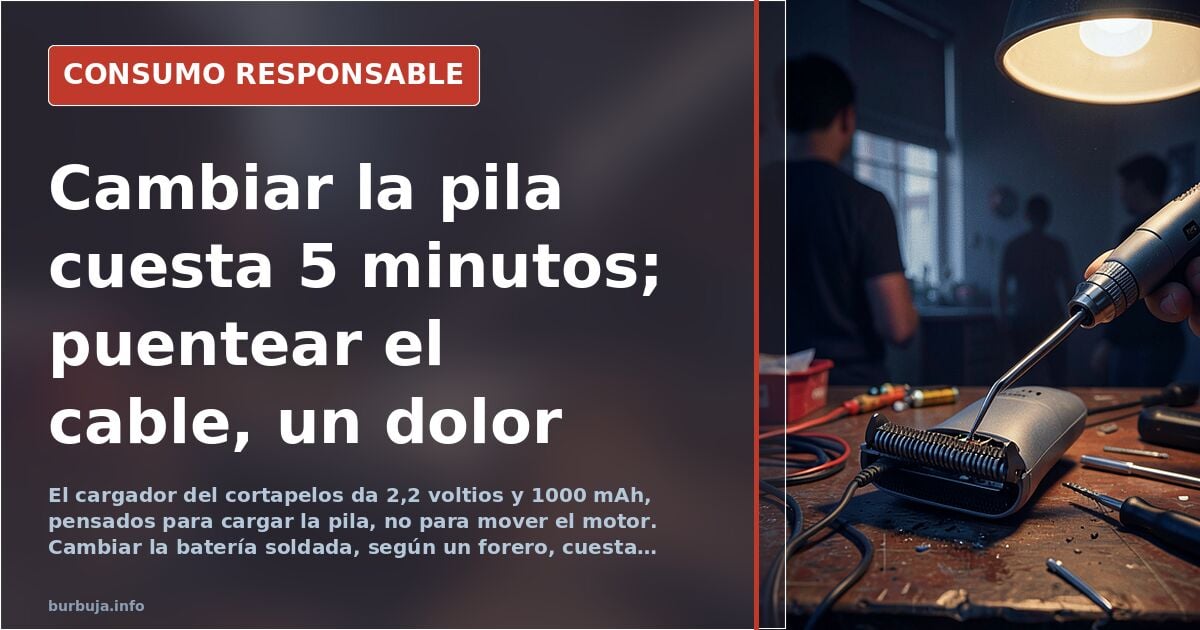
The clipper's charger delivers 2.2 volts and 1000 mAh, designed to charge the battery, not to power the motor. Replacing the soldered battery, according to one forum user, costs…
English · Original discussion in Spanish · Published
Cordless hair clipper: the charger won't run the motor
A Remington hair clipper bought at Lidl stops working when its 1.2-volt, 1500 mAh AA battery dies. Plugged into the mains, it won't start either. Intuition says it should be enough to bridge the battery and run it off the cable. Physics says otherwise: the adapter delivers 2.2 volts and 1000 mAh, a current designed for charging, not for driving the motor.
The question that opens the case is whether a battery-powered device can be converted to mains power without touching a soldering iron. The short answer: it can, but it costs more in time and bodging than simply replacing the cell. The long answer fills the rest of this analysis.
What happens if you connect the motor straight to the charger
The clipper's charger is not a power supply: it's a charger. It supplies a low current, just enough to fill the battery slowly, and in many models it only feeds the charging circuit, not the motor's. That's why the device won't start when plugged in with a dead battery.
Some argue that the 2.2 volts could overheat the motor by exceeding the cell's 1.2. The most cautious calculation assumes that voltage drops when a real load is connected, so the risk is less burning out the motor than losing torque. The pessimistic scenario is different: 1000 mAh isn't enough to turn the blades and the device just hums.
Replacing the cell: five minutes versus an afternoon of splicing
The cell is spot-soldered, not held in a battery holder. That makes the swap trickier, but not impossible: you desolder it with the same iron and solder in the new one, preferably one with tabs. A soldering iron runs about 12 euros and a roll of solder around 3. The math favors the replacement.
As for capacity, fitting a 2500 mAh cell instead of 1500 breaks nothing: it takes longer to charge and lasts longer. The chemistry matters. The original cell is NiMH, and a NiCd charger won't charge a NiMH; the other way around, it will. The device's charger keeps its routine of about 12 hours for roughly 30 minutes of runtime.
Then there's the external battery holder route, a long-cable contraption that turns the clipper into a corded trimmer without its hazards. It's the cheapest option and the ugliest. With 1.2 volts you couldn't electrocute a snail, but the splice in such a tight space ends up a monstrosity. The hedged prediction: anyone with a friend who owns a soldering iron will swap the cell; anyone without one will keep chewing over the cable.
Also available in: Deutsch
Summary of a discussion on Burbuja.info - Foro de economía, actualidad y política., translated from Spanish and reviewed before publication. Read the full discussion (19 replies).
More summaries
-
€15 Hair Clipper: What You Should Know Before Buying
A €15 hair clipper pays for itself in three uses, according to a popular calculation. Corded or cordless, Wahl or Lidl, and why the…
-
Charging a broken tablet by wiring 5V straight to the battery: works until it doesn't
Feeding 5V from USB directly into the lithium battery powers the tablet on but doesn't charge it: a 20% overvoltage and a risk of the cell swelling or catching fire.
-
Lidl launches 2.24 kWh home battery for €299
Lidl sells a 2.24 kWh solar battery for €299. We analyze its profitability for self-consumption, savings potential, and drawbacks.
-
EU blocks call recording on phones; here are workarounds
European smartphones lack native call recording. Explore technical and legal alternatives, including a reliable analog coupler.
-
Ikea: solid pine in 1988, pressed cardboard in 2015
An Ikea table peels down to the pressed paper, reigniting the debate: solid pine in 1988, MDF in 2015. The price comparison that leaves critics speechless.
-
Men's bags win the battle of the shoulder strap
The men's bag is gaining ground on the backpack: class, practicality and the old prejudice about manhood in the war of accessories.