
Rechargeable batteries: four for €6.99 and made in Japan
Four 1,700 mAh AA rechargeable batteries for €6.99, made in Japan: the charging-time calculation and the charger that decide whether the purchase is worth it.
English · Original discussion in Spanish · Published
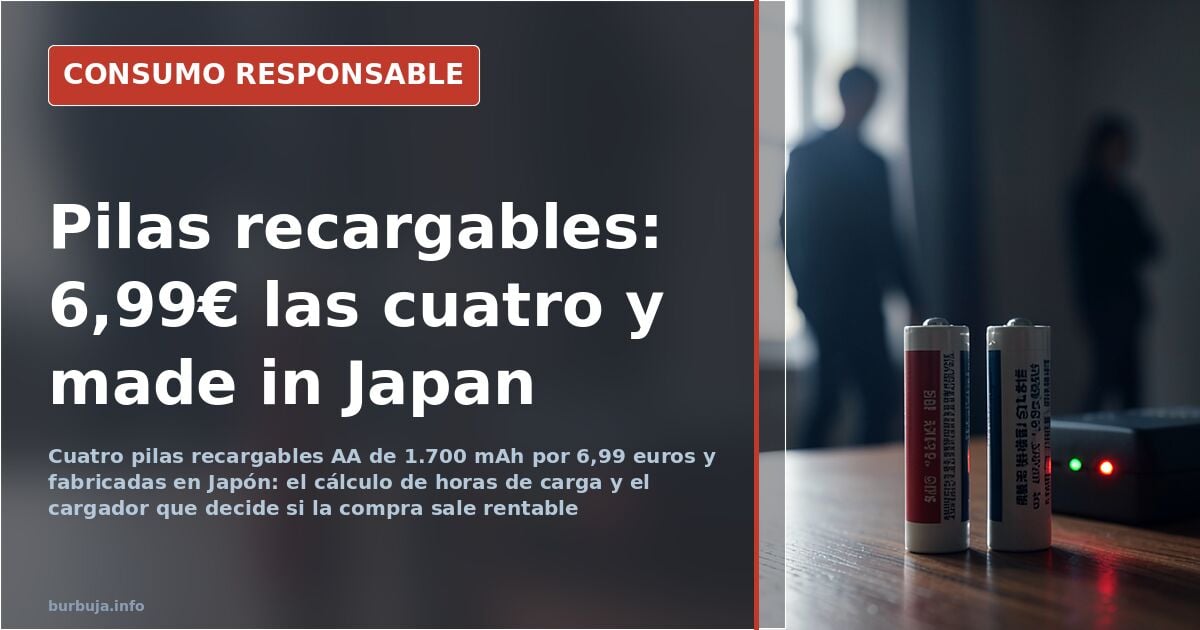
Paying €6.99 for four rechargeable batteries isn't a bargain: it's the new floor of the market
The price of rechargeable batteries is no longer a mystery. Four AA units for €6.99, with 1,700 mAh of capacity, made in Japan for a well-known brand. The AAAs, at 750 mAh, cost the same. The figure is making the rounds in the low-cost consumer world and unsettles anyone still buying alkalines in bulk: the rechargeable is no longer an environmentalist's investment, it's simple arithmetic.
The key isn't the battery, it's the charger. And that's where the confusion begins.
How long does a 1,700 mAh rechargeable battery last?
The short answer: longer than an alkaline, if charged properly. The long answer is that most people charge them badly. The basic calculation making the rounds is to divide the battery's capacity by the charger's current and not exceed those hours. A 200 mA charger with a 1,700 mAh battery needs a little over eight hours. Overcharging cooks the battery from the inside and gifts it a premature death.
Some point to a smarter method: intelligent fast chargers calculate the charge based on voltage and temperature, and maintain it without the user having to do any math. The price difference pays for itself with the first battery that doesn't get fried.
The Lidl charger and the 2,400 mAh batteries
The debate over where to buy is settled by capacity. The 2,400 mAh batteries that appear seasonally at Lidl for about €5 for four offer more milliamps per euro than the 1,700 mAh ones. The 1,100 mAh ones, at €4, are for remotes and low-drift toys. The problem is their sporadic availability: they no longer show up every four or five months like before, and anyone who needs them on some random Tuesday is left wanting.
At Mercadona the offer is more stable: green own-brand batteries and white pre-charged Panasonic ones, all made in China. They're not the Powerex batteries of radio-control enthusiasts, but they do the job. The comparison with the Japanese ones at €6.99 is the usual one: origin alone guarantees nothing, but the price does say something.
The mouse that eats batteries and the battery that dies on its own
The most revealing anecdote in this story is that of a wireless mouse that stops working when one of its two batteries drops to 1.0 volts. Always the same battery, always the same side. The conclusion isn't that the mouse devours batteries: it's that it discharges them unevenly and wastes half the charge of the other one. A digital battery tester, the kind sold at Lidl, lets you check this before and after each charge.
The alternative that wins out in these cases is a mouse that runs on a single battery or distributes the discharge evenly. There are models that last months on a pair of AA rechargeables and give no trouble for years. The brand matters less than the power-management circuit.
What nobody calculates: the real cost per use
A quality alkaline battery costs between €0.50 and €1 and is thrown away after one use. A rechargeable at €6.99 for four pays for itself by the fifth recharge, electricity included. The full calculation, factoring in wear per cycle and the price of a kilowatt hour, yields a saving that surprises anyone who only looks at the shelf label.
The fine print is lifespan. A well-treated rechargeable lasts hundreds of cycles; a badly charged one, just a few. The charger isn't an accessory: it's the variable that decides whether the purchase is a good deal or a ticket to the trash.
What to look for before buying rechargeable batteries
Capacity in mAh, origin, price per unit and, above all, the charger. The 1,700 mAh ones are the reasonable standard for household use; the 2,400 mAh ones, for genuinely power-hungry devices. The 750 mAh AAA ones are for remotes and mice, not cameras.
The market has changed: the rechargeable is no longer an environmentalist's curiosity and has become the default option for anyone who does the math. The next time someone buys a pack of alkalines, they should think twice. Or three times.
The prediction, with reservations: the price of rechargeables will keep falling while capacity rises. What won't fall is the temptation to overcharge them.
Also available in: Deutsch
Summary of a discussion on Burbuja.info - Foro de economía, actualidad y política., translated from Spanish and reviewed before publication. Read the full discussion (17 replies).
More summaries
-
The voltage dilemma: why 1.2V rechargeable batteries dominate
Technical analysis: why rechargeable batteries stay at 1.2V and never reach 1.5V
-
Alkaline batteries can actually be recharged, forum users show
A forum member recharges used alkaline batteries with a Tronic charger from Lidl, while others warn that a special pulse-current charger is required and that the...
-
Mercadona and Lidl wines: from €1.85 Monte Ducay to Abadía Mantrús
Monte Ducay crianza 2011 at €1.85 works; its 2010 reserva does not. A look at Mercadona and Lidl wines, their prices, vintages and the problem of corked bottles.
-
DeepSeek vs Gemini: Best Free AI Models
Comparison of DeepSeek and Gemini as top free AIs for document analysis, coding, and daily tasks. Which one wins without paying?
-
Filters, reverse osmosis or distillation: the tap water battle
Filters, reverse osmosis or distillation: the WHO admits there is not enough data on drinking demineralized water, and the price of each system changes everything.
-
Charging batteries at night to use power by day: the numbers don't add up
A calculation using bargain-priced batteries and chargers plus DIY installation gave 18 cents per stored kWh, more than the peak rate. The sums just don't work.